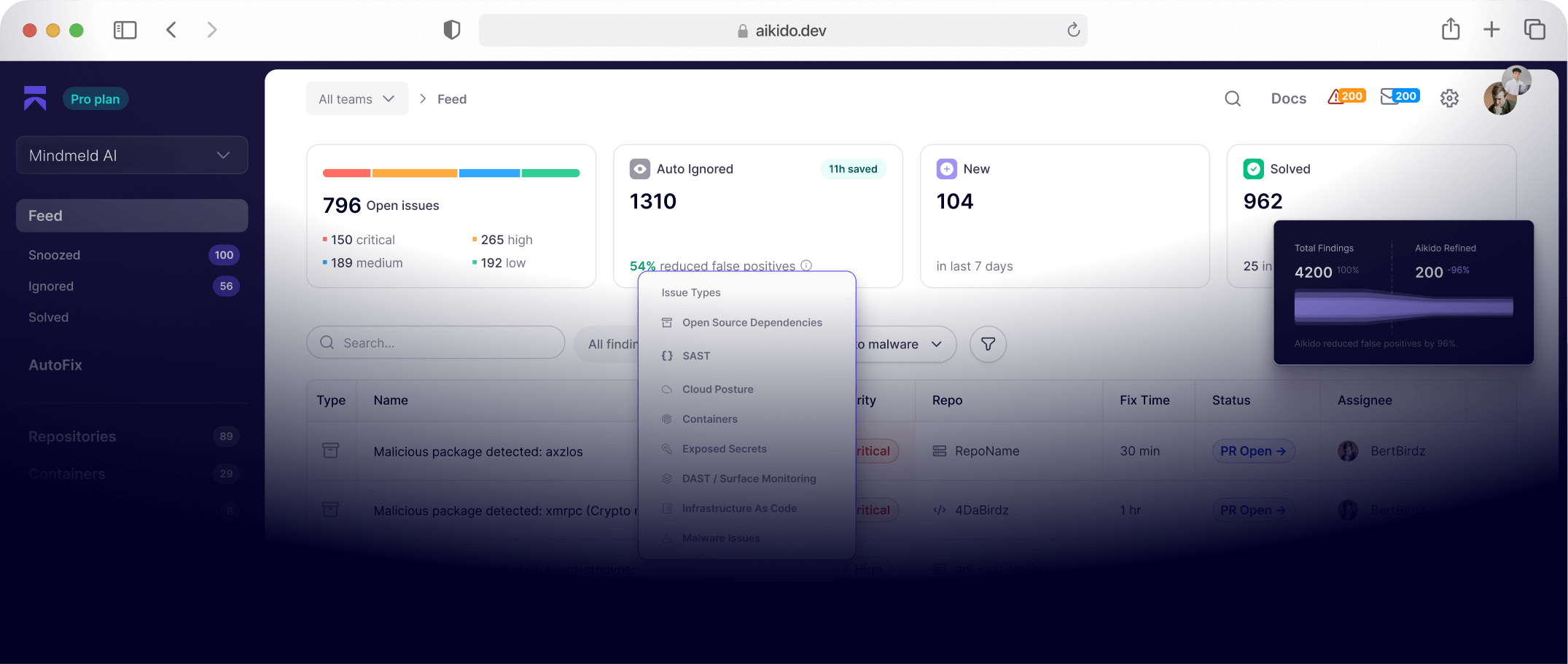
DAST is the layer of the security stack that tests the running application, probing for exploitable weaknesses like SQL injection, XSS, and authentication bypasses that reach production despite everything shift-left is meant to catch. That job matters more in 2026 because of the sheer volume of code being generated. According to Aikido's State of AI in Security and Development 2026 report, 69% of organizations have uncovered vulnerabilities introduced by AI-generated code, and 1 in 5 suffered a serious incident directly tied to it.
{{cta}}
The appeal of DAST is that it's cheap and fast enough to run on every deploy, which is exactly what you want when the same class of automated tooling is available to anyone probing your app. But no DAST catches business-logic flaws like broken authorization or skippable workflow steps. That's the job of pentesting, which is why most enterprise teams pair continuous DAST with AI pentesting rather than treating either as complete on its own.
Enterprises have a higher bar for DAST to clear, which we've measured the top competitors in the marketplace against. This post compares the leading enterprise DAST options on authenticated coverage, API discovery, exploit validation, governance, and how well they pair with pentesting. The tools covered are:
- Aikido Security
- Invicti
- Burp Suite DAST
- Rapid7 InsightAppSec
- Checkmarx DAST
- HCL AppScan
- Qualys WAS
TL;DR
Aikido Security's enterprise-grade DAST runs authenticated testing on every deploy, with API discovery from live traffic, attack surface monitoring, exploit validation, governed by RBAC, SSO, and per-repo or per-app policy enforcement so findings reach the right owners. Its AI pentesting sends hundreds of autonomous agents to reason about business logic, chain findings across endpoints, and produce audit-grade SOC 2 and ISO 27001 reports in hours. Both sit alongside SAST for source code, SCA with reachability analysis, and container image scanning in one platform.
Invicti, Burp Suite DAST, Rapid7, Checkmarx, HCL AppScan, and Qualys each round out the list for teams with more specific needs around standard web apps, manual testing depth, or an existing platform commitment.
What makes DAST enterprise-grade
The basic version is DAST that points at a URL, crawls what it can see, fires known payloads at the endpoints it finds, and matches the responses against a signature database.
Enterprise-grade DAST authenticates as a real user, using form logins, tokens, and session headers, and tests the parts of the application only logged-in users can reach, which is where a great deal of sensitive data and dangerous functionality live. It discovers hidden APIs and subdomains, so an endpoint that shipped without making it into the docs gets checked for vulnerabilities. And it runs on every deploy so it can keep up with an enterprise team using AI to generate more code than a quarterly test is equipped to deal with.
How to evaluate enterprise DAST
Once you know the difference between enterprise and basic DAST, the next question is how to tell the tools apart in practice. Use the following as a checklist when you evaluate tools.
- Authenticated testing: A good tool will be able to test authenticated workflows where the sensitive data and dangerous functionality live.
- Endpoint and API discovery: The tool should find shadow APIs, internal microservices, and endpoints that never made it into a spec.
- API protocol coverage: Check for first-class support across REST, GraphQL, and SOAP, plus crawling that handles JavaScript-heavy apps.
- Exploit validation: Tools that prove exploitability cut the manual triage that otherwise gets more expensive with every app you add.
- Deployment model and time to first result: How the tool runs (SaaS, on-prem, or hybrid) and how long it takes to go from signing to a usable finding. Legacy DAST can mean weeks of rollout before the first scan, while newer tools return results the same day.
- Governance: RBAC, SSO, and per-repo or per-app policy enforcement, so findings reach the right owners and access vulnerabilities are closed.
- Compliance reporting: PCI DSS, SOC 2, and ISO 27001 all expect evidence that running applications are tested, and your tool should map to those frameworks.
- Complementary pentesting: No DAST validates business logic, so the deepest flaws like broken authorization and privilege escalation need pentesting to surface. The strongest platforms pair continuous DAST with pentesting.
- Pricing predictability. Per-FQDN and per-app models get unpredictable as your org grows.
Top enterprise DAST tools 2026
Aikido Security
Enterprise-grade DAST and autonomous AI pentesting in one platform
Aikido Security pairs enterprise-grade DAST with autonomous AI pentesting in one platform. For teams that want both the continuous, low-cost coverage of DAST and the depth that only pentesting reaches, it's the strongest choice on this list.
On DAST specifically, Aikido Security offers:
- Authenticated testing that checks if logged in users can break your application or access sensitive data. The scanner logs in as a real user, exposing deeper vulnerabilities and ensuring the security of your JWT tokens.
- Continuous attack surface monitoring that discovers subdomains, exposed assets, and forgotten infrastructure without adding them to a license count
- Automatic API discovery from live traffic, so you can test endpoints you never documented
- Compliance coverage for frameworks like SOC 2 and PCI DSS require regular application vulnerability testing.
- DAST that runs on every deploy, with findings routed to Jira, Slack, or wherever your team already works.
Then it goes beyond DAST with AI pentesting.
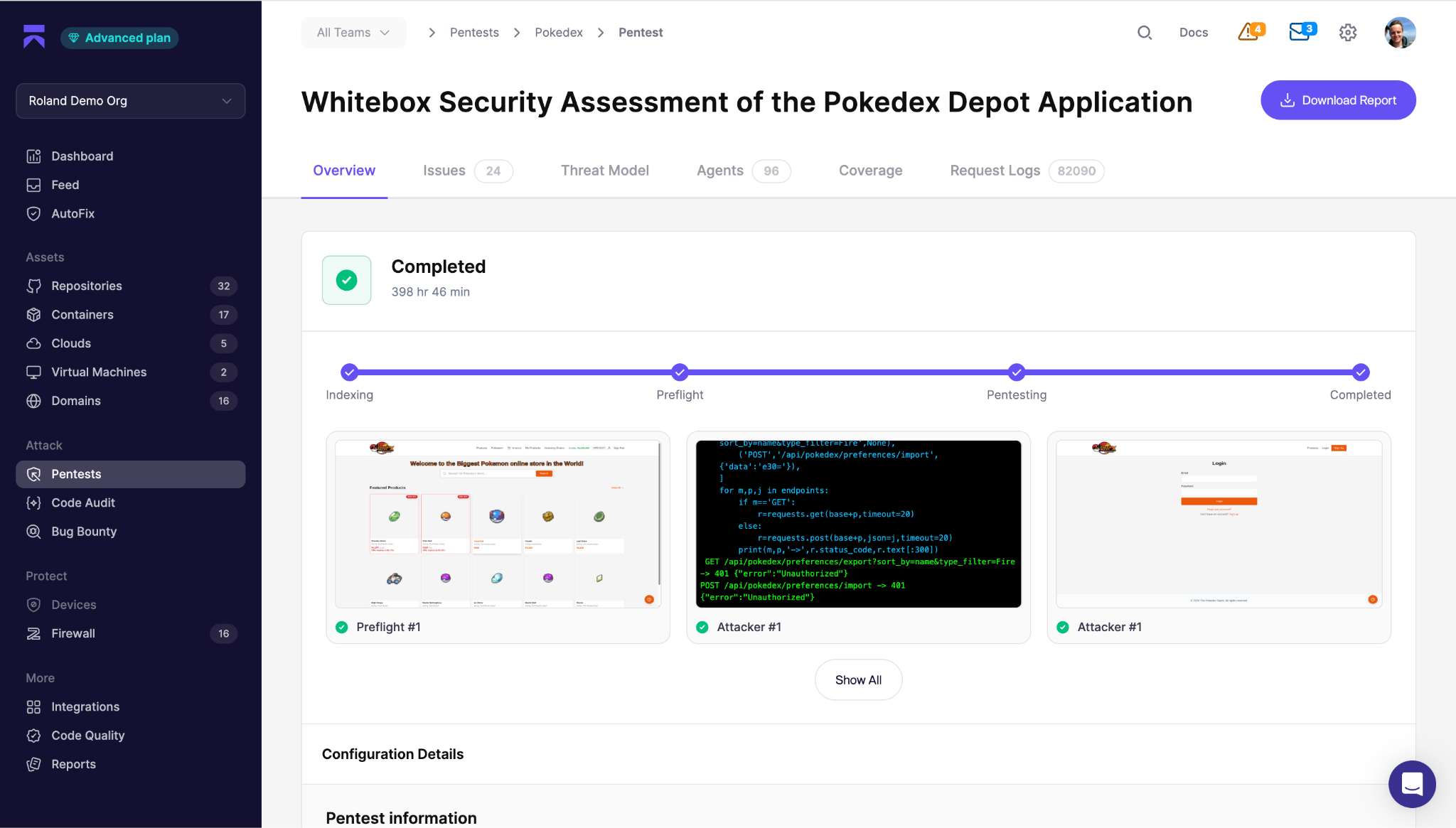
Aikido AI Pentesting deploys hundreds of autonomous AI agents that behave like real pentesters, mapping your attack surface, and reasoning about how your application is meant to work. The agents exploit flaws to prove real impact, and validate every finding with a working proof-of-concept. Separate agents re-exploit each finding to confirm it's real, which removes the false-positives.
Where DAST checks the box that you tested, pentesting produces more thorough compliance coverage. Every run generates an audit-grade report with validated findings, proof-of-exploit detail, and remediation guidance, structured for SOC 2 and ISO 27001 and delivered in hours. Retests are included for up to 90 days after fixes, including finding bypasses for your bug fixes. The governance around it is built for enterprise. Access is controlled through RBAC and SSO, and for teams that can't send data outside their environment, private scanning keeps code local.
If you want to test deployments before they go live, Deep PR Review reasons about business logic on every pull request, catching access-control flaws and IDORs as the code is written, before anything ships. When you deploy especially meaningful changes, AI Code Analysis reasons over your whole codebase, surfacing real logic flaws well before a live target even exists to test against.
Aikido is trusted across enterprise orgs in fintech, gaming, media, and enterprise software like Revolut, Belfius, the Premier League, Deel, SoundCloud, and Visma, which runs Aikido across its 200-plus portfolio companies and 6,000 developers.
Best for: Enterprises that want validated, low-noise DAST alongside autonomous AI pentesting in one platform, with governance, and same-day compliance reporting.
Invicti
DAST for standard web apps, priced per domain
Invicti is the enterprise-tier product from the same company behind Acunetix. Its DAST aims to confirm certain classes of vulnerability by exploiting them. It also includes capabilities the entry-tier Acunetix leaves out, such as automatic API discovery and advanced correlation across findings, which is what you're paying the step-up for.
Pricing is quote-based and calculated per fully qualified domain name, so every subdomain, including your dev, staging, and production environments, consumes a separate licensed target, and a modest portfolio adds up quickly. Those licenses aren't released back to your pool until the contract renews, so you keep paying for targets you're no longer scanning. Setup is heavier than dev-native tools, and reviewers also cite slow scan times, performance issues, and the need for manual tuning.
While Invicti is a DAST-centric platform, it is aiming to move into autonomous testing. However, its product Octo layers AI on top of Invicti's existing DAST engine, so the reasoning sits above a scanner that still works by firing payloads and matching responses. That's a different approach from an AI pentest that reasons about and attacks the application. Octo is currently early-access rather than generally available. That makes it one to watch rather than something a team can turn on today.
Best for: large teams that want a low false-positive rate on standard web apps and can absorb the per-FQDN cost, but it's not the right fit for teams that need pentesting for compliance.
Burp Suite DAST (formerly Enterprise)
Deeply configurable DAST for teams with dedicated AppSec departments
Burp Suite DAST, renamed from Burp Suite Enterprise, is PortSwigger's automated, portfolio-scale product, distinct from the manual Burp Suite Professional. Pro is the interception proxy and manual toolkit a security engineer reaches for by hand. DAST is the automated engine meant to run across an application portfolio. Burp AI is built into Repeater in Burp Suite, which means AI assistance on top of manual pesting, rather than the truly agentic reasoning that Aikido's AI pentesting offers.
That flexibility comes with a cost, though, because it demands more security expertise to configure and tune than dev-native tools, a learning curve reviewers consistently flag, so it rewards teams that already have in-house AppSec depth. Pricing is quote-based and metered on concurrent scanning capacity rather than a flat per-app rate, which makes cost harder to predict as your scanning needs grow.
Best for: teams with the in-house security expertise to get the most out of a deeply configurable automated DAST. For a deeper dive, see this piece on Burp Suite alternatives.
Rapid7 InsightAppSec
Solid DAST for teams already on Rapid7
InsightAppSec is Rapid7's cloud-native automated DAST, and it sits inside a broader security portfolio that spans vulnerability management and cloud posture. If you're already running Rapid7 for infrastructure vulnerability management, adding InsightAppSec puts web application findings in the same console and the same risk view as the rest of your security findings.
The DAST itself is competent but unremarkable. It carries the same business-logic limitations as every other pure-DAST offering, its developer workflow is weaker than dev-native tools, and CI/CD setup takes more effort than others on this list. Reviewers also point to high false positives, dated reporting, and gaps in ticketing integration, while others cite customer service and steep price. Pricing is a per-app subscription, so cost scales with the number of applications you point it at.
As a DAST, it tells you what's wrong with the running app but doesn't validate exploitability or produce pentest evidence on its own. Rapid7 does have AI-assisted red-teaming, but it lives in the separate Vector Command service rather than in InsightAppSec, and it is manual rather than autonomous.
Best for: organizations already standardized on the Rapid7 platform that want an integrated view across infrastructure and web apps, but it's not the right choice for teams looking for agentic pentesting.
Checkmarx DAST
DAST as a consolidation play inside Checkmarx One
Checkmarx DAST is one module inside Checkmarx One, the company's broader AppSec platform, and the reason to choose it is consolidation. Checkmarx's reputation was built on SAST, and for teams already running that alongside its SCA and API security, adding DAST means dynamic findings land in the same console and the same reporting layer as everything else, which is helpful for teams trying to reduce the number of tools and dashboards it maintains.
The catches are cost structure and weight. Checkmarx One is licensed per contributing developer, with each module billed separately, so turning on DAST is another line item on top of a platform that already isn't cheap, and total cost climbs with every capability you add. It also requires the kind of heavy setup that assumes dedicated AppSec staff to administer it, and reviewers point to a steep learning curve and slow full scans.
And as with the other platform-bundled options here, the DAST covers the scan requirement for compliance, but it stops there. It doesn't reason, validate exploitability or produce the pentest evidence that carries the most real weight in a SOC 2 or ISO 27001 review.
Best for: organizations already committed to Checkmarx that want one reporting layer across SAST, SCA, and DAST, but not for teams choosing a DAST on its own merits or looking for modern pentesting.
HCL AppScan
DAST for highly regulated industries
HCL AppScan is one of the oldest names in the category, originally IBM AppScan before HCL acquired it, and used for regulated work. It's a common fixture in US federal environments, defense, banking, and healthcare, where an established compliance track record can be required. It covers SAST, DAST, and more across on-premises, cloud, and hybrid deployment, so teams that need an air-gapped or on-prem option have one.
The trade-offs are cost, weight, and age. Licensing runs high and is quote-based, and reviewers single out a clumsy license manager on top of that. The on-premises deployment carries real infrastructure and maintenance overhead, and the developer experience reflects a product that predates modern CI/CD pipelines, so it feels dated next to dev-native tools, with a learning curve to match. Reviewers also report higher false positives than other enterprise options.
Recent releases have added AI-assisted analysis, but it's a separate, newer add-on rather than something baked in, and like other options here, it's not an autonomous pentest.
Best for: government, defense, and regulated enterprises where FIPS, air-gapped deployment, and a long compliance track record outweigh the cost and the dated developer experience, but not for teams that want a modern workflow or pentesting built in.
Qualys WAS
Web app scanning for teams already living in Qualys
Qualys WAS (Web Application Scanning) sits inside the broader Qualys platform, which teams run for infrastructure vulnerability management and compliance. That's the whole case for it. If your security or operations team lives in Qualys, WAS puts web application findings in the same console and the same risk picture as everything else you track, so you get one reporting layer across infrastructure and apps instead of a separate tool to administer and reconcile.
The catch is that WAS is a web application module inside a vulnerability management platform rather than a purpose-built DAST. Reviewers consistently flag pricing as expensive and point to gaps like the crawler not running fully automatically, as it does with dedicated DAST tools. False-positive feedback is mixed, with some users reporting minimal noise and others wanting fewer false alarms.
Like the other platform-bundled options here, it tests the running app but doesn't produce pentest evidence.
Best for: enterprises already standardized on Qualys that want web apps in the same view as their infrastructure, but not for teams choosing a DAST on capability alone or looking for modern pentesting.
FAQ