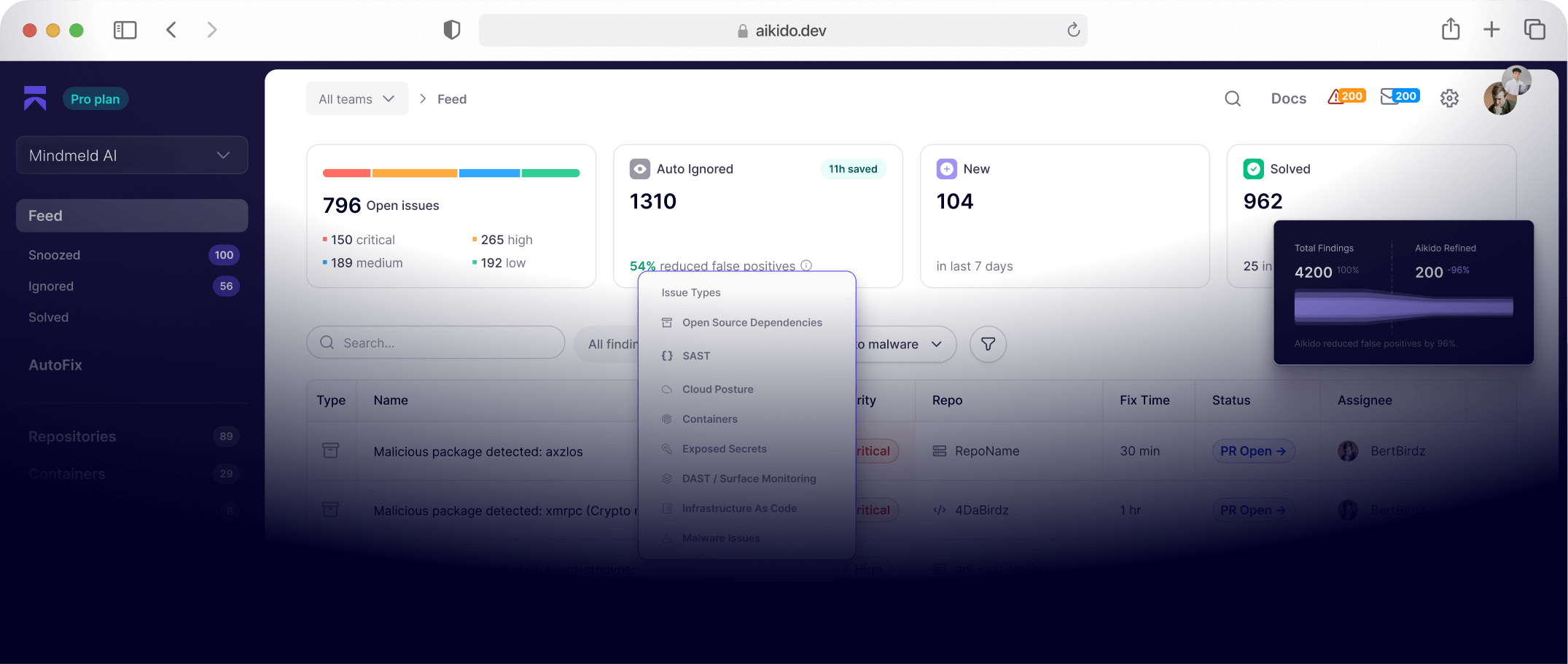
Burp Suite is a web application security testing tool built and maintained by PortSwigger. At its core it's an intercepting proxy that catches requests between your browser and a target, letting security teams probe web apps and APIs for vulnerabilities the way a real attacker would.
But most teams looking at Burp today are asking for things it wasn't built for. They want DAST that runs continuously in CI/CD. They want pentesting that scales past the quarterly engagement, with AI agents that reason about apps the way a human tester would. They want discovery that finds shadow APIs, internal microservices, and endpoints that never made it into a spec. And they want visibility beyond the running app into the code, dependencies, containers, and cloud posture behind it.
The tools below are ranked by how well they hold up against Burp for teams shipping to production continuously.
TL;DR
Aikido Security is the strongest Burp Suite alternative for teams that want DAST and continuous AI pentesting. Aikido's DAST runs authenticated testing, API discovery through live traffic, and attack surface management, while its AI pentesting sends autonomous agents to reason about business logic, chain findings, and produce audit-ready reports. It also traces runtime issues back to their causes in code, dependencies, containers, and cloud posture. Caido, ZAP, and Invicti round out the list for teams with more specific needs around manual testing, open source, or proof-based scanning.
The three editions of Burp Suite
Before comparing alternatives, it helps to know what you're actually comparing against. PortSwigger offers Burp in three flavors.
- Burp Suite Community is free. You get the proxy, Repeater, Decoder, Comparer, and a heavily rate-limited Intruder. What you don't get is Burp Scanner, which means no automated vulnerability detection at all, making Community better suited as a learning tool rather than a working one.
- Burp Suite Professional is the per-user paid tier and adds the pieces that make Burp a serious DAST tool. The Pro edition includes Burp Scanner for automated vulnerability checks, unthrottled Intruder for real fuzzing, BApp Store access for the extension ecosystem, and Burp AI, an assistant that suggests attack ideas and guides testing.
- Burp Suite DAST is the edition formerly known as Enterprise, renamed in April 2025. It's built for teams rather than individuals, runs from Docker containers, integrates with the usual CI/CD suspects (Jenkins, GitHub Actions, GitLab CI), and is priced on request based on scan volume and application count.
What Burp Suite does well
Manual pentesting
Once you have that Burp proxy sitting between your browser and the target app, you can do interesting things to the traffic. Catch a request in Repeater and change a user ID to see if you can read someone else's data. Feed a parameter into Intruder with a wordlist and fire variations at a login form. Use Collaborator to confirm a blind SSRF by watching for the callback on a server you control. Extender and the BApp Store let the community bolt on additional tooling such as JWT editors and GraphQL support. Burp AI, added in 2025, sits inside Burp Pro as an assistant that helps testers investigate findings, generate proofs of concept, and interpret unfamiliar behavior, though PortSwigger is explicit that it augments the human rather than replacing them.
DAST
Scanner (available in Pro, also the core of Burp Suite DAST) crawls the app and runs automated checks for common web vulnerabilities like SQL injection, XSS, and SSRF. PortSwigger's ongoing research feeds new vulnerability classes into it as they emerge. In Burp Suite DAST, it runs from Docker containers, integrates with CI/CD, and handles portfolio-scale scanning across many apps. It's the closest Burp gets to "modern DAST" in the CI-native sense, though it's a newer product line than the pentesting side of the platform.
Why teams look for Burp Suite alternatives
DAST has evolved
DAST is an automated technique that runs headlessly, sends payloads, analyzes responses, and reports findings without a human in each loop. Burp Scanner does that inside Burp Pro, and Burp Suite DAST does it at enterprise scale in CI/CD.
But modern DAST products are built CI-native from day one, opinionated about defaults, easy to trigger on every pull request, and designed to push findings straight into Jira or Slack. Burp Suite DAST does this too, but it's a newer product line on top of a platform whose brand and pricing model are still built around the manual tooling in Pro. Teams looking for CI-native DAST from day one often find purpose-built alternatives fit more naturally.
Pentesting has evolved too
The pentesting workflow Burp Pro supports is time-boxed, expensive, and difficult to run frequently across rapidly changing systems. Someone books an engagement, spends days or weeks probing the app manually, writes it up, and delivers a report. Burp AI added an assistant layer in 2025 that helps testers investigate findings and interpret behavior, but PortSwigger is explicit that it augments the human rather than replacing them.
The shape of pentesting has shifted since Burp Pro was built. AI pentesting uses autonomous agents to perform many of the reasoning steps a human tester would, such as mapping APIs, following workflows end to end, evaluating assumptions, and validating exploitability. Unlike traditional automation, AI pentesting does not rely on predefined payloads or signatures. It reasons about application behavior and tests how features interact across roles, state, and sequence. This allows deeper tests to run more frequently and closer to CI/CD, dramatically expanding coverage beyond what DAST or periodic manual testing can achieve on their own.
Here's Mackenzie Jackson on what AI pentesting can find that DAST can't:
Discovery only finds what you point it at
Burp can test APIs, and its coverage of REST, GraphQL, and SOAP is solid. But its discovery model is configuration-based. You feed it specs or crawl your app, and hope the endpoints show up. Undocumented endpoints, internal microservices, and deprecated-but-still-live APIs stay invisible because they were never in the configuration to begin with. A skilled pentester can find those manually, but that's a lot of expertise to depend on for something automation should handle. Alternatives that discover APIs from live traffic or from source code pick up more of what's actually exposed.
Runtime testing is only part of the story
Burp tells you what's wrong with a running application, whether through automated DAST or manual pentesting. It doesn't tell you which line of code caused the issue, whether the vulnerable dependency has a patched version available, whether the same class of bug exists elsewhere in the codebase, or whether the container you're deploying has ten other issues that matter more. Modern security teams work across code, dependencies, containers, cloud, and runtime. A tool focused on runtime testing is one input into that picture, not the whole answer, and stitching it together with four or five other vendors can become cumbersome and expensive quickly.
What to look for in a Burp Suite alternative
AI-driven pentesting
Modern pentesting tools use autonomous AI agents that reason about applications, chain findings, and probe business logic the way a human tester would. Some also accept source code as context (whitebox pentesting), which lets the AI reason about application logic alongside the live exploitation. That combination catches complex vulnerabilities like IDORs and business logic flaws that DAST tools and rule-based scanners can't find on their own.
API discovery that goes beyond specs
Tools that only test what you feed them will miss shadow endpoints, internal microservices, and APIs that never made it into the documentation. Look for discovery that pulls from live traffic or source code, not just uploaded specs.
CI/CD-native workflow
If you're shipping code multiple times a day, DAST needs to run in the pipeline. Look for tools that trigger on pull requests, run headlessly in containers, and push findings into Jira or Slack without a human moving them there.
Coverage beyond DAST
A vulnerability in a running app usually has a cause somewhere else, like the code, a dependency, a misconfigured container, or a permissive cloud role. Tools that give you the whole picture in one platform cut down on the vendor sprawl and the manual correlation work.
Automated remediation
Finding a vulnerability is half the job. Modern tools go further by suggesting or generating the fix itself, often as a pull request the developer can review and merge. That closes the loop from detection to remediation in minutes rather than sprints.
The table below shows how the five alternatives stack up against Burp on each of these.
Top Burp Suite alternatives
1. Aikido Security
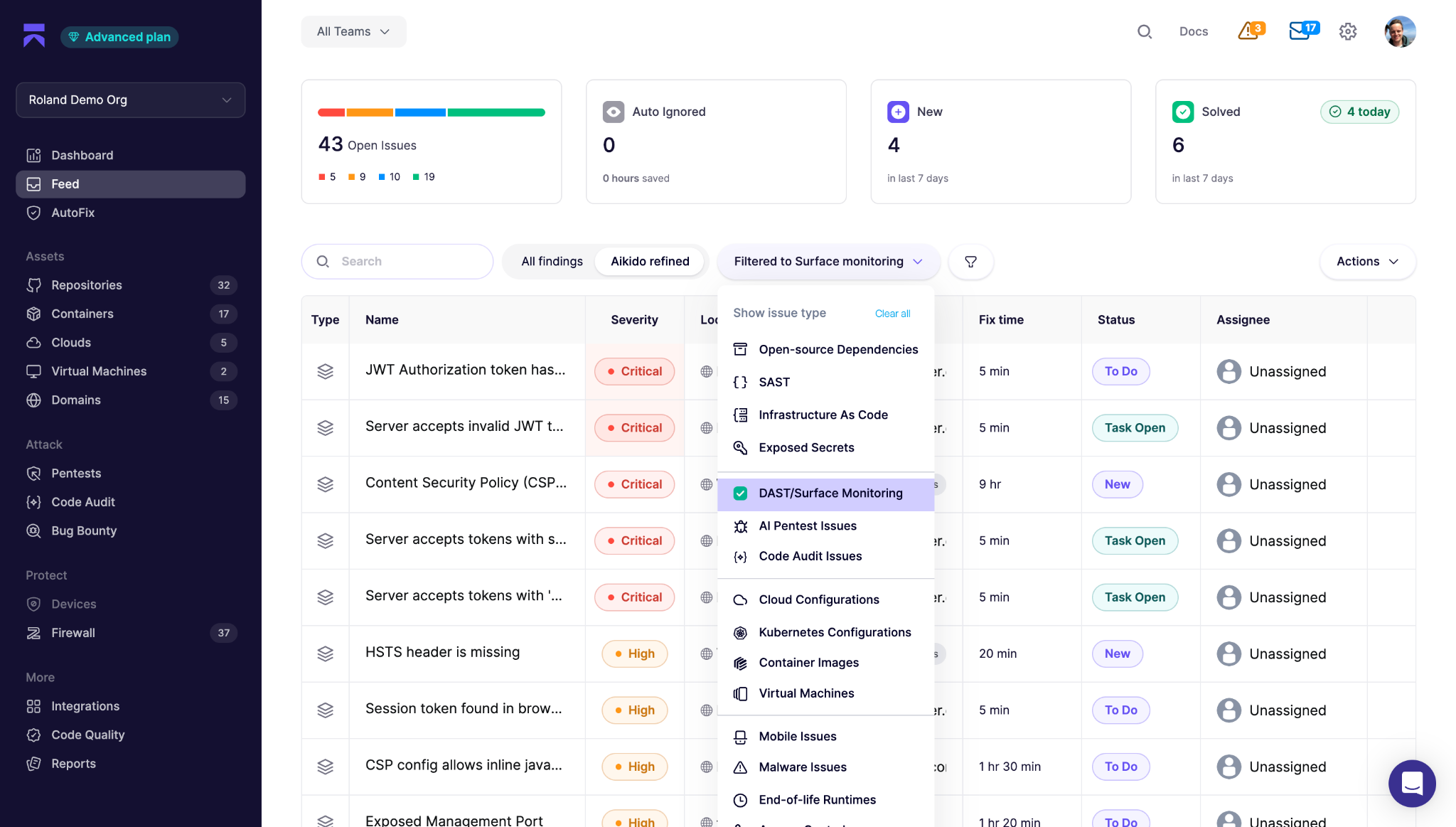
If you're looking at Burp because you need DAST but the workflow doesn't fit how your team ships, Aikido Security is the best choice.
Aikido DAST goes beyond Burp's, offering authenticated testing, API discovery and fuzzing, automated Swagger generation, and attack surface management. It's built on a Nuclei-based engine and runs against your live applications the way you'd expect. If your reason for using Burp was to find SQL injection, XSS, CSRF, and the rest of the OWASP catalog in a running app, Aikido does that and more.
Aikido's AI Pentesting sends AI agents to simulate real attacks on APIs and web apps, covering OWASP risks alongside logic flaws, IDOR, and cross-tenant data leaks. Instead of surfacing isolated findings, it maps exploitable attack paths across code, cloud, and runtime, showing how weaknesses chain together into actual compromise. Every simulation produces an audit-ready report mapped to standards like SOC 2 and ISO.
Code Audit sits between SAST and pentesting, applying pentest-grade reasoning to static code to catch multi-step logic flaws and business logic issues that rule-based SAST can't match against. At roughly a tenth of the cost of a full pentest engagement, it fills the gap for teams that want deep reasoning between releases. Burp only offers manual pentesting sessions or scheduled Scanner runs, not autonomous reasoning.
Another big difference is scope. Burp tells you what's wrong with the running app. Aikido tells you that too, and also brings in SAST to catch issues in the source code that never reach runtime, SCA with reachability analysis to tell you which vulnerable dependencies actually matter, container image scanning to flag CVEs before you deploy, and malware detection to catch things that show up in npm overnight. Fixes go through AutoFix, which opens the PR for you. Findings route to Jira, Slack, or wherever your team already lives.
Best for: Teams that want DAST and AI pentesting built for CI/CD, plus code-to-cloud coverage in one platform.
{{pentest}}
2. Caido
Caido is a Rust-based intercepting proxy with a browser UI, built explicitly as a modern take on what Burp does. The core workflow is the same. Route your traffic through it, intercept requests, replay them in a Repeater-equivalent, tamper with parameters, and probe the app the way you would with Burp. A big difference is performance. Caido is built from the ground up in Rust to deliver low memory usage and better performance than a Java-based tool that's been accreting features for over two decades.
Two things stand out beyond the performance story. HTTPQL is a query language for filtering requests that doesn't require scripting. Workflows is a node-based visual system for building automations without writing Java extensions. Plugins are written in HTML, CSS, and JavaScript rather than Java, which lowers the barrier for anyone who wants to extend the tool.
Where Caido is still behind Burp is the depth of the extension ecosystem and the automated scanner. Burp Suite Professional still leads on its 500+ BApp Store extensions, its automated scanner, and Burp Collaborator for out-of-band detection. Caido's scanner exists as a plugin rather than a built-in feature, and in head-to-head testing it finds fewer issues than Burp Pro's Scanner does. If you rely on Collaborator-style out-of-band detection for blind SSRF or blind injection work, that's not something Caido has an equivalent for yet.
Best for: Individual testers who work in a proxy and want a faster, cleaner one. Not the right pick if your workflow depends on Burp's Scanner or Collaborator, or on specific BApp Store extensions.
3. ZAP
If you want a free, open-source alternative to Burp that isn't pushing you toward a paid tier, Zed Attack Proxy (ZAP) is the answer.
ZAP (formerly OWASP ZAP) is a full DAST tool that does most of what Burp Pro does, at no cost. It includes an intercepting proxy, active and passive scanning, fuzzer, spider, scripting engine, and a REST API for CI/CD integration. It's Docker-ready, has a YAML-based automation framework for pipelines, and a plugin marketplace for extensions.
As of September 2024, the core ZAP team works at Checkmarx and the project is now branded ZAP by Checkmarx, though it remains fully open source and community-maintained. It's also the engine behind StackHawk, one of the newer developer-friendly DAST products on the market. If you're evaluating StackHawk, you're using ZAP with a nicer wrapper and a support contract.
The tradeoffs are real. The UI feels dated compared to Burp or Caido, and running ZAP well in CI takes effort. You'll write your own automation, tune the scanner to reduce noise, and figure out authentication flows on your own. The community is active and the documentation is decent, but there's no vendor to call when something breaks. False positive rates are moderate rather than low, and you'll spend time triaging.
For a team with security-minded engineers and time to invest, ZAP does the job. For a team that wants results quicker without hiring an AppSec engineer to run the tool, a commercial DAST is a better call.
Best for: Teams with the engineering appetite to run open source well, and anyone who needs a full-featured DAST at zero license cost.
4. Invicti and Acunetix
If your reason for looking at Burp is enterprise-grade DAST across a large application portfolio, both products from Invicti Security are worth a look. They're built on shared engineering DNA and scanning technology, but sold to different buyers.
Invicti (formerly Netsparker) is the enterprise-tier product. Its headline feature is proof-based scanning. When the scanner finds a potential vulnerability, it attempts to safely exploit it to confirm the issue is real. Findings land in your team's queue with evidence attached rather than a maybe. For AppSec teams drowning in false positives, that changes the shape of the workday. Invicti also expands beyond DAST with SAST, SCA, IAST (via the Invicti Shark sensor for .NET, Java, PHP, and Node.js), container scanning, secrets, and API security. The 2025 acquisition of Kondukto added ASPM correlation on top, so findings from all these sources land in one prioritized view.
Acunetix is the mid-market sibling. Same underlying scanning technology, sold at a lower entry point, aimed at smaller AppSec teams that don't need the full enterprise apparatus. Acunetix leans lighter on API security and enterprise workflow automation, and the pricing is more transparent. It's the closer fit for teams that want proof-based scanning without an enterprise procurement cycle.
Where both products get awkward is fit for modern dev teams. Pricing is gated behind quotes for Invicti and calculated per fully qualified domain name across the platform. Each subdomain counts as a separate licensed target, which can create budget surprises for teams with dev, staging, and production environments. Setup is heavier than other tools on this list, with implementation typically requiring professional services and specialized expertise. Invicti Security was originally built for security teams rather than developers, which shows in the workflow. The DevSecOps integrations exist and are comprehensive, but implementing them across a real pipeline takes engineering time. Invicti offers proof-of-concept licenses for evaluation; Acunetix does not.
Best for: Enterprise AppSec teams (Invicti) or mid-market AppSec teams (Acunetix) with mature security programs and the appetite to run a proper procurement process. Not the right pick for smaller dev teams.
<script type="application/ld+json">
{
"@context": "https://schema.org",
"@graph": [
{
"@type": "BlogPosting",
"@id": "https://www.aikido.dev/blog/top-burp-suite-alternatives#article",
"url": "https://www.aikido.dev/blog/top-burp-suite-alternatives",
"headline": "Top Burp Suite Alternatives for DAST and AI Pentesting",
"description": "The best Burp Suite alternatives for teams shipping continuously. Compare Aikido, Caido, ZAP, and Invicti on DAST, AI pentesting, and platform coverage.",
"inLanguage": "en-US",
"datePublished": "2026-07-07T00:00:00Z",
"dateModified": "2026-07-07T00:00:00Z",
"isPartOf": {
"@id": "https://www.aikido.dev/blog/top-burp-suite-alternatives#webpage"
},
"mainEntityOfPage": {
"@id": "https://www.aikido.dev/blog/top-burp-suite-alternatives#webpage"
},
"author": {
"@id": "https://www.aikido.dev/authors/nicholas-thomson#person"
},
"publisher": {
"@id": "https://www.aikido.dev#organization"
},
"image": {
"@type": "ImageObject",
"url": "https://www.aikido.dev/blog/top-burp-suite-alternatives/cover.png",
"width": 1200,
"height": 630
},
"keywords": [
"Burp Suite alternatives",
"DAST",
"AI pentesting",
"dynamic application security testing",
"web application security",
"penetration testing",
"Aikido Security",
"Caido",
"OWASP ZAP",
"Invicti",
"Acunetix",
"CI/CD security",
"API discovery"
],
"about": [
{ "@id": "https://www.aikido.dev/glossary/dast#term" },
{ "@id": "https://www.aikido.dev/glossary/pentesting#term" },
{ "@id": "https://www.aikido.dev/glossary/ai-pentesting#term" }
],
"mentions": [
{
"@type": "SoftwareApplication",
"name": "Burp Suite",
"applicationCategory": "SecurityApplication",
"operatingSystem": "Cross-platform",
"url": "https://portswigger.net/burp"
},
{
"@type": "SoftwareApplication",
"name": "Aikido Security",
"applicationCategory": "SecurityApplication",
"operatingSystem": "Cross-platform",
"url": "https://www.aikido.dev/"
},
{
"@type": "SoftwareApplication",
"name": "Caido",
"applicationCategory": "SecurityApplication",
"operatingSystem": "Cross-platform",
"url": "https://caido.io/"
},
{
"@type": "SoftwareApplication",
"name": "ZAP",
"alternateName": "Zed Attack Proxy",
"applicationCategory": "SecurityApplication",
"operatingSystem": "Cross-platform",
"url": "https://www.zaproxy.org/"
},
{
"@type": "SoftwareApplication",
"name": "Invicti",
"applicationCategory": "SecurityApplication",
"operatingSystem": "Cross-platform",
"url": "https://www.invicti.com/"
},
{
"@type": "SoftwareApplication",
"name": "Acunetix",
"applicationCategory": "SecurityApplication",
"operatingSystem": "Cross-platform",
"url": "https://www.acunetix.com/"
}
],
"articleSection": "DevSec Tools & Comparisons",
"wordCount": 2300,
"timeRequired": "PT10M",
"speakable": {
"@type": "SpeakableSpecification",
"cssSelector": ["h1", "h2", ".tldr"]
}
},
{
"@type": "WebPage",
"@id": "https://www.aikido.dev/blog/top-burp-suite-alternatives#webpage",
"url": "https://www.aikido.dev/blog/top-burp-suite-alternatives",
"name": "Top Burp Suite Alternatives for DAST and AI Pentesting",
"description": "The best Burp Suite alternatives for teams shipping continuously. Compare Aikido, Caido, ZAP, and Invicti on DAST, AI pentesting, and platform coverage.",
"isPartOf": {
"@id": "https://www.aikido.dev#website"
},
"primaryImageOfPage": {
"@type": "ImageObject",
"url": "https://www.aikido.dev/blog/top-burp-suite-alternatives/cover.png"
},
"breadcrumb": {
"@id": "https://www.aikido.dev/blog/top-burp-suite-alternatives#breadcrumb"
},
"inLanguage": "en-US"
},
{
"@type": "BreadcrumbList",
"@id": "https://www.aikido.dev/blog/top-burp-suite-alternatives#breadcrumb",
"itemListElement": [
{
"@type": "ListItem",
"position": 1,
"name": "Home",
"item": "https://www.aikido.dev/"
},
{
"@type": "ListItem",
"position": 2,
"name": "Blog",
"item": "https://www.aikido.dev/blog"
},
{
"@type": "ListItem",
"position": 3,
"name": "Top Burp Suite Alternatives for DAST and AI Pentesting",
"item": "https://www.aikido.dev/blog/top-burp-suite-alternatives"
}
]
},
{
"@type": "ItemList",
"@id": "https://www.aikido.dev/blog/top-burp-suite-alternatives#itemlist",
"name": "Top Burp Suite Alternatives",
"description": "Four alternatives to Burp Suite ranked for teams shipping to production continuously.",
"numberOfItems": 4,
"itemListOrder": "https://schema.org/ItemListOrderAscending",
"itemListElement": [
{
"@type": "ListItem",
"position": 1,
"item": {
"@type": "SoftwareApplication",
"name": "Aikido Security",
"applicationCategory": "SecurityApplication",
"operatingSystem": "Cross-platform",
"url": "https://www.aikido.dev/",
"description": "The strongest Burp Suite alternative for teams that want DAST and continuous AI pentesting in one platform, with authenticated testing, API discovery through live traffic, autonomous AI agents, and coverage across code, dependencies, containers, and cloud."
}
},
{
"@type": "ListItem",
"position": 2,
"item": {
"@type": "SoftwareApplication",
"name": "Caido",
"applicationCategory": "SecurityApplication",
"operatingSystem": "Cross-platform",
"url": "https://caido.io/",
"description": "A Rust-based intercepting proxy with a browser UI, built as a modern take on Burp for individual testers who want a faster, cleaner proxy."
}
},
{
"@type": "ListItem",
"position": 3,
"item": {
"@type": "SoftwareApplication",
"name": "ZAP",
"alternateName": "Zed Attack Proxy",
"applicationCategory": "SecurityApplication",
"operatingSystem": "Cross-platform",
"url": "https://www.zaproxy.org/",
"description": "A free, open-source DAST tool that does most of what Burp Pro does at no cost, now maintained by the core team at Checkmarx."
}
},
{
"@type": "ListItem",
"position": 4,
"item": {
"@type": "SoftwareApplication",
"name": "Invicti and Acunetix",
"applicationCategory": "SecurityApplication",
"operatingSystem": "Cross-platform",
"url": "https://www.invicti.com/",
"description": "Enterprise-grade DAST platform from Invicti Security featuring proof-based scanning, sold under two brands: Invicti (enterprise) and Acunetix (mid-market)."
}
}
]
},
{
"@type": "FAQPage",
"@id": "https://www.aikido.dev/blog/top-burp-suite-alternatives#faq",
"mainEntity": [
{
"@type": "Question",
"name": "What is DAST?",
"acceptedAnswer": {
"@type": "Answer",
"text": "Dynamic Application Security Testing (DAST) is the practice of testing a running application from the outside by sending traffic to it and analyzing the responses. Unlike SAST, which reads source code, DAST doesn't need access to the codebase. It probes the app the way an attacker would, looking for issues like SQL injection, XSS, SSRF, authentication flaws, and misconfigurations. Modern DAST tools run continuously in CI/CD pipelines rather than as one-off manual engagements."
}
},
{
"@type": "Question",
"name": "What is AI pentesting?",
"acceptedAnswer": {
"@type": "Answer",
"text": "AI pentesting uses autonomous agents to perform many of the reasoning steps a human tester would, such as mapping APIs, following workflows end to end, evaluating assumptions, and validating exploitability. Unlike traditional automated testing, it does not rely on predefined payloads or signatures. It reasons about application behavior and tests how features interact across roles, state, and sequence. Some AI pentesting tools also accept source code as context (called whitebox pentesting) to reason about application logic alongside live exploitation."
}
},
{
"@type": "Question",
"name": "Is Burp Suite a DAST tool?",
"acceptedAnswer": {
"@type": "Answer",
"text": "Yes, and it's also a manual pentesting toolkit. Burp Suite Professional is designed around session-based manual pentesting with automated DAST checks via Burp Scanner. Burp Suite DAST (renamed from Enterprise in April 2025) is PortSwigger's automated CI/CD-integrated DAST edition. Most professional pentesters know Burp for Pro, while newer buyers evaluating Burp for continuous DAST are typically looking at Burp Suite DAST."
}
},
{
"@type": "Question",
"name": "Is Burp Suite the same as PortSwigger?",
"acceptedAnswer": {
"@type": "Answer",
"text": "PortSwigger is the company; Burp Suite is the product. PortSwigger was founded in 2004 by Dafydd Stuttard, who started building the tools that became Burp Suite in 2003. Burp Suite v1.0 was released in 2005. PortSwigger also runs the Web Security Academy, a free web security training platform that a large portion of the industry has learned on."
}
},
{
"@type": "Question",
"name": "Is Burp Suite free?",
"acceptedAnswer": {
"@type": "Answer",
"text": "Burp Suite Community Edition is free but limited. You get the proxy, Repeater, Decoder, and a heavily rate-limited version of Intruder. What you don't get is Burp Scanner, so there's no automated vulnerability detection at all. For real testing work, you need Burp Suite Professional (per-user annual license) or Burp Suite DAST (custom enterprise pricing)."
}
},
{
"@type": "Question",
"name": "Can Burp Suite be used in CI/CD pipelines?",
"acceptedAnswer": {
"@type": "Answer",
"text": "Burp Suite DAST (formerly Enterprise) is built for CI/CD. It runs from Docker containers and integrates with Jenkins, GitHub Actions, GitLab CI, Azure DevOps, and TeamCity. Burp Suite Professional was designed for session-based pentesting and doesn't have native CI/CD integration, though community extensions can bridge some of the gap. Teams building CI-native DAST from scratch often find purpose-built alternatives such as Aikido fit their pipelines more naturally than adapting a manual tool."
}
}
]
},
{
"@type": "Person",
"@id": "https://www.aikido.dev/authors/nicholas-thomson#person",
"name": "Nicholas Thomson",
"url": "https://www.aikido.dev/authors/nicholas-thomson",
"jobTitle": "Senior SEO & Growth Lead",
"worksFor": {
"@id": "https://www.aikido.dev#organization"
},
"sameAs": [
"https://www.linkedin.com/",
"https://x.com/"
]
},
{
"@type": "Organization",
"@id": "https://www.aikido.dev#organization",
"name": "Aikido Security",
"url": "https://www.aikido.dev",
"logo": {
"@type": "ImageObject",
"url": "https://www.aikido.dev/logo.png"
},
"sameAs": [
"https://www.linkedin.com/company/aikido-security",
"https://x.com/AikidoSecurity"
]
},
{
"@type": "WebSite",
"@id": "https://www.aikido.dev#website",
"url": "https://www.aikido.dev",
"name": "Aikido Security",
"publisher": {
"@id": "https://www.aikido.dev#organization"
},
"inLanguage": "en-US"
}
]
}
</script>