

Acunetix is a DAST solution for web applications and APIs maintained by Invicti. It runs predefined checks against discovered endpoints and matches responses against known signatures to flag standard vulnerability classes, and outdated components.
But most teams looking at Acunetix today are asking for things it wasn't built for. Modern DAST bundles continuous attack surface monitoring and automatic API discovery from live traffic, capabilities Acunetix either lacks or gates behind Invicti's enterprise tier. And with the availability of modern pentesting, DAST is no longer enough. A pentest is a context-aware attack simulation, evaluating how permissions and workflows interact under real conditions. And when a SOC 2 or ISO 27001 review comes around, teams need audit-grade pentest reports.
The tools below are ranked by how well they hold up against Acunetix for teams that need real pentest coverage alongside their DAST.
TL;DR
Aikido Security is the strongest Acunetix alternative for teams that want DAST and continuous AI pentesting. Aikido's enterprise-grade DAST runs authenticated testing, API discovery through live traffic, and attack surface monitoring, while its AI pentesting sends hundreds of autonomous agents to reason about business logic, chain findings, and produce audit-ready SOC 2 and ISO 27001 reports the same day. Burp Suite, StackHawk, Invicti, and Rapid7 round out the list for teams with more specific needs around manual testing, CI-native DAST, or existing platform commitments.
What problems does Acunetix aim to solve
Acunetix's pitch is automated DAST for teams that need to check their web apps and APIs for common vulnerability classes, and it does that job well enough. It carries a large vulnerability database that covers the standard OWASP top 10 classes. Proof-based scanning for certain categories like SQLi and some XSS reduce false positives on those findings. And it offers coverage across the major API protocols, with the deepest testing on REST and SOAP.
But the tool's capabilities are hampered by DAST's inherent limitations. Acunetix produces a tickbox output. It doesn't reason about how your application is meant to behave, and it doesn't chain findings into attack paths.
Best for: Small and mid-sized businesses that need automated DAST and don't require testing for complex logic workflows or compliance-grade pentesting.
Why teams look for Acunetix alternatives
A DAST report isn't a pentest
In places, Acunetix markets itself as "automated penetration testing software." Their own product page defines it as a vulnerability scanner and concedes automated tools can't fully replace human judgment for business logic flaws. "Automated" here means rule-based automation, not autonomous reasoning.
This means that things like broken authorization, chained attack paths, IDORs, cross-tenant data access, and privilege escalation via legitimate workflows are invisible to DAST because DAST doesn't understand what your application is meant to do. It fires payloads at endpoints and grades the responses.
For compliance, this gap becomes a blocker. SOC 2 Type II, ISO 27001, and PCI DSS all expect penetration testing evidence. Handing over a DAST report and calling it a pentest is the kind of thing that surfaces in an audit finding.
Scaling is a challenge
A 10-application portfolio in Acunetix can easily become 30-50 licensed FQDNs, because subdomains consume separate license slots regardless of shared codebase and every FQDN needs its own authentication, scan profile, and agent configuration. Acunetix's own docs confirm that subdomains like api.example.com and app.example.com count as two targets. Teams running dev, staging, QA, and prod subdomains feel this immediately.
Sitting in the Invicti stack
Acunetix is the entry-tier product in Invicti's portfolio. The deeper capabilities (ASPM, multi-team RBAC, advanced DAST-to-SAST correlation, the Network Traffic Analyzer, and automatic API discovery) live with Invicti and are gated behind higher tiers. Teams that outgrow Acunetix don't get a natural upgrade path within the same product. They get pushed toward a different product line with different pricing and different procurement conversations.
What to look for in an Acunetix alternative
The bar has moved. A modern replacement should include:
- AI-driven pentesting: Autonomous agents that reason about application behavior, chain exploits, and produce validated findings with working proof-of-concepts.
{{pentest}}
- Scalability without per-FQDN friction: No punitive license consumption for every subdomain.
- Automatic API discovery from live traffic or code: You can't test the endpoints you don't know exist.
- Coverage beyond DAST: SAST, SCA, container image scanning, cloud posture, and API testing in the same platform, so findings can be easily correlated.
Top Acunetix alternatives
Aikido Security
Aikido Security is the strongest Acunetix alternative for teams that want enterprise-grade capabilities.
On DAST specifically, Aikido Security covers what Acunetix does and adds capabilities Acunetix leaves out:
- Continuous attack surface monitoring that discovers subdomains, exposed assets, and forgotten infrastructure without adding them to a license count
- Automatic API discovery from live traffic, so you can test endpoints you never documented
Then it goes beyond DAST with AI pentesting.
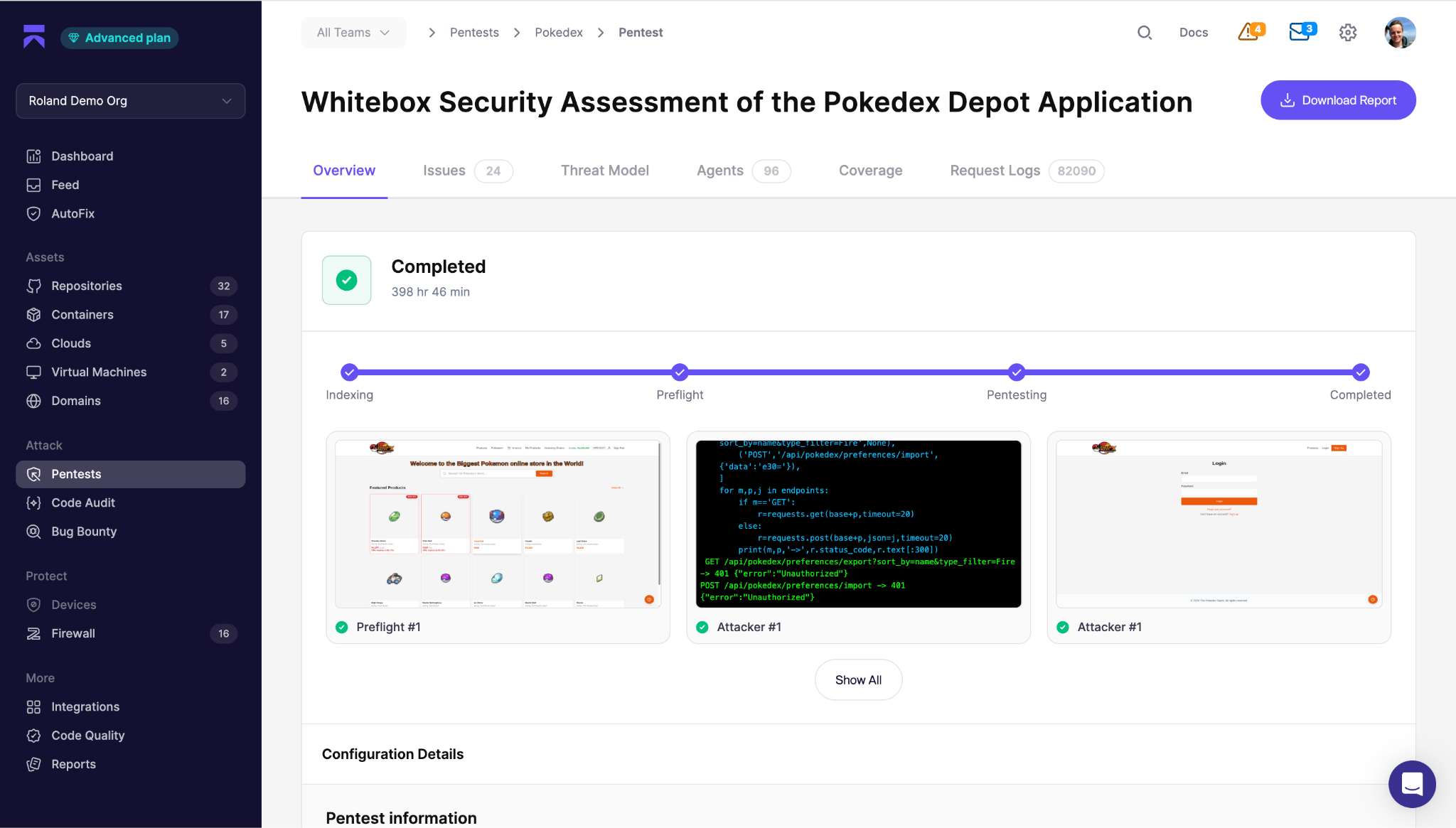
DAST tests your application from the outside and reports on what it can pattern-match. AI pentesting does something structurally different. Aikido Attack deploys hundreds of autonomous AI agents that behave like real pentesters, mapping your attack surface, and reasoning about how your application is meant to work. The agents exploit flaws to prove real impact, and validate every finding with a working proof-of-concept. Separate agents re-exploit each finding to confirm it's real, which removes the false-positive triage burden that can make pentest reports painful to work through.
Critically for compliance, Aikido produces audit-grade SOC 2 and ISO 27001 pentest reports in hours rather than weeks. Retests are included for up to 90 days after fixes, including finding bypasses for your bugfixes.
Another big difference is scope. Acunetix tells you what's wrong with the running app. Aikido tells you that too, and also brings in SAST to catch issues in the source code that never reach runtime, SCA with reachability analysis to tell you which vulnerable dependencies actually matter, container image scanning to flag CVEs before you deploy, and malware detection to catch things that show up in npm overnight. Fixes go through AutoFix, which opens the PR for you. Findings route to Jira, Slack, or wherever your team already lives.
Best for: Teams that need enterprise-grade pentest coverage alongside enterprise-grade DAST that covers what Acunetix does and more.
{{walkthrough}}
Burp Suite
A well-known manual testing tool. Burp Suite Professional gives you an interception proxy, Burp Scanner, and a large extension ecosystem. Its strength is manual pentesting flexibility. If you have an experienced security engineer, Burp is what they'll reach for.
Its limitation is that it's built for individual practitioners rather than organizational programs. It doesn't produce continuous coverage on its own, it doesn't scale across an application portfolio without significant scripting, and its automated scanner inherits the same structural limits on business logic that every DAST tool does.
Best for: Individual security engineers and small teams doing hands-on manual testing, but not teams that need the deeper reasoning capabilities of automated pentesting.
Check outthis piece on Burp Suite alternatives for a deeper dive.
StackHawk
StackHawk positions itself as DAST built for CI/CD. Its findings surface in pull requests, GitHub Actions integration is native, and the scanning model is meant to run on every build rather than as an out-of-band security exercise.
The tradeoff is depth. StackHawk is a DAST product, which means it inherits the same structural limits Acunetix has around business logic and complex authorization. It has a better developer experience than Acunetix, but it is the same class of tool.
Best for: Engineering teams that want DAST embedded in their CI pipeline, but not for teams that need compliance-grade pentesting.
Invicti
Invicti is the enterprise-tier product from the same company that manages Acunetix. It includes capabilities Acunetix leaves out, such as automatic API discovery, and advanced correlation.
The catches are procurement timelines, and the fact that Invicti is still a DAST-centric platform. You get better DAST than Acunetix, but you don't get autonomous pentesting or the wider security posture coverage a modern platform includes.
Best for: Large enterprises already invested in Invicti tooling that want the fuller DAST feature set, but not the right choice for teams that need pentesting for compliance.
Rapid7 (InsightAppSec)
Rapid7's InsightAppSec is the DAST product in a broader security portfolio that spans vulnerability management and cloud posture. If you're already using Rapid7 for infrastructure vulnerability management, adding InsightAppSec gives you an integrated view.
The DAST itself is competent but unremarkable. It has similar business logic limitations as other pure-DAST offerings, and a weaker developer workflow story than StackHawk or Aikido Security.
Best for: Organizations already standardized on the Rapid7 platform, but not the right choice for teams looking for modern pentesting.
FAQ
<script type="application/ld+json">
[
{
"@context": "https://schema.org",
"@type": "TechArticle",
"@id": "https://www.aikido.dev/blog/top-acunetix-alternatives#article",
"mainEntityOfPage": {
"@type": "WebPage",
"@id": "https://www.aikido.dev/blog/top-acunetix-alternatives"
},
"headline": "Top Acunetix alternatives for automated vulnerability scanning",
"description": "Acunetix is a DAST solution, but teams today need AI pentesting, attack surface monitoring, and automatic API discovery. Compare Aikido Security, Burp Suite, StackHawk, Invicti, and Rapid7 as Acunetix alternatives.",
"image": {
"@type": "ImageObject",
"url": "https://www.aikido.dev/blog/top-acunetix-alternatives/og.png",
"width": 1200,
"height": 630
},
"author": {
"@type": "Person",
"@id": "https://www.aikido.dev/authors/nicholas-thomson#person",
"name": "Nicholas Thomson",
"jobTitle": "Senior SEO & Growth Lead",
"url": "https://www.aikido.dev/authors/nicholas-thomson",
"worksFor": {
"@type": "Organization",
"name": "Aikido Security",
"url": "https://www.aikido.dev"
},
"sameAs": [
"https://www.linkedin.com/in/nicholas-thomson",
"https://x.com/nicholas-thomson"
]
},
"publisher": {
"@type": "Organization",
"@id": "https://www.aikido.dev#organization",
"name": "Aikido Security",
"url": "https://www.aikido.dev",
"logo": {
"@type": "ImageObject",
"url": "https://www.aikido.dev/logo.png"
}
},
"datePublished": "2026-07-24T00:00:00+00:00",
"dateModified": "2026-07-24T00:00:00+00:00",
"wordCount": 2100,
"timeRequired": "PT9M",
"inLanguage": "en",
"keywords": [
"Acunetix alternatives",
"DAST",
"dynamic application security testing",
"AI pentesting",
"automated penetration testing",
"vulnerability scanning",
"application security",
"SOC 2 pentesting",
"ISO 27001 pentesting",
"API security testing",
"attack surface monitoring",
"Aikido Security",
"Burp Suite",
"StackHawk",
"Invicti",
"Rapid7 InsightAppSec",
"OWASP Top 10",
"IDOR",
"business logic testing"
],
"about": [
{
"@type": "SoftwareApplication",
"name": "Acunetix",
"applicationCategory": "SecurityApplication",
"operatingSystem": "Web",
"url": "https://www.acunetix.com"
},
{
"@type": "Thing",
"name": "Dynamic Application Security Testing",
"sameAs": "https://en.wikipedia.org/wiki/Dynamic_application_security_testing"
},
{
"@type": "Thing",
"name": "Penetration testing",
"sameAs": "https://en.wikipedia.org/wiki/Penetration_test"
}
],
"mentions": [
{
"@type": "SoftwareApplication",
"name": "Aikido Security",
"applicationCategory": "SecurityApplication",
"url": "https://www.aikido.dev"
},
{
"@type": "SoftwareApplication",
"name": "Burp Suite",
"applicationCategory": "SecurityApplication",
"url": "https://portswigger.net/burp"
},
{
"@type": "SoftwareApplication",
"name": "StackHawk",
"applicationCategory": "SecurityApplication",
"url": "https://www.stackhawk.com"
},
{
"@type": "SoftwareApplication",
"name": "Invicti",
"applicationCategory": "SecurityApplication",
"url": "https://www.invicti.com"
},
{
"@type": "SoftwareApplication",
"name": "Rapid7 InsightAppSec",
"applicationCategory": "SecurityApplication",
"url": "https://www.rapid7.com/products/insightappsec/"
},
{
"@type": "Thing",
"name": "SOC 2",
"sameAs": "https://en.wikipedia.org/wiki/System_and_Organization_Controls"
},
{
"@type": "Thing",
"name": "ISO 27001",
"sameAs": "https://en.wikipedia.org/wiki/ISO/IEC_27001"
},
{
"@type": "Thing",
"name": "PCI DSS",
"sameAs": "https://en.wikipedia.org/wiki/Payment_Card_Industry_Data_Security_Standard"
},
{
"@type": "Thing",
"name": "OWASP Top 10",
"sameAs": "https://owasp.org/www-project-top-ten/"
}
],
"speakable": {
"@type": "SpeakableSpecification",
"cssSelector": [
".article-headline",
".article-tldr"
]
}
},
{
"@context": "https://schema.org",
"@type": "ItemList",
"@id": "https://www.aikido.dev/blog/top-acunetix-alternatives#alternatives-list",
"name": "Top Acunetix alternatives for automated vulnerability scanning",
"description": "Ranked list of Acunetix alternatives for teams that need AI pentesting alongside DAST.",
"numberOfItems": 5,
"itemListOrder": "https://schema.org/ItemListOrderDescending",
"itemListElement": [
{
"@type": "ListItem",
"position": 1,
"name": "Aikido Security",
"url": "https://www.aikido.dev",
"description": "Enterprise-grade DAST with attack surface monitoring and automatic API discovery, plus AI pentesting with hundreds of autonomous agents that produce audit-ready SOC 2 and ISO 27001 reports."
},
{
"@type": "ListItem",
"position": 2,
"name": "Burp Suite",
"url": "https://portswigger.net/burp",
"description": "Industry-standard manual security testing tool with an interception proxy, automated scanner, and large extension ecosystem. Built for individual practitioners."
},
{
"@type": "ListItem",
"position": 3,
"name": "StackHawk",
"url": "https://www.stackhawk.com",
"description": "DAST built for CI/CD with native GitHub Actions integration and pull request findings. Same structural DAST limits on business logic."
},
{
"@type": "ListItem",
"position": 4,
"name": "Invicti",
"url": "https://www.invicti.com",
"description": "Enterprise-tier DAST from the same company as Acunetix. Adds automatic API discovery and advanced correlation but remains DAST-centric without autonomous pentesting."
},
{
"@type": "ListItem",
"position": 5,
"name": "Rapid7 InsightAppSec",
"url": "https://www.rapid7.com/products/insightappsec/",
"description": "DAST product within Rapid7's broader security portfolio spanning vulnerability management and cloud posture. Competent DAST with weaker developer workflow integration."
}
]
},
{
"@context": "https://schema.org",
"@type": "FAQPage",
"@id": "https://www.aikido.dev/blog/top-acunetix-alternatives#faq",
"mainEntity": [
{
"@type": "Question",
"name": "Is DAST enough for compliance?",
"acceptedAnswer": {
"@type": "Answer",
"text": "Not for most standards that require pentesting evidence. SOC 2, ISO 27001, and PCI DSS specifically call for penetration testing, which requires reasoning about application behavior in ways DAST doesn't do. A DAST report can be one input, but on its own it isn't a pentest, and auditors know the difference."
}
},
{
"@type": "Question",
"name": "Can automated tools replace human pentesters?",
"acceptedAnswer": {
"@type": "Answer",
"text": "Traditional automated tools like DAST can't. They match against known signatures and can't reason about your application. AI pentesting is a different category: autonomous agents that plan, reason, and chain exploits at machine speed, then validate with proof-of-concepts. The 2026 model is autonomous agents for breadth and continuous coverage, humans for the highest-stakes validation."
}
},
{
"@type": "Question",
"name": "How does Acunetix pricing work?",
"acceptedAnswer": {
"@type": "Answer",
"text": "Acunetix licenses by Fully Qualified Domain Name (FQDN). Each subdomain is a separate FQDN, so license count scales with infrastructure sprawl rather than application count. All prices are quote-based on Acunetix's own site."
}
},
{
"@type": "Question",
"name": "What's the difference between Acunetix and Acunetix 360?",
"acceptedAnswer": {
"@type": "Answer",
"text": "Acunetix is the standalone product. Acunetix 360 (formerly Netsparker Enterprise) adds gRPC API testing, reusable authentication profiles, and other capabilities missing from the base product. They're often treated as one product in marketing but they're separately licensed."
}
}
]
},
{
"@context": "https://schema.org",
"@type": "BreadcrumbList",
"@id": "https://www.aikido.dev/blog/top-acunetix-alternatives#breadcrumb",
"itemListElement": [
{
"@type": "ListItem",
"position": 1,
"name": "Home",
"item": "https://www.aikido.dev"
},
{
"@type": "ListItem",
"position": 2,
"name": "Blog",
"item": "https://www.aikido.dev/blog"
},
{
"@type": "ListItem",
"position": 3,
"name": "Top Acunetix alternatives for automated vulnerability scanning",
"item": "https://www.aikido.dev/blog/top-acunetix-alternatives"
}
]
}
]
</script>


