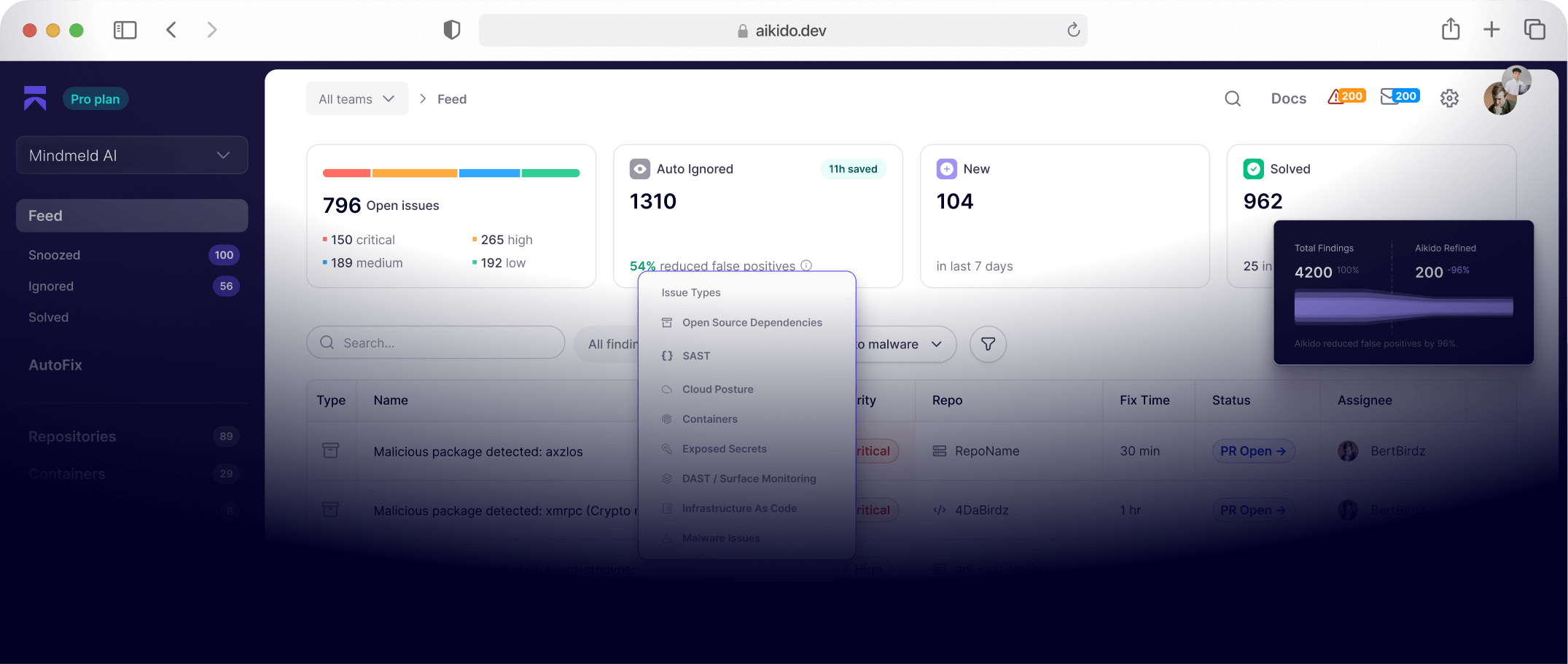
Aikido's State of AI in Security 2026 report found that 69% of organizations have uncovered vulnerabilities introduced by AI-generated code, and 1 in 5 suffered a serious incident directly tied to it. That's pushing teams toward AI code review tools like Greptile, which reviews pull requests with the whole repo as context, mapping files and dependencies so its agents can reason across a codebase. Now those same teams are searching for Greptile alternatives that keep the repo-wide reasoning but close the security gaps it leaves behind.
{{cta}}
The trouble is that Greptile's broad reasoning tends to generate noise. Independent testing clocked it at around 11 false positives on a single benchmark run. It also won't reliably catch a hardcoded secret or a vulnerable dependency it just pulled in, and while it recently added a security check, that feature is new and unproven next to tools built for security from the start.
This is why teams start searching for something else. In this post, we compare the following on reasoning capabilities, review noise, security coverage, pricing, and more:
- Aikido Security: The only option here that reviews pull requests for quality and backs it with security across code, dependencies, cloud, and runtime
- CodeRabbit: For teams that want the lowest review noise
- Qodo: Code review and generated tests in one pass
- Graphite: For teams already working in stacked PRs
- SonarQube: Standardizes quality gates across many repositories
- CodeAnt AI: Review plus SAST in one pass
Which Greptile alternatives should you shortlist?
Greptile alternatives split along what you need the reviewer to do, whether that's catching more bugs, making less noise, generating tests, or backing the review with real security. Here's the shortlist by situation:
If you want code review backed by real security coverage:
- Aikido Security: Brings a full security platform behind the review, including SCA, secrets, IaC, cloud, runtime, and agents that reason about exploit paths
- CodeAnt AI: pairs review with SAST in a single pass
If you want the lowest review noise:
- Aikido Security: Tunes each rule to under-flag ambiguous cases
- CodeRabbit: suppresses low-confidence comments across the board
If you're standardizing quality gates across many repositories:
- Aikido Security: runs the same tuned rules at both PR and repo level with security attached.
- SonarQube: quality gates block substandard code before it merges, across a deep rule library
If you want review paired with generated tests:
- Qodo: writes unit tests for the gaps it finds, so review and test coverage arrive in the same pass.
If you already ship in stacked pull requests:
- Graphite: is built around stacked PRs and tunes for low comment volume, but most of the value depends on committing to that workflow.
Greptile alternatives comparison table
How the top Greptile alternatives compare on review noise, security coverage, pricing, and limitations.
What Greptile aims to do
Greptile bets that a reviewer with the whole codebase in view beats one looking only at the diff. It indexes the repo into a graph of files, functions, and dependencies, then reviews each change against that map.
- Cross-file context on large or legacy codebases: It flags a change that breaks something three modules away, the bug a diff-only reviewer never sees.
- High bug detection: Greptile reports an 82% catch rate, though it's their own benchmark, and Greptile is tuned for recall over precision.
- Plain-English custom rules: Tell it what to flag or ignore in a sentence, no rule syntax.
- Memory that learns your team's preferences. It adjusts as people accept or dismiss its comments.
Why teams look for alternatives
- Review depth comes with noise: Full-codebase context finds more and flags more. One independent benchmark clocked Greptile at roughly 11 false positives, more than five times what the most precise tool in the same test produced, the kind of volume that trains developers to tune the bot out.
- A new, unproven security feature: It's trying to do a job dedicated security tools have spent years learning to do.
- Per-review pricing: The March 2026 move to metered pricing past the included 50 reviews. High-PR or agentic workflows hit that ceiling fast.
- No Bitbucket, no Azure DevOps: That rules it out for a chunk of enterprises.
- Unpredictable bills: Developers have flagged the metered model as hard to forecast, since cost tracks pull-request volume rather than headcount.
Top Greptile alternatives in 2026
Aikido Security
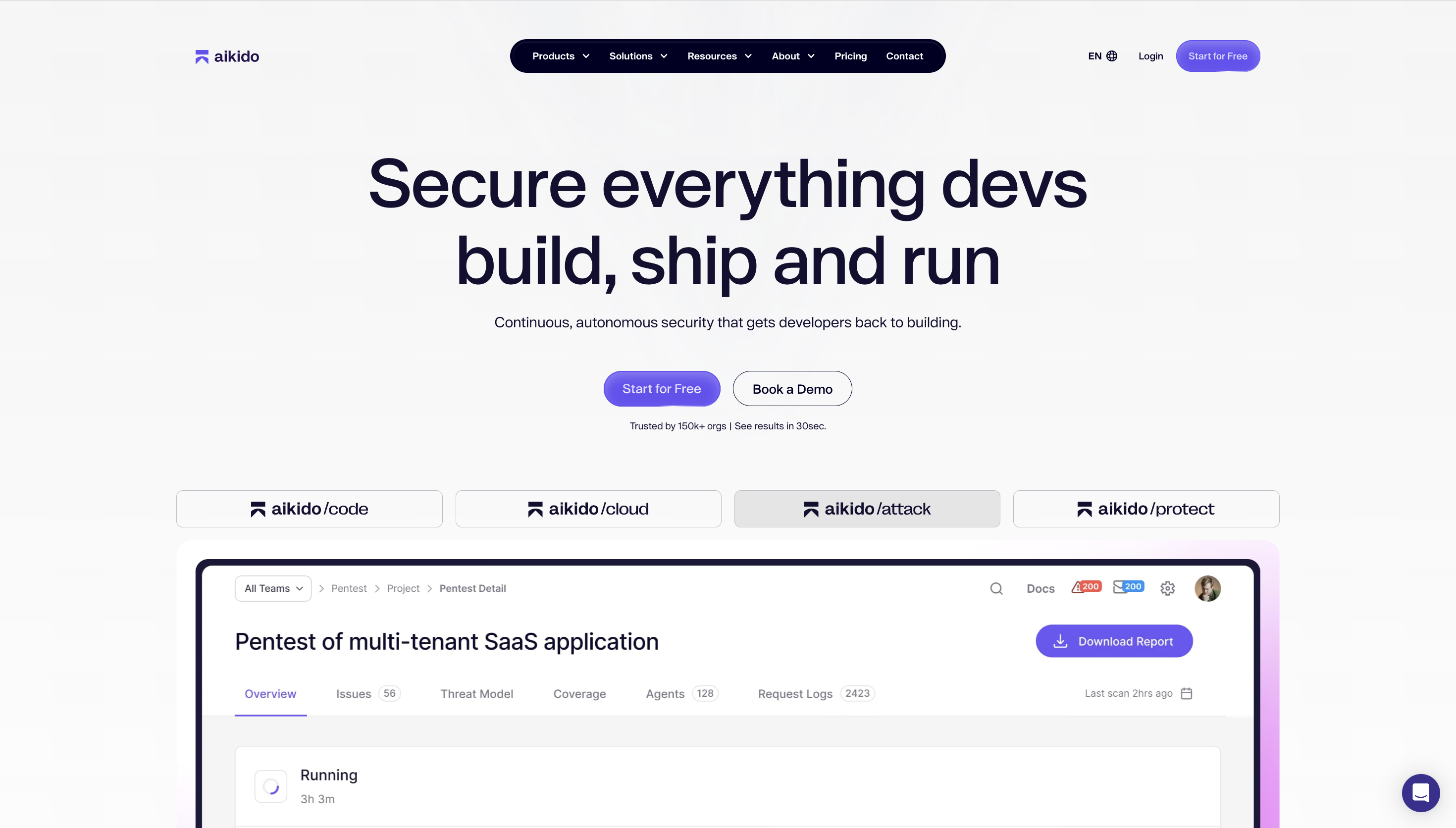
When it makes sense: Teams that want code review backed by real security coverage. It also fits if review noise is your main problem, or if you're standardizing quality gates across many repos and want security attached to them.
Aikido Security is a complete software security platform with a best-in-class code quality product. It reviews pull requests for quality and backs that review with security across everything the code touches, from the dependencies it imports to the cloud it runs on.
Aikido's Code Quality module runs on per-rule LLM calls, so each check answers one specific question with the model's full attention. This produces sharper findings and less noise than asking one pass to catch everything. Rules are fine-tuned with your own context so findings match your code style, with custom rules available for anything not already covered. You teach it your team's standards and exceptions once, and it applies them consistently.
Its prompts are benchmarked against samples that people have labeled with confidence scores, then tuned so the findings developers see are the ones they actually want flagged. Under the hood, ambiguous cases are handled deliberately. A wrong call on a borderline finding is penalized less than a wrong call on an obvious one, which keeps findings precise and cuts the noise developers learn to ignore.
The same tuned rules run on both pull requests and full repositories, so repo-level numbers match the feedback developers see on their PRs. That repo-level review doubles as management visibility, showing which teams need senior support and which need the quality bar raised.
Code Quality runs with no setup required. It connects to a repo and reviews it against sensible defaults out of the box, with custom rules available when you want them. And it posts inline PR comments with one-click fixes on every change. It works across any system or language, and both quality and security checks finish in under a minute after a push.
Its Code Coverage feature also reports test coverage in the same place, so you can see which repositories, files, and lines your tests miss right alongside the quality and security findings, rather than in a separate tool.
Once an AI is reviewing every change, the natural question is why it's only looking for half of what can go wrong. Quality and security problems ship in the same pull request, and most reviewers only catch the first kind. Security is where most other code quality reviewers are weakest. They catch obvious secrets and injection, but a subtle authorization flaw that depends on business logic slips past. Aikido runs two tools built for exactly this, reasoning about what the code is meant to do.
Deep PR Review and Code Security Audit both run on AI agents that reason about intent and trace data flow across files.
Code Security Audit is where most teams start. You point it at the whole codebase, and it reasons across every service, following data flow and permission checks wherever they lead. Its strongest capability is chaining, taking several individually low-severity findings and working out the single privilege-escalation path they add up to, the kind of multi-step exploit an attacker would actually build. It's built for a high-stakes release, or for an inherited codebase you want reviewed the way a pentester would.
Deep PR Review then keeps that same reasoning running on every new change. It reads each pull request as it opens, pulling in the whole codebase and related repos as context before it reasons about the diff in front of it. The result is an attacker's-perspective review on every change, at the point it's cheapest to fix.
{{walkthrough}}
CodeRabbit
When it makes sense: You want low review noise. Aikido sits on that same shortlist too. The difference is that CodeRabbit gives you quiet review on its own, while Aikido pairs the same restraint with security coverage.
If you've searched for Greptile alternatives, CodeRabbit vs Greptile is the likely matchup you've seen most. The two solve the same problem from opposite ends. Greptile is tuned to catch as much as possible and accepts the noise that comes with it. CodeRabbit holds back low-confidence comments, so it posts fewer findings and earns more trust per comment. CodeRabbit pairs its model with 40+ linters and static analysis tools. It runs on all four major git platforms and posts inline comments with autofixes.
But CodeRabbit's restraint means it catches fewer issues than a noisier tool, and independent testing scores it lower on depth and completeness. Independent testing also scores it lower than Greptile on raw depth, so on a large or legacy codebase where cross-file bugs hide in the connections between files, it can miss things a noisier reviewer catches. And on busy repos, the comment volume still needs some tuning.
CodeRabbit added a security capability in August 2026, but it's new and unproven next to dedicated security tooling. And while it now flags secrets and common vulnerabilities, neutral comparisons agree it isn't a dedicated security platform. It doesn't offer SCA or cloud and runtime coverage, so a security-critical codebase still pairs it with tools built for that.
Qodo
When it makes sense: You want code review and generated tests in one pass. It's not the pick if you need that reviewer to double as your security layer.
Qodo offers multi-agent review with separate agents for bugs, security, code quality, and test coverage, and it generates unit tests for the gaps it finds. Its Git integration triggers on every PR and draws on historical context, past comments, accepted suggestions, and prior discussions, so it judges a change against how your team has decided before. On top of the review, an IDE plugin catches issues before a PR opens, and enterprise plans add a governance layer with on-prem or air-gapped deployment.
But the context engine indexing can take time, credit-based pricing is opaque, and custom CLI agents take configuration effort. It reviews quality but doesn't run SAST, check dependencies, catch secrets, or reason about exploit paths. Its security track record has also been rough. Kudelski researchers turned a single PR comment into remote code execution on Qodo's review server and pulled an AWS admin key with full admin permissions, twice, though Qodo has since fixed the issues and rotated the key.
Graphite
When it makes sense: Your team already ships in stacked pull requests.
Graphite is built around stacked pull requests, breaking large changes into small, tightly scoped diffs and tuning for low comment volume, which is intended to cut time-to-merge. If your team already works in stacks, the review can fit into how you ship.
The catch is that most of the value comes from adopting that workflow, so it's a poor fit unless the whole team commits to stacked PRs, and there's a learning curve to get there. Since Anysphere (Cursor's parent) acquired Graphite in December 2025, it also leans increasingly toward Cursor-native teams.
SonarQube
When it makes sense: You want static-analysis gates and can absorb the setup and slower reviews, knowing static analysis alone won't catch vulnerabilities that only appear once the application is running.
SonarQube brings a broad rule library and quality gates that block substandard code before it merges, with SSO and audit logs for the governance side. It also runs a static analysis engine that catches bugs and vulnerabilities across a wide variety of languages. It's worth a look for teams standardizing code health across many repositories.
But SonarQube also asks more of you. Rule setup takes real effort, and costs climb on large or on-prem deployments. SonarQube identifies problems but leaves developers to interpret and apply many fixes manually. It also only inspects your source code without running it, so teams add other tools to test the application while it's live and to check test coverage. And its reviews are slow, reportedly taking 40 minutes to scan any project with 10k files. Pricing is tied to lines of code, which gets harder to predict as AI pushes your codebase to grow faster than your headcount.
CodeAnt AI
When it makes sense: You want review and security in one pass without enterprise pricing. CodeAnt covers the same review-plus-security ground as Aikido. The difference is depth. Aikido brings a full platform behind the review, while CodeAnt stops at review plus SAST in one pass.
CodeAnt AI pairs AI review with security in one pass, running deterministic checks across languages plus bulk-fix that handles up to 200 files in a single click. Teams write custom rules in plain English, and a bulk-fix action can clean up as many as 200 files at once. It's a fit for teams that want review and SAST together without enterprise pricing.
It's also the newest and least battle-tested option here, and it can get pricey for smaller teams. Because it's heavily cloud-based, offline and pre-commit support is limited. And some users report occasional false positives that need manual tuning.
Which Greptile alternative you need in 2026
Most teams are leaving Greptile because review is where its depth stops, while the noise and the missing platform support add up. That's why Aikido Security is the strongest replacement. It reviews pull requests for quality and backs it with security that carries from the pull request through to the running application, so one workflow tells you whether the code is clean and whether it's safe to ship.
FAQ
Aikido Security. It pairs code review with a full software security platform, including static analysis, software composition analysis, secrets detection, infrastructure-as-code checks, and agents that reason about business-logic and access-control flaws across the codebase.
CodeRabbit is the strongest on signal-to-noise. It holds back low-confidence comments, so it posts fewer findings than Greptile but developers trust the ones it does post. Aikido Code Quality also tunes deliberately to under-flag ambiguous cases for the same reason.
No. Greptile connects only to GitHub and GitLab. If you're on Bitbucket or Azure DevOps, Aikido Security, CodeRabbit, and CodeAnt AI all support the four major git platforms.
Both, depending on the tool. Greptile indexes the whole repo but reviews at the pull request. Aikido reviews each PR and runs a full-codebase security audit on demand, so you can check a single change or the entire codebase.