Checkmarx and Veracode differ most in how code enters the scanner and how findings reach developers. Checkmarx SAST analyzes source without requiring a build. Veracode Static Analysis uses packaged application artifacts, with preparation requirements that vary by language. This comparison focuses on Checkmarx One and Veracode’s SAST workflows, not every module they sell. Aikido SAST belongs on the shortlist when code-aware triage and controlled, reviewable fixes are the main requirements.
This comparison uses published product documentation, not a hands-on accuracy benchmark.
TL;DR
- Choose Checkmarx for source-level analysis and customizable detection queries when your team wants direct control over its SAST configuration.
- Choose Veracode for packaged-application assessments and portfolio-wide security policies when centralized assessment records are the primary requirement.
- Consider Aikido for codebase-specific triage and confidence-gated SAST fixes that developers can review in their existing Git workflow.
Checkmarx vs Veracode at a glance
Compare the workflow you will deploy, not the longest feature list. The table highlights SAST-specific differences; AI features and integrations depend on the selected configuration. For a wider shortlist, see our Checkmarx alternatives and Veracode alternatives guides.
Source scans or packaged application scans?
Checkmarx removes the build prerequisite; Veracode makes packaging part of the assessment. Checkmarx constructs a graph of source-code elements and flows, then applies security queries. This suits teams that want to scan changes before producing a complete application artifact. Its SAST scanner documentation explains that processing model.
Veracode’s packaging requirements depend on the language: compiled applications can require binaries or bytecode, while interpreted languages have different submission rules. “Veracode always needs a compiled binary” is therefore too broad. Autopackaging can automate preparation, but the submitted artifact must still meet the scanner’s requirements.
Veracode also has two distinct assessment paths. Upload and Scan provides platform-based assessments, policy evaluation and development sandboxes. Pipeline Scan supports frequent developer checks and a baseline for identifying new findings, but does not provide the platform’s flaw-mitigation and matching features.
The practical question is where friction appears in your delivery process. Test a representative repository, including its build dependencies, rather than comparing advertised scan times. A scanner that starts quickly but produces an unusable assessment has not shortened the path to a fix.
Aikido offers local IDE checks and repository scanning. Its cross-file tracing documentation distinguishes cross-file from intra-file support by language. Check that depth for your stack instead of treating every supported language as equally covered.
Triage that understands your codebase
A useful finding explains whether untrusted input can reach a dangerous operation. A severity label alone does not answer that question, especially when internal libraries perform validation outside the flagged file.
Checkmarx’s AI Triage evaluates reachability, exploitability and mitigating controls. Its query-based engine can also be customized, and the AI Query Builder helps generate CxQL queries. Those are real customization capabilities, not merely a manual alert queue.
Veracode supports custom cleanser annotations for supported Java and .NET cases. They identify functions that sanitize data and can influence mitigation decisions. Pipeline baselines serve a different purpose: excluding previously known findings from new-issue checks is not proof that those findings are false positives.
Aikido’s SAST AutoTriage first checks whether exploitability can be ruled out, then prioritizes remaining findings using code context. It combines rules with reasoning models for more complex cases. Developers can inspect a finding’s execution path rather than judge an isolated line.
The buying distinction is how you maintain that context. Checkmarx offers query customization; Veracode offers supported cleanser annotations and mitigation controls; Aikido lets you add plain-language context to an eligible SAST rule, globally or for one repository. This changes interpretation, not the detector itself. Compare how each approach handles your real validation helpers, including an intentionally unsafe path.
From finding to reviewed code fix
All three offer AI-generated fixes. Where those fixes can be generated and reviewed is more useful than an “AI: yes/no” comparison.
Checkmarx’s Triage and Remediation Assist can generate fixes for supported findings. Its PR-native workflow and automatic remediation PR creation currently apply to supported GitHub Code Repository Integration projects. Other supported project types can receive remediation inside Checkmarx One without an automatically created PR. Do not confuse broader Git-host scanning support with equivalent fix delivery.
Veracode Fix for SAST uses source files and Pipeline Scan results to propose patches. It supports IDE, CLI and GitHub Action workflows, but does not directly resolve Upload and Scan findings. A policy-scan result therefore needs the appropriate developer scan-and-fix path, not simply a Fix button on that assessment. Check the supported languages and vulnerability classes before assuming every finding is eligible.
Aikido AutoFix provides patch previews and confidence levels. Teams can create PRs from the interface or apply supported fixes in the IDE, where the apply-and-rescan workflow checks whether the reported issue remains. Its documented PR-check workflow spans GitHub, GitLab, Bitbucket and Azure DevOps.
For selection, follow one supported SAST issue from detection through developer approval. Record every handoff and required integration. A generated patch is useful only when the responsible team can review it, run tests and merge it under the required controls.
Deployment choices and security program controls
Deployment and governance deserve explicit checks, not a blanket “enterprise-ready” score. Checkmarx’s current commercial guidance describes SaaS and self-hosted options. Confirm which product configuration, AI services and data flows are included rather than assuming every Checkmarx One feature works identically on-premises.
Veracode’s managed assessment model suits organizations standardizing how applications are tested. Its security policies can define requirements and scan frequency across application profiles. The trade-off is maintaining the distinction between platform assessments and developer-only results when tracking remediation.
Aikido supports local code scanning for appropriate workspaces, but local execution is not identical to the standard integration. Its documentation recommends standard integrations for better coverage, and local-scan accounts have different AutoFix access. Treat this as an architecture choice, not a claim that every AI function operates offline.
Having a dedicated security team does not automatically favor either competitor. Define the required controls, reporting and deployment boundaries first, then ask each vendor to demonstrate the same acceptance criteria. The decision should follow those requirements, not an assumption about company size.
Pricing, packaging and operating effort
Checkmarx publishes packages rather than a universal list price. The quote depends on scope and deployment. Its AI assistance pricing adds a measurable usage component: one credit per triage action and three per remediation action. Credits are not dollar amounts.
For Veracode, request a scoped commercial quote and confirm the included products. Upload and Scan can perform SAST and SCA together, but access to both result sets requires the appropriate licenses. Its developer guidance also specifies a Veracode Fix license. Do not assume remediation is included in every SAST agreement.
Aikido’s public pricing includes a free Developer tier with two users and ten repositories, published platform tiers, and a standalone SAST quote option. Paid platform tiers list unlimited AI AutoFixes, but separate credit-based products and plan restrictions still matter. Free access is not equivalent to every workflow described here.
Illustrative quote brief: price the same 20 developers, 50 repositories, required Git hosts, SAST coverage and remediation workflow. Under Checkmarx’s published action rates, 100 triages and 25 remediations consume 175 credits; that calculation does not establish a monetary cost. Ask Veracode and Aikido to include equivalent entitlements and usage. Add the internal effort to maintain packaging, queries and review queues before comparing totals.
When Aikido is a better fit
Aikido’s case rests on SAST depth, not additional scanners. Our Checkmarx comparison and Veracode comparison provide broader context; these two requirements make the specialist argument concrete.
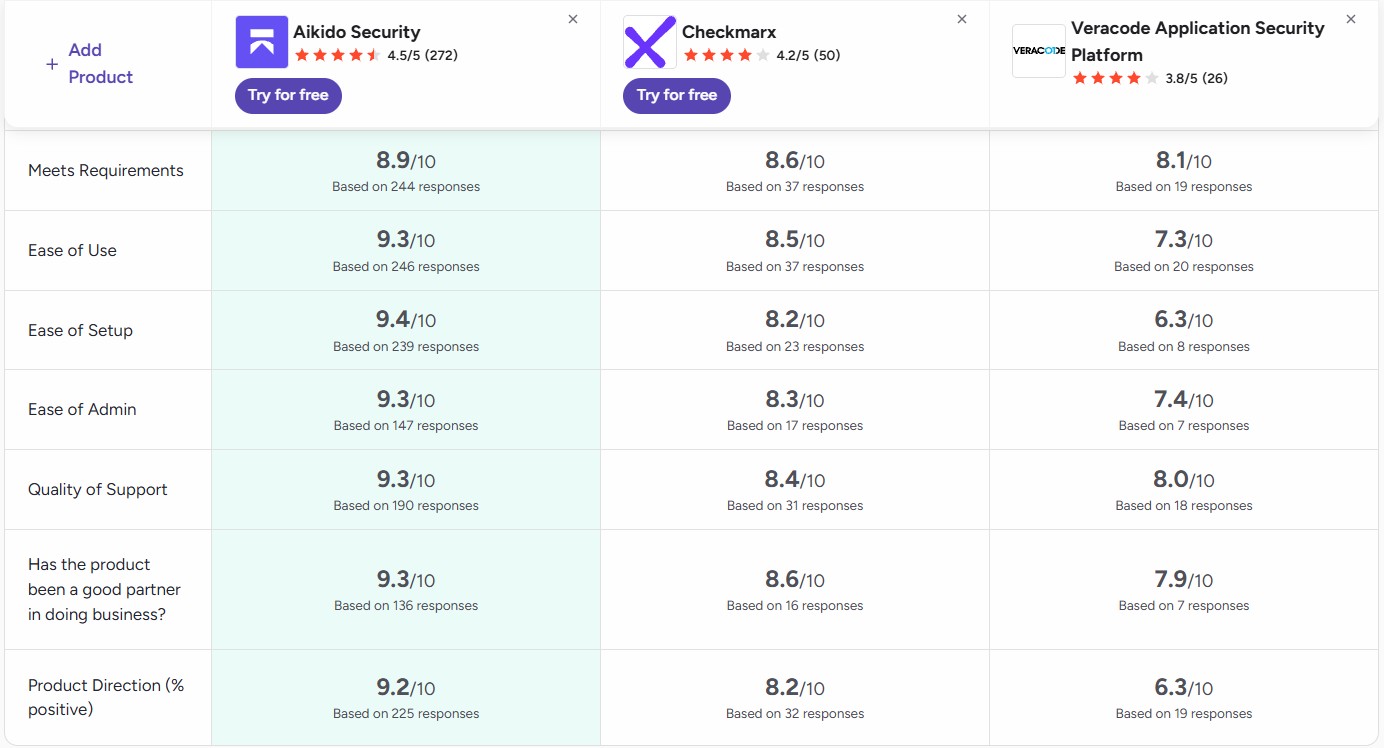
Teach triage your actual security boundaries
Aikido combines cross-file tracing with rule-specific code context. Illustrative example: an internal approvedRedirect() helper enforces a destination allowlist. Explain that narrow guarantee for the relevant rule and repository, then rescan. A direct redirect that bypasses the helper should still receive scrutiny. This is contextual interpretation, not a blanket suppression of redirect findings.
That approach is worth preferring when the requirement is to describe trusted wrappers without editing detector queries or adding analyzer-specific annotations to application code. Checkmarx’s query tools and Veracode’s supported cleanser annotations address related needs, but with different maintenance work. Aikido’s advantage here is the targeted configuration workflow, not an unmeasured accuracy claim.
Turn the backlog into controlled fix reviews
Aikido’s scheduled SAST AutoFix workflow turns eligible findings into a bounded daily review queue. By default, it creates up to two SAST PRs per repository per daily run, changes at most five files per PR, and caps open SAST AutoFix PRs at ten per repository. Automatic creation requires medium or high confidence.
This gives security teams a concrete way to manage remediation volume rather than flood developers with patches. Teams can configure draft PRs, labels and linked tasks to fit existing approval processes.
Compared with Checkmarx’s documented GitHub-specific AI PR creation, Aikido is worth testing when delivery across other supported Git hosts matters. Compared with Veracode’s Pipeline Scan-based Fix path, its appeal is a centrally configured, recurring SAST remediation queue. Both competitors have automation; demonstrate the exact repository workflow rather than assuming parity or absence.
Keep human review and CI tests in place. Aikido’s confidence gates manage automation; they do not prove that every patch preserves application behavior.
Checkmarx vs Veracode: which should you choose?
Choose Checkmarx when custom detection queries and source-first scanning are decisive. Choose Veracode when packaged-application assessment and centralized policy records are the best match for your operating model.
Choose Aikido when you want code-specific SAST triage and a controlled route from eligible findings to reviewable fixes. Those are reasons to shortlist it for the original security task, even without considering its wider platform.
Evaluate Aikido SAST on a representative repository: test one internal validation helper, one genuinely unsafe path and one fix through your normal review process.