

Protect your apps against Mythos
The emergence of frontier models like Claude Mythos enable attackers to find and exploit vulnerabilities inside your codebase within hours of release. You need Aikido to catch vulns before they get released.
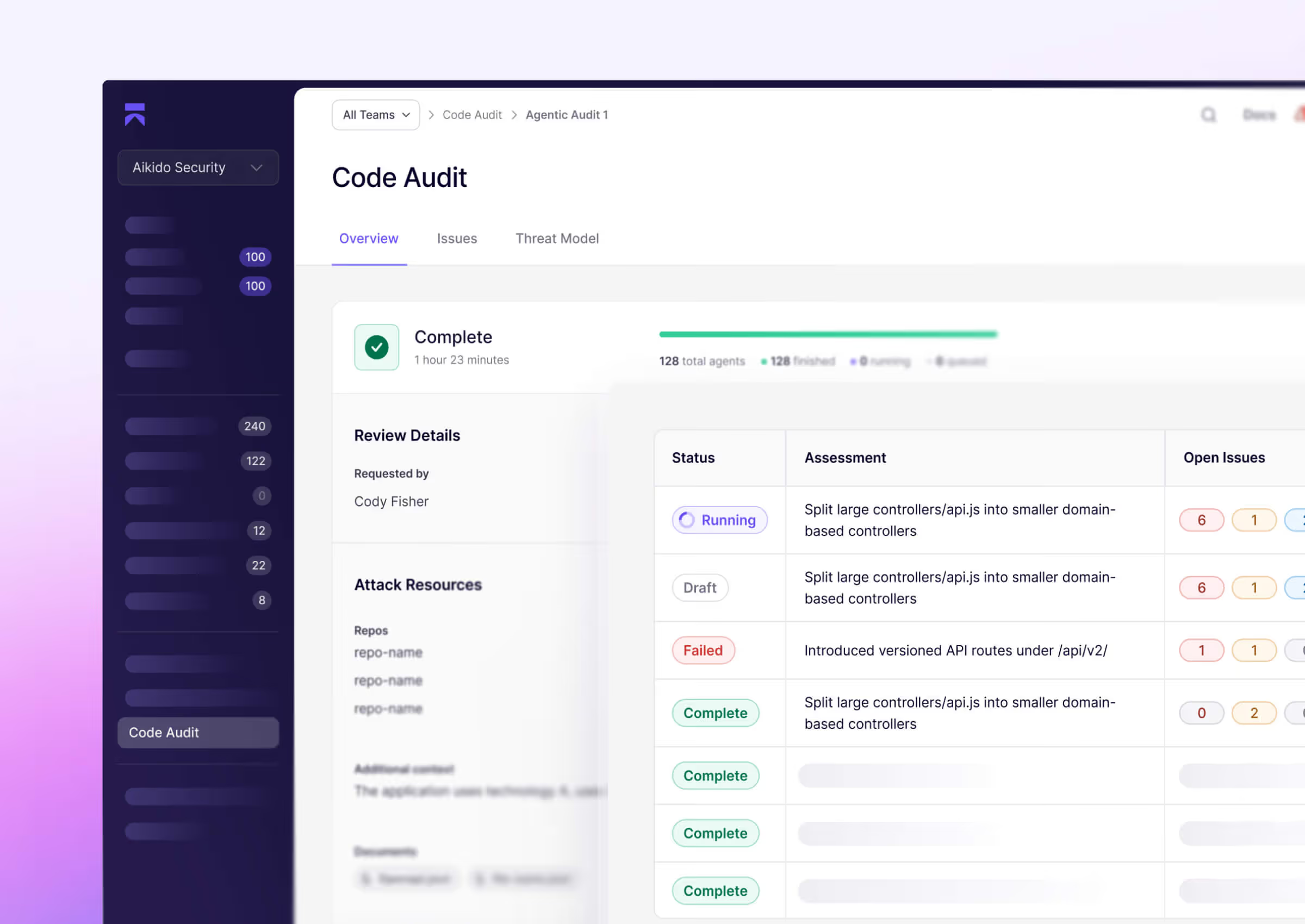



LLMs are reducing the time between vulnerability and working exploits
Tools like Claude Mythos change the skill and speed required to pull off a serious attack.
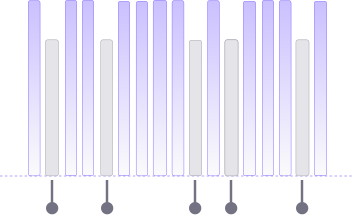
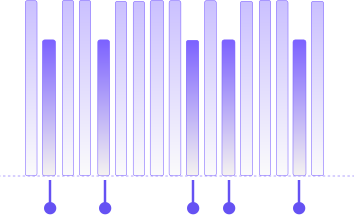
Application security is transitioning between two worlds
On one hand you have the traditional set of automated scanners that do the job but lack reasoning while in the other you have autonomous agents pushing your application to its limits.
Automated scanners.
Shallow, cheap, narrow context.
Deterministic scanners run against your codebase. They catch the OWASP regulars. Every finding is a candidate that still needs triage.

Autonomous agents.
Deep, validated, continuous.
Code audit agents reason across your codebases finding advanced logic flaws before you ship.
A practical CTO security checklist to be Mythos-ready
The gold standard for offensive appsec
.jpg)
.jpg)
Secure your app against Mythos
Connect a repo to discover what the reasoning agents find in your codebase.
Or let hundreds of AI agents attack your live app.



Two different questions.
Two different tools.
“Is this code exploitable before it ships?”
FAQs about Claude Mythos

- AI increases speed and capability on both sides, but it does not automatically give attackers the advantage.
- Defenders still have the ultimate advantage because they possess full system context (code, runtime behavior, boundaries), whereas attackers operate with limited visibility.
- We continuously evaluate and benchmark all new models. Stronger models get integrated into our workflows where they add value, but no single model is best at everything.
- The value comes from orchestration and the harness, not just the model choice.
- Detection will become commoditized, but the bottleneck simply shifts.
- With more findings comes more noise. The platforms that win will be the ones that actually execute—validating, prioritizing, and getting the most issues fixed in real systems without slowing developers down
- Yes, it represents a real step forward, especially for analyzing complex systems like browsers and operating systems, but it primarily changes the scale of discovery rather than completely reinventing the field.
- The main shift is an increase in vulnerability volume, published CVEs, and faster timelines from discovery to exploitation. However, AI SAST tools operating with proper harnesses are already highly effective, yielding up to 10x the results of traditional SAST.
- Not necessarily. When the highly-audited
curlcodebase was analyzed by Mythos, the model initially claimed to have found five "confirmed" vulnerabilities. - Upon expert human review, this list was reduced to just one low-severity vulnerability, one standard bug, and three false positives.
- Other AI tools, such as AISLE and ZeroPath, had already triggered hundreds of bugfixes in
curlprior to this, demonstrating that existing AI SAST is already highly competitive.
- Running a single large model across an entire codebase is both slow and financially prohibitive.
- For a 10,000-employee company, Claude itself estimated that running raw Mythos AI tokens natively would cost approximately $52 million per year.
- Furthermore, relying on one model is suboptimal because different models are uniquely suited for different tasks.
- A raw model without supporting infrastructure is effectively just a research tool.
- Operationalizing it requires a "harness" to provide the correct whitebox context (so the AI knows what to do), and "scaffolding" to allow the platform to swap in different models as the technology evolves
- Furthermore, the workload must be structured into distinct execution stages: discovery, validation, exploitability, and remediation.
- As detection capabilities spread and are embedded across broader platforms, the sheer volume of findings and noise will skyrocket.
- The critical bottleneck will permanently shift from merely finding issues to validating, prioritizing, and fixing them in production environments. The security tools that win will be those focused on the execution layer, helping developers ship fixes seamlessly without friction.
- Being "Mythos-Ready" requires abandoning point-in-time scans in favor of continuous application testing
- Organizations must prepare for an influx of CVEs and dependency updates by gaining clear visibility into their microservices and establishing tighter patching cycles
- The goal is to build automated workflows that dramatically reduce the time it takes to move from finding a vulnerability to pushing a fix.
- Check out our https://www.aikido.dev/blog/mythos-ready-checklist
- No, but the market will shift toward tools that provide continuous execution. While traditional non-AI SAST may become less relevant, AI-driven solutions for SCA and continuous code auditing will become more critical
- Platforms utilizing AI can leverage current models like GPT 5.5 to deliver the same class of findings as Mythos today, and are built with the scaffolding required to seamlessly integrate stronger models as they become available.