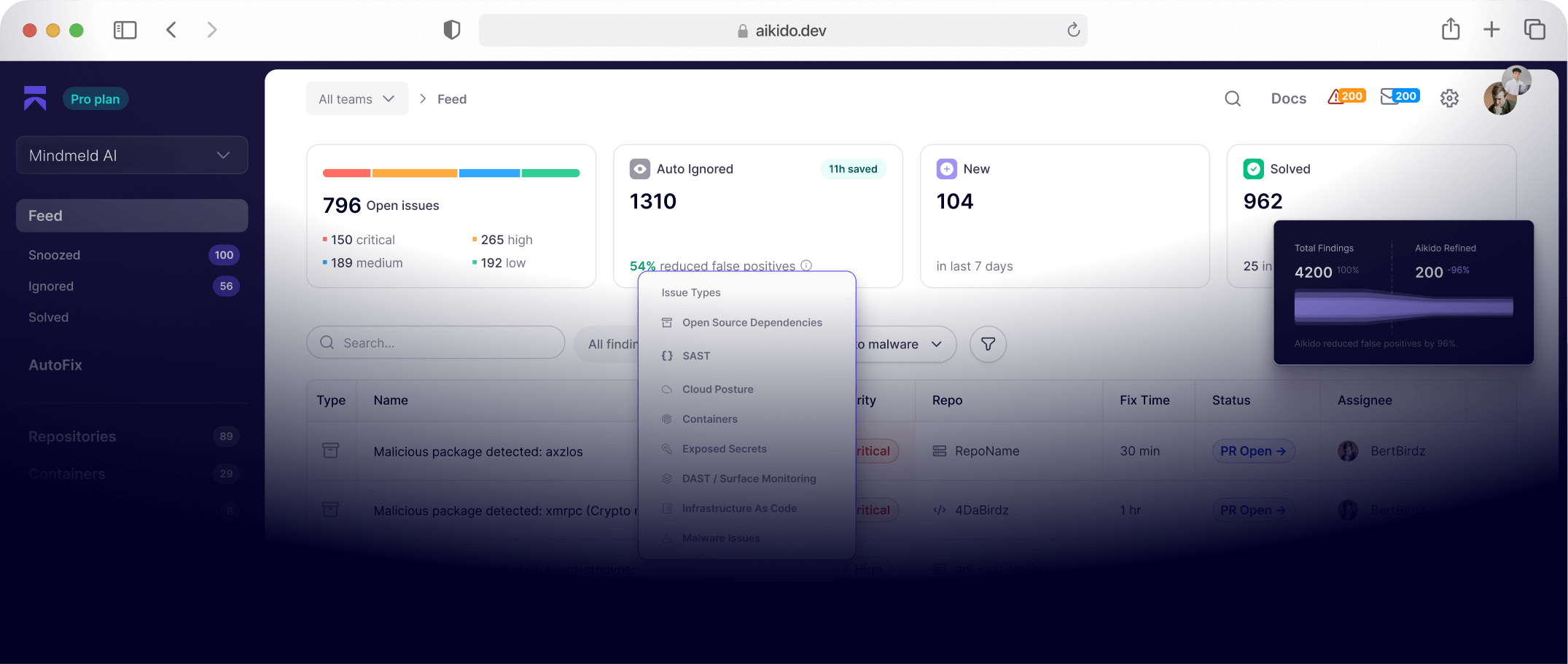
Vulnerability remediation tools find security weaknesses in code and infrastructure and help teams fix them. Those weaknesses can come from a flaw in the code your team wrote, or a vulnerable open-source dependency, or a misconfigured server or cloud resource. The fix differs by origin. Fixing a vulnerability in a dependency usually means upgrading to a patched release, which fails when no patched release exists or the new one breaks your build.
With frontier models surfacing vulnerabilities faster than teams can validate them, the bottleneck for engineering teams is now remediation. The 2026 Verizon Data Breach Investigations Report found vulnerability exploitation was the top breach vector, behind roughly 31% of breaches, while the median time to full patching rose to 43 days.
We compare the following vulnerability remediation tools on what they cover, whether they actually fix or only surface findings, how they prioritize, how they deploy, and who owns the fix:
- Aikido Security
- Snyk
- GitHub Advanced Security
- Tenable
- Qualys
- Wiz
{{cta}}
Which vulnerability remediation tools should you shortlist?
If you need to fix code and dependency vulnerabilities before release
- Aikido Security: Intel flags undisclosed vulnerabilities before a CVE exists, then AutoFix opens the pull request for the code or dependency fix
- Snyk: Opens upgrade pull requests for vulnerable dependencies and generates code fixes with Agent Fix, though noise remains a common complaint
If you need to reduce workload and misconfiguration risk across multi-cloud residency
- Wiz: Ranks cloud risk by attack path across its security graph, and has been part of Google Cloud since March 2026
If you need audit-ready evidence tied to remediation
- Aikido Security: Maps code and cloud findings to SOC 2, ISO 27001, and ISO 42001 continuously, so evidence comes from the fixes developers already ship
- Qualys: Adds Policy Compliance modules that map configuration checks to frameworks like CIS and PCI DSS
If you need to cut remediation backlog with risk-based prioritization
- Aikido Security: Weighs reachability, EPSS, proof-of-concept availability, and internet exposure, so unexploitable findings are deprioritized
- Wiz: Prioritizes by cloud attack path, ranking exposed and overprivileged workloads above isolated ones
Where vulnerability remediation tools often fall short
- Detection without remediation: Tools in this category find and rank vulnerabilities, then hand the fix back to your team as a ticket.
- Severity scores only: A CVSS 9.8 in an unreachable function gets the same urgency as one in an internet-facing service. Tools that don't factor in reachability or exploitability mean inefficient triage.
- False positives: Every finding that turns out to be a test file or dead code costs engineering time to rule out.
- Findings live outside the developer workflow: Tools that don't surface issues in the IDE or the pull request get ignored by the people expected to fix them.
- Limited coverage: Code scanning in one product, cloud posture in another, dependencies in a third. Each has its own severity model and its own queue, and nobody can see that three findings are the same underlying problem.
- No verification: Some tools mark a ticket resolved when someone closes but without a rescan confirming the vulnerability is gone, this is guesswork.
- Auto-update: Automated patches can break builds when a dependency upgrade crosses a major version.
Top vulnerability remediation tools 2026
Aikido Security
For the earliest detection and automated fixes before release
What it does: Aikido Security is a code-to-cloud security platform that covers code, open-source dependencies, containers, IaC, and cloud configurations from one place, then fixes what it finds. AutoFix opens pull requests for dependency upgrades, SAST findings, IaC misconfigurations, and container base image updates. When there's no clean upstream patch, or the only upgrade available would cross a major version and break the build, AutoFix pulls in Aikido Libraries, secured drop-in replacements for vulnerable packages, and Aikido Images, hardened base images with FIPS-compliant options, and backports the fix into the version you're already running. AutoShip then pushes the change through for review.
Why it stands out: Remediation happens where developers already work. AutoTriage filters out findings that aren't reachable or exploitable before they reach anyone's queue, so the backlog reflects real risk. Findings are grouped by repo and team, which makes ownership part of the setup rather than a separate project. Integrations cover GitHub, GitLab, Bitbucket, Jira, Slack, and CI pipelines, and SOC 2 and ISO 27001 reporting draws on the same findings developers are fixing.
What to know: AutoFix generates one-click fixes and pull requests for dependency (SCA), SAST, IaC, and container findings, plus pentest and AI Code Audit issues. DAST findings are surfaced but need to be remediated by hand.
Snyk
For dependency-heavy backlogs inside the developer workflow
What it does: Snyk is a developer security platform that scans code, open-source dependencies, containers, and IaC, surfacing findings in the IDE, the pull request, and the CLI.
Why it stands out: Remediation is built into the developer workflow. Snyk Open Source opens pull requests that upgrade vulnerable dependencies, and Agent Fix generates code fixes for Snyk Code findings. For teams whose risk lives mostly in dependencies, automated upgrade PRs can clear a large share of the backlog without manual work.
What to know. Noise is the most consistent user complaint, and non-exploitable findings lengthen triage. Pricing climbs with team size, and advanced capabilities sit on higher tiers. The company is also mid-transition, with CEO Peter McKay announcing in February 2026 that he would step down and layoffs following a few months later. Network vulnerability management sits outside its scope.
GitHub Advanced Security
For teams already building in GitHub
What it does. GitHub now sells its security features as GitHub Code Security and GitHub Secret Protection, which replaced the GitHub Advanced Security bundle. Code Security runs CodeQL scanning on pull requests, and Dependabot handles dependency alerts and update PRs.
Why it stands out. Remediation happens where most teams do their code review. Copilot Autofix suggests fixes for code scanning alerts directly in the pull request, and Dependabot opens upgrade PRs automatically. For teams already on GitHub, there's no new tool for developers to adopt.
What to know. The full experience only works on GitHub, so teams on GitLab, Bitbucket, or Azure DevOps are largely out. CodeQL builds a database before scanning compiled languages, which slows scans on large codebases. Private repositories are billed per active committer. Coverage stops at code, dependencies, and secrets, with no container, cloud, or runtime scanning.
Tenable
For hybrid estates with heavy on-prem infrastructure
What it does: Tenable Vulnerability Management scans servers, endpoints, network devices, and cloud assets using Nessus scanners, agents, and passive monitoring. Tenable One adds exposure management on top, pulling in identity, OT, web app, and cloud findings.
Why it stands out: Coverage depth is the draw. Tenable's plugin library is among the largest in the market, and Vulnerability Priority Rating (VPR) weighs threat intelligence and exploit activity alongside CVSS. For hybrid estates with a lot of on-prem infrastructure, it's worth considering. Tenable Security Center remains available for teams that need a fully on-prem deployment.
What to know: Tenable identifies and prioritizes but doesn't deploy patches itself. Fixes run through ServiceNow, Jira, or your patch tooling. Its 2025 acquisition of Vulcan Cyber added remediation orchestration to Tenable One, so check what's included at your tier. Code and dependency scanning sit outside its core strength.
Qualys
For IT-owned patch programs
What it does: Qualys VMDR uses a lightweight Cloud Agent plus network scanners to inventory assets, detect vulnerabilities, and track them through remediation. TruRisk scoring ranks findings by asset criticality and exploitability.
Why it stands out: Patch Management runs from the same agent, so a team can go from detection to deployed patch without switching tools, and TruRisk Eliminate offers mitigations for vulnerabilities that can't be patched yet. Policy Compliance maps configuration checks to frameworks like CIS and PCI DSS, which helps with audit evidence.
What to know: Much of the value sits in add-on modules, and licensing adds up as you enable them. The console has a learning curve. Like Tenable, it's built for infrastructure, so application code and open-source dependencies in repos need a separate tool.
Wiz
For multi-cloud posture ranked by attack path
What it does: Wiz is an agentless CNAPP that connects to cloud accounts through APIs and maps workloads, identities, data, and network exposure into a single security graph.
Why it stands out: Prioritization runs on attack paths rather than severity alone. A vulnerable package on an internet-exposed VM with an overprivileged role ranks above the same package on an isolated host. Wiz Code extends scanning into repos and traces cloud findings back to the code that deployed them. Coverage spans AWS, Azure, Google Cloud, OCI, and Kubernetes.
What to know: Wiz became part of Google Cloud in March 2026 and kept its brand. It remains multi-cloud, but buyers running mainly on AWS or Azure should ask about roadmap commitments. Remediation largely runs through guidance and ticketing, so the actual fix is still your team's job. Pricing is enterprise-oriented and rises with workload count.
How to choose a vulnerability remediation tool
- Start with where your vulnerabilities originate: If most of your backlog comes from application code and open-source dependencies, a tool that fixes issues in the repo will cut more risk than one that scans running hosts. If it comes from servers and network gear, an infrastructure scanner like Tenable or Qualys fits better.
- Decide whether you need fixes or findings: Some tools stop at a prioritized list. Others deploy patches or open pull requests.
- Check how it prioritizes: CVSS alone isn't enough. Look for reachability analysis, exploit intelligence, KEV status, and exposure context.
- Ownership: The right tool puts findings in front of the people who will actually close them, in the tools they already use.
Fix vulnerabilities at the source with Aikido
Aikido is the best vulnerability remediation tool on the market. AutoTriage clears out findings that aren't reachable or exploitable, so developers see a short, accurate queue instead of thousands of alerts. AutoFix turns what's left into pull requests your team can review and merge, which shortens the gap between detection and a shipped fix.
Because code, dependencies, containers, IaC, and cloud posture sit in one platform, the same issue doesn't show up three times in three tools, and compliance evidence comes from the findings you're already fixing. Connect a repo to Aikido for free and see what AutoFix can close on the first scan.
FAQ