Developer endpoints are now one of the biggest targets of supply chain attacks. There are 15 times more valid secrets on developer laptops than in git repos. 45% of those were put there by coding AI agents, which stash credentials in .env files, shell histories, local caches, and their own config directories as they work. The share keeps climbing as more work shifts to agents.
Traditional endpoint security tools are designed to catch malware once it executes by watching file writes and process behavior. What they've historically lacked is any notion of package identity. When a postinstall script runs, EDR sees a signed interpreter doing ordinary work, with no verdict to match it against, because there's no feed telling it that this specific version of this specific package was confirmed malicious an hour ago. Amalicious IDE extension or AI tool can read secrets off the machine without ever looking like malware. That supply chain layer on the endpoint is the focus of this post.
In this post, we compare:
- Aikido Security
- GitGuardian Developer Endpoint Protection
- Koi Security
- Socket
- CrowdStrike Falcon
{{cta}}
Which endpoint security tools should you shortlist?
Here's our breakdown of endpoint security tools by use case, with a shortlist of the top picks for each.
If you already run EDR but can't control what developers install
- Aikido Device Protection: Blocks across the full install surface, packages, IDE and browser extensions, and AI tools, with a minimum package age default
- Koi Security: Centers on extension and marketplace governance across browser stores and editor marketplaces
If your exposure is secrets already sitting on developer laptops
- Aikido Device Protection: Scans local files for hardcoded secrets, and blocks the malicious install that would harvest them in the first place
- GitGuardian Developer Endpoint Protection: Finds credentials across
.envfiles, shell history, and AI agent configs, and forwards results to your SIEM
If you want to stop malicious open source packages specifically
- Aikido Device Protection: Blocks at the device with a default 48-hour package-age hold, stopping the publish-and-pray releases most malware hides in, enforced through an MDM-deployed agent rather than a package-manager wrapper a developer can skip
- Socket: Intercepts at the package manager and surfaces dependency risk in pull requests
You need to govern AI tools and MCP servers
- Aikido Device Protection: Covers Cursor, Windsurf, Copilot, Claude Code, MCP servers, and Hugging Face, with per-tool and per-team policy
- Koi Security: Governs AI model repositories and MCP servers alongside its extension marketplace coverage, enforced through your existing MDM or EDR
You need runtime detection across the whole fleet
- CrowdStrike Falcon: Runtime detection and response across the whole fleet, now with npm and pip install blocking through the same sensor.
Where endpoint security tools fall short
- Wrappers and network blocking: Package-manager wrappers only cover installs someone chooses to route through them, so anything pulled outside the wrapper goes straight past. Network-level blocking has the same problem in a different form, since a personal hotspot or cafe WiFi routes around it without the developer even trying.
- Coverage of only one slice of the install surface: Package-focused tools miss rogue browser and editor extensions, while extension governance misses a poisoned npm or PyPI release. The EDR vendors now moving into this layer are starting at package managers, so extensions, browser plugins, and AI tooling are still uncovered.
- Detection without blocking: Some tools surface credentials already sitting in
.envfiles, shell history, and agent configs but never stop the install that harvested them, and leave rotation and vaulting to a separate product. - No minimum package age hold: Without one, a version published minutes ago installs before any feed or researcher has had the chance to flag it, which is exactly the window most supply chain malware is built to exploit.
Top endpoint security tools for developers in 2026 comparison table
The top endpoint tools compared on enforcement point, package blocking, minimum package age, extension governance, AI tool governance, local secrets scanning, and best use case:
Top 5 endpoint security tools for developers in 2026 reviewed
Aikido Device Protection
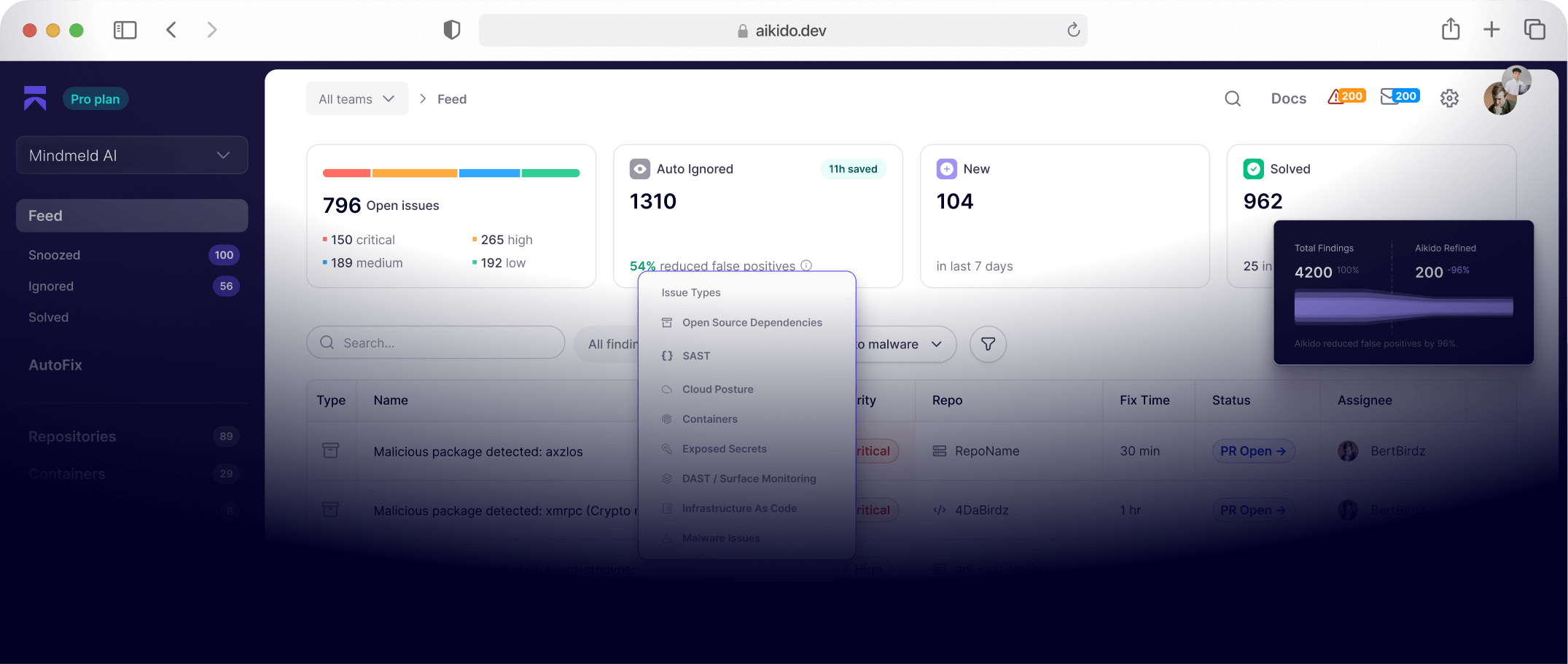
What it does: Aikido Device Protection blocks risky packages, IDE extensions, browser plugins, and AI tools and models before they install, and flags anything already on the machine that later turns out to be malicious. It also scans local files for hardcoded secrets. It deploys its own agent through your existing MDM (Jamf, Intune, Kandji, Fleet, and others) on macOS and Windows, adding a system extension and network content filter. Allow and block decisions happen locally, so Aikido never sees your traffic, browsing history, or downloads.
Why it stands out: Protection works off-network, so installs over hotspots and cafe WiFi don't route around it. The same device-level firewall blocks specific domains, keeping npm mirrors, ClawHub, and other sites you don't want on work machines unreachable wherever the laptop is. A default 48-hour minimum package age means that if the latest release is too new, the install falls back to the newest version that meets the policy. Every new package is scanned on first request, so typosquatting packages carrying malware are caught with no configuration. Allowlists, blocklists, approval workflows, and per-team rules apply across every monitored ecosystem.
It runs on Aikido Intel, which covers malware and undisclosed vulnerabilities across 4M+ packages in 20 ecosystems, maintained by the team credited with discovering the Shai-Hulud worm. Intel detonates npm packages in a sandbox and records their behavior, including the connections they open and the files they read, on top of static rules and AI analysis that follows an attack chain across multiple files.In Q2 2026, Intel confirmed 19,500 malicious package versions, with a median detection time under six minutes. You can test the npm malware blocking locally with Safe Chain, Aikido's free open-source package-manager wrapper. Device Protectionand sits in the same platform as SAST, SCA, IaC, containers, and CSPM.
What to know: It isn't a virus scanner or a replacement for EDR.
{{walkthrough}}
GitGuardian Developer Endpoint Protection
What it does: GitGuardian Developer Endpoint Protection finds credentials on developer machines, in .env files, shell histories, AI agent configs, and local caches. It's built into ggshield, the CLI GitGuardian customers already run for pre-commit and CI/CD scanning, and runs on Windows, Linux, and macOS.
Why it stands out: Teams already using ggshield, GitGuardian’s command-line tool, can extend secrets detection to laptops without adding another agent or workflow. Rollout runs through your existing MDM, with ready-made scripts for Jamf and Kandji, and any MDM or config management tool that can run a scheduled script works the same way, with structured output forwarding to a SIEM, API retrieval, configurable exclusions, and CPU and memory limits. GitGuardian's early-access data averages 150 secrets per developer laptop, with some machines in the thousands.
What to know: It finds and flags credentials but doesn't store or rotate them itself. Vaulting and rotation run through GitGuardian's NHI Governance and ggscout, which write secrets into an existing secrets manager like HashiCorp Vault, CyberArk Conjur, or AWS Secrets Manager. Plan on having one of those in place. It also doesn't block packages, extensions, or AI tool installs the way Aikido and Koi do.
Koi Security
What it does: Koi Security governs what developers install, covering packages, extensions, and AI tooling, through continuous inventory and automated enforcement. Rather than deploying its own on-device component, it works through the endpoint agents an organization already runs. In practice that means the MDM, EDR, or secure web gateway already on the fleet does the enforcing, with Koi supplying the verdict on what to allow or block.
Why it stands out: Palo Alto Networks completed its acquisition of Koi on April 14, 2026. Koi's technology is going into Prisma AIRS and a new Cortex XDR module under a category Palo Alto calls Agentic Endpoint Security, and it remains available standalone. Koi had 40 to 50 customers at acquisition, including OpenAI and Fireblocks.
What to know: There's no public pricing or detailed public technical documentation, so evaluation runs through Palo Alto sales and a custom POC. Pricing and roadmap now sit with the parent company.
Socket
What it does: Socket runs behavioral analysis on open source dependencies, flagging network connections, filesystem access, shell execution, and obfuscated code before a CVE exists. It also handles CVE scanning and license compliance, and generates SBOMs. A GitHub App surfaces dependency risk in pull requests.
Why it stands out: Socket Firewall Free is a CLI wrapper for npm, yarn, pnpm, pip, uv, and cargo, invoked by prefixing sfw to an install command or through shell aliases. The Enterprise version runs as an HTTP/HTTPS proxy with custom registries, configurable policies, and Go, Java, Ruby, and .NET support. An Extension Firewall for VS Code and Open VSX is in closed beta for enterprise customers.
What to know: The free wrapper only protects installs routed through it, and there's no AI SAST, DAST, IaC, or cloud posture.
CrowdStrike Falcon
What it does: CrowdStrike launched Real-Time Supply Chain Attack Protection at Fal.Con on September 2, 2026. The Falcon sensor intercepts npm install and pip install transactions on Windows, macOS, and Linux, blocking malicious packages before their embedded code runs.
Why it stands out: For teams already running Falcon, the capability runs through the sensor already on the endpoint, with no separate deployment. Enforcement carries forward into what a package does next, including execution and credential access, with response orchestration through Charlotte Agentic SOAR. Coverage extends to any endpoint running agentic applications, not only developer workstations.
What to know: It covers npm and PyPI at launch, with no IDE extension, browser plugin, AI tool governance, or local secrets scanning. It requires Falcon, so the evaluation is really a Falcon platform decision.
How to choose an endpoint security tool
- If EDR is already in place and the exposure is developers pulling packages and AI tools, that's the developer-device layer.
- Decide whether you need blocking or just visibility. Aikido and Socket block at install time. GitGuardian centers on finding what's already there.
- Map coverage to your install surface: Weigh packages against extensions and AI tooling your engineers install.
- Factor in deployment: MDM rollout, per-team policy, local-only decisioning, and audit trail all vary across these tools.
Conclusion
Endpoint security tools that govern what developers install, and find what's already sitting on their machines, are addressing where the exposure has moved as coding agents pull dependencies.
Most teams reading this already have EDR, but not necessarily tooling that watches the install itself, across every surface a developer actually pulls from. And not all tools on the market hold enforcement when someone is working off the corporate network.
Aikido Device Protection is the install-and-secrets layer that runs alongside whatever EDR you already have. It blocks across packages, IDE extensions, browser plugins, and AI tools at the device, holds new releases for 48 hours by default, and scans local files for hardcoded secrets, all deployed through the MDM you already run.