Qodo is an AI code quality and governance platform that reviews a pull request by reasoning over the diff using the context around it, including Jira tickets and past PRs. It focuses on multi-agent design and test generation.
But Qodo isn't the best at any one thing. Benchmarks put Qodo at the middle of the pack on review depth and noise, so if you're looking for the sharpest review on the market, Qodo isn't it. Additionally, Qodo runs a security agent as one pass among several, but it isn't a replacement for dedicated SAST or SCA, so you have to get more tools to complement it. And Qodo was proven to be vulnerable to attack when a cybersecurity service turned a single PR comment into remote code execution and a leaked AWS admin key on Qodo's own servers.
Teams looking for Qodo alternatives want one that tells you whether the code is safe to ship, and backs that up with real coverage of your dependencies, your secrets, and the paths an attacker would actually take. The tools below split on what they optimize for. Some tune for the least review noise, others for the deepest cross-file reasoning, and a few pair review with real security. In this post we compare:
- Aikido Security
- CodeRabbit
- Greptile
- Graphite
- SonarQube
- CodeAnt AI
TL;DR
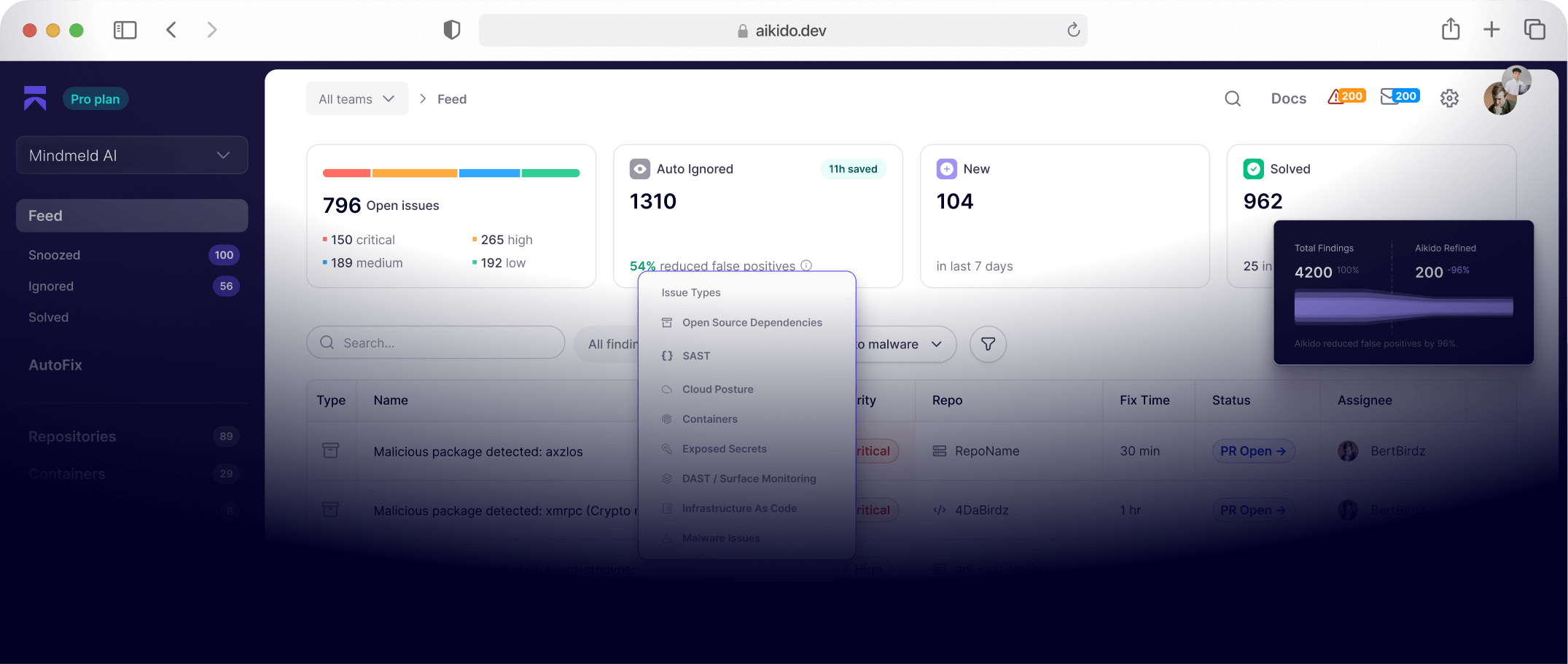
Aikido Security is the strongest pick because it reviews your code and secures it. Its Code Quality module tunes for precision by design, and it works across any language, including legacy ones like COBOL that modern-only reviewers skip. Where Qodo's deeper analysis narrows to a handful of mainstream languages, Aikido reviews and audits the older, niche languages that static-analysis engines were never built to support. It checks your code against one rule at a time, each in its own separate pass, so the model gives its full attention to a single question instead of juggling everything at once. Prompts are benchmarked against human-labeled samples and deliberately set to under-flag ambiguous cases, so developers get fewer low-value findings. This is complemented by AI code review for security, where agents read code you've already shipped and each pull request using the whole codebase and related repos as context to catch complex vulnerabilities like business-logic and access-control bugs.
Qodo alternatives comparison table
The table below compares the top Qodo alternatives in 2026, Aikido Security, CodeRabbit, Greptile, Graphite, SonarQube, and CodeAnt AI, across review noise, security coverage, pricing, and limitations.
What Qodo aims to do
Qodo, formerly CodiumAI, reviews every pull request automatically for reliability and bugs, and generates unit testing. Its Git integration triggers on each PR and draws on historical context, past PR comments, accepted suggestions, and prior review discussions, to judge a change against how your team has decided before. Reviews run on frontier models from OpenAI, Anthropic, and Google, and the premium ones cost more. Claude Opus runs about five credits per request against one for a standard model, so heavy use of the top models burns the credit pool fast. It offers a multi-agent design, with separate agents for bugs, security, code quality, and test coverage. When it finds code with no test, it generates a test to cover it.
On top of the review capability, it offers an IDE plugin that enables developers to catch quality issues before opening a PR, and a governance layer, with on-prem or air-gapped deployment, which is available on enterprise plans.
Why teams are looking for Qodo alternatives
Qodo reviews quality competently. The reasons to look elsewhere are that it isn't the best at the review itself, and that the review is most of what you get.
- It's mid-pack: Benchmarks place Qodo in the middle of the list of competitors on review depth and noise. Qodo's edge is test generation, not the sharpest review on the market.
- The security stops inside the pull request: Qodo runs a security agent, but it isn't a replacement for dedicated SAST, and it doesn't check the dependencies your code pulls in or follow a flaw out into cloud or runtime.
- Credit-based pricing is hard to predict: Premium models cost extra credits, and heavy IDE or CLI use can hit limits unexpectedly, with the free tier capped at 30 PR reviews and 250 credits a month.
- Custom CLI agents take real configuration effort: A barrier for teams without the DevOps capacity to build and maintain them.
- It's been breached: Kudelski researchers turned a single PR comment into remote code execution on Qodo's review server and pulled an AWS admin key, twice. Qodo patched it and rotated the key, but anything with write access to your repos is worth scrutinizing on its own security.
Top Qodo alternatives in 2026
Aikido Security
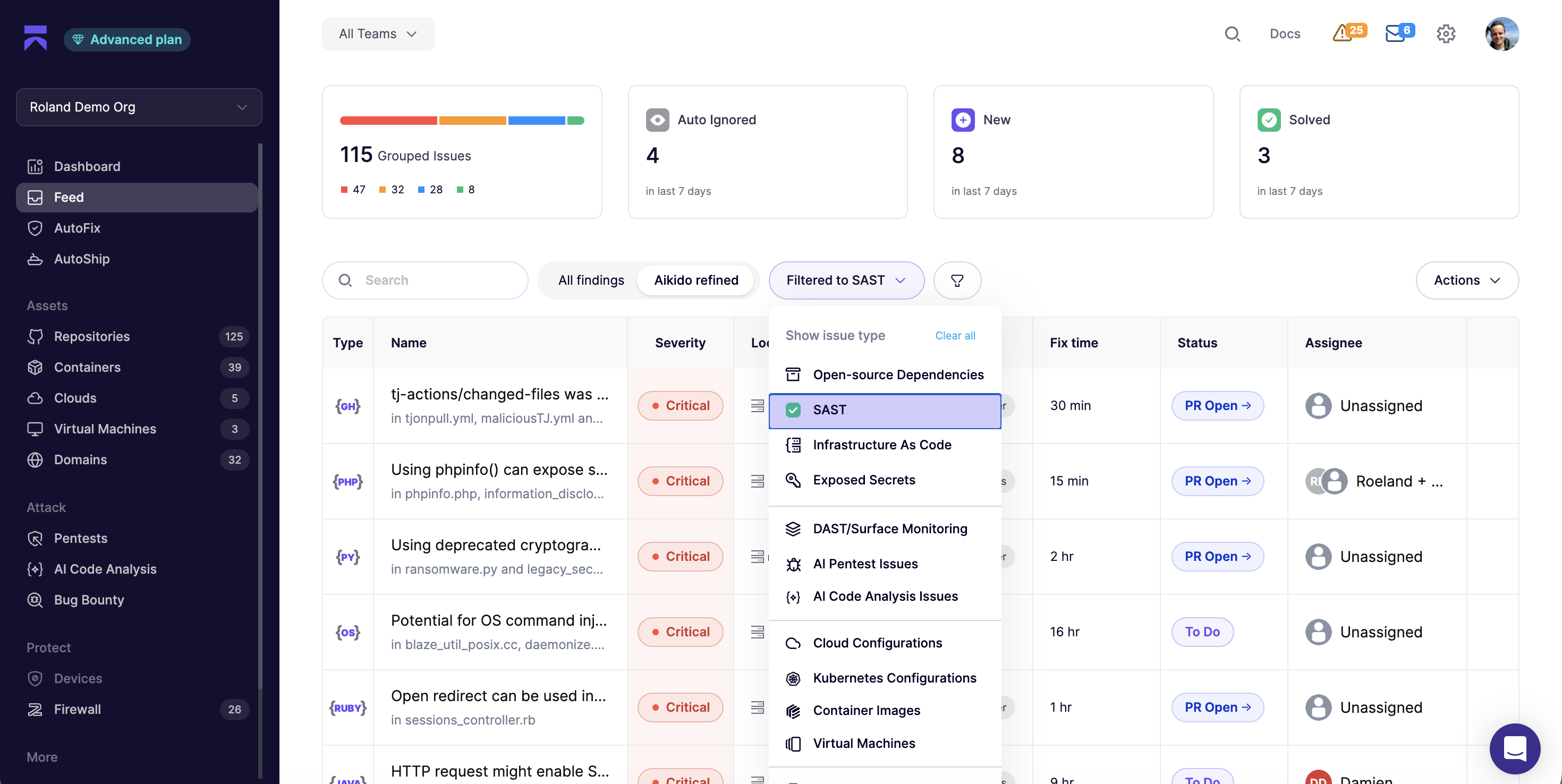
Aikido Security is a complete software security platform with a complete code quality product. It reviews pull requests for quality and backs that review with security coverage that reaches across your code, dependencies, cloud, and runtime.
Aikido's Code Quality module runs on per-rule LLM calls, so each check answers one specific question with the model's full attention, which produces sharper findings and less noise than asking one pass to catch everything. Rules are fine-tuned with your own context so findings match your code style, with custom rules available for anything not already covered. You teach it your team's standards and exceptions once, and it applies them consistently.
Its prompts are benchmarked against samples that people have labeled with confidence scores, then tuned so the findings developers see are the ones they actually want flagged. Under the hood, ambiguous cases are handled deliberately. A wrong call on a borderline finding is penalized less than a wrong call on an obvious one, which keeps findings precise and cuts the noise developers learn to ignore.
The same tuned rules run on both pull requests and full repositories, so repo-level numbers match the feedback developers see on their PRs. That repo-level review doubles as management visibility, showing which teams need senior support and which need the quality bar raised.
Code Quality runs on with no setup required. Connect a repo and it reviews against sensible defaults out of the box, with custom rules available when you want them. And it posts inline PR comments with one-click fixes on every change. It works across any system or language, and both quality and security checks finish in under a minute after a push.
Its Code Coverage feature also reports test coverage in the same place, so you can see which repositories, files, and lines your tests miss right alongside the quality and security findings, rather than in a separate tool.
Once an AI is reviewing every change, the natural question is why it's only looking for half of what can go wrong. Quality and security problems ship in the same pull request, and most reviewers only catch the first kind. Security is where most other code quality reviewers are weakest. They catch obvious secrets and injection, but a subtle authorization flaw that depends on business logic slips past. Aikido runs two tools built for exactly this, reasoning about what the code is meant to do.
Deep PR Review and Code Security Audit both run on AI agents that reason about intent and trace data flow across files.
Code Security Audit is where most teams start. You point it at the whole codebase and it reasons across every service, following data flow and permission checks wherever they lead. Its sharpest move is chaining, taking several individually low-severity findings and working out the single privilege-escalation path they add up to, the kind of multi-step exploit an attacker would actually build. It's built for a high-stakes release, or for an inherited codebase you want reviewed the way a pentester would.
Deep PR Review then keeps that same reasoning running on every new change. It reads each pull request as it opens, pulling in the whole codebase and related repos as context before it reasons about the diff in front of it. The result is an attacker's-perspective review on every change, at the point it's cheapest to fix.
Best for: Enterprise teams shipping AI-generated code faster than they can review it, who want that review backed by real security coverage.
{{walkthrough}}
CodeRabbit
CodeRabbit pairs its AI code quality model with more than 40 linters and static analysis tools. It holds back low-confidence comments, so it posts fewer findings but earns more trust per comment. It reviews across GitHub, GitLab, Bitbucket, and Azure DevOps, and public repositories get Pro features free.
The flip side is recall and scope. CodeRabbit's restraint means it catches fewer issues than a noisier tool, and independent testing scores it lower on depth and completeness. And while it now flags secrets and common vulnerabilities, neutral comparisons agree it isn't a dedicated security platform. It doesn't offer SCA, or cloud and runtime coverage, so a security-critical codebase still pairs it with tools built for that.
Best for: Teams that want a reviewer they can leave on by default, but not as their only security layer.
Greptile
Greptile takes the opposite bet. It builds a graph index of your whole codebase, including functions and call relationships, before it reviews, so it can find bugs that span multiple files, the kind a diff-only reviewer never sees. Aikido reads across the whole codebase too, tracing tainted input and data flow through multiple files rather than judging a diff in isolation, so cross-file bugs and the runtime errors they cause don't slip through. It also runs a beta agent that writes and executes tests for each PR in a sandbox, though reviewers note the results are still inconsistent.
But Greptile's depth comes with noise and cost. Greptile produces more false positives than competitors, and it can take time to index massive codebases. Its pricing charges a dollar per scan past 50 reviews a month, so high-volume or agentic workflows need to model the overage rather than assume a flat seat fee. This contributes to its pricing being hard to predict.
Best for: Large or legacy codebases where cross-file bugs hide in the connections between files, but only if your team can absorb the extra comments and model the per-review cost.
Graphite
Graphite is built around stacked pull requests, breaking large changes into small, tightly scoped diffs and tuning for low comment volume, which is intended to cut time-to-merge. If your team already works in stacks, the review can fit into how you ship.
The catch is that most of the value comes from adopting that workflow, so it's a poor fit unless the whole team commits to stacked PRs, and there's a learning curve to get there. Since Anysphere (Cursor's parent) acquired Graphite in December 2025, it also leans increasingly toward Cursor-native teams.
Best for: Teams already working in stacked pull requests, but a hard sell if adopting that workflow isn't already on the table.
SonarQube
SonarQube brings a broad rule library, and quality gates that block substandard code before it merges, with SSO and audit logs for the governance side. It also runs a static analysis engine that catches bugs and vulnerabilities across a wide variety of languages. It's worth a look for teams standardizing code health across many repositories.
But Sonarqube also asks more of you. Rule setup takes real effort, and costs climb on large or on-prem deployments. SonarQube identifies problems but leaves developers to interpret and apply many fixes manually. It also only inspects your source code without running it, so teams add other tools to test the application while it's live and to check test coverage. And its reviews are slow, reportedly taking 40 minutes to scan any project with 10k files.
Best for: Larger orgs standardizing code health and quality gates across many repositories, but not for teams that want to test the running application.
CodeAnt AI
CodeAnt AI pairs AI review with security in one pass, running deterministic checks across languages plus bulk-fix that handles up to 200 files in a single click. Teams write custom rules in plain English, and a bulk-fix action can clean up as many as 200 files at once. It's a fit for teams that want review and SAST together without enterprise pricing.
It's also the newest and least battle-tested option here, and it can get pricey for smaller teams. Because it's heavily cloud-based, offline and pre-commit support is limited. And some users report occasional false positives that need manual tuning.
Best for: Teams that want AI review and security checks in one pass, but a gamble if you need a track record before you commit.
Best Qodo alternatives if you want a better remediation workflow
Qodo posts fixes as suggestions inside the pull request, some applied with a checkbox click. If you want fixes triaged before they reach a developer, a few tools take a different route.
- Aikido Security offers the best remediation workflow of the bunch. AutoTriage uses reachability and runtime context to drop non-exploitable findings before a developer ever sees them, and AutoFix drafts the remediation for the rest.
- Snyk Code puts AI fix suggestions in the IDE and the pull request, close to where the developer is working.
- CodeRabbit applies one-click fixes on review comments and pairs them with linters it can auto-apply.
Best Qodo alternatives if you want more than code review
Qodo reviews code and generates tests, but dependencies, secrets, infrastructure-as-code, and cloud all need other tools.
- Aikido Security is a complete security platform, covering static analysis alongside software composition analysis, secrets detection, infrastructure-as-code checks, container image scanning, dynamic testing, AI pentesting, and cloud.
- Snyk grew up around dependency and open-source security and extends out to infrastructure-as-code and containers.
- CodeAnt AI pairs review with static analysis, secrets, and infrastructure-as-code in a single pass.
Best Qodo alternatives if you want predictable pricing
Qodo runs on credits, and premium models like Claude Opus burn several per request, so heavy use gets hard to forecast.
- Aikido Security is the best fit here. Flat-rate plans with users included and no metering, so the cost is known upfront.
- CodeRabbit charges a flat per-seat fee with unlimited reviews, billing only developers who open pull requests.
- SonarQube's community tier is free to self-host, with paid plans priced by lines of code.
Which Qodo alternative you need in 2026
Most teams leaving Qodo are going because code review is all they get, while the code still ships with unchecked dependencies, committed secrets, and logic flaws. That's why Aikido Security is the best replacement, reviewing pull requests for quality and backing it with security across your code, dependencies, cloud, and runtime, so one workflow tells you whether the code is clean and whether it's safe to ship.
FAQ
<script type="application/ld+json">
{
"@context": "https://schema.org",
"@graph": [
{
"@type": "BlogPosting",
"@id": "https://www.aikido.dev/blog/top-qodo-alternatives#article",
"isPartOf": { "@id": "https://www.aikido.dev/blog/top-qodo-alternatives#webpage" },
"mainEntityOfPage": { "@id": "https://www.aikido.dev/blog/top-qodo-alternatives#webpage" },
"headline": "Top Qodo Alternatives for AI-Powered Code Review in 2026",
"description": "A comparison of the top Qodo alternatives in 2026, including Aikido Security, CodeRabbit, Greptile, Graphite, SonarQube, and CodeAnt AI, across review noise, security coverage, pricing, and limitations.",
"articleSection": "AI Code Review",
"inLanguage": "en",
"datePublished": "2026-09-16",
"dateModified": "2026-09-16",
"wordCount": 1850,
"timeRequired": "PT8M",
"author": { "@id": "https://www.aikido.dev/authors/nicholas-thomson#person" },
"publisher": { "@id": "https://www.aikido.dev#organization" },
"image": { "@id": "https://www.aikido.dev/blog/top-qodo-alternatives#primaryimage" },
"keywords": [
"Qodo alternatives",
"AI code review tools",
"code review automation",
"AI code quality",
"SAST",
"software composition analysis",
"CodeRabbit",
"Greptile",
"Graphite",
"SonarQube",
"CodeAnt AI",
"Aikido Security"
],
"about": [
{ "@type": "Thing", "name": "AI code review" },
{ "@type": "Thing", "name": "Application security" },
{ "@type": "Thing", "name": "Code quality" }
],
"mentions": [
{ "@type": "SoftwareApplication", "name": "Qodo", "applicationCategory": "DeveloperApplication", "operatingSystem": "Web" },
{ "@type": "SoftwareApplication", "name": "Aikido Security", "applicationCategory": "SecurityApplication", "operatingSystem": "Web", "url": "https://www.aikido.dev" },
{ "@type": "SoftwareApplication", "name": "CodeRabbit", "applicationCategory": "DeveloperApplication", "operatingSystem": "Web" },
{ "@type": "SoftwareApplication", "name": "Greptile", "applicationCategory": "DeveloperApplication", "operatingSystem": "Web" },
{ "@type": "SoftwareApplication", "name": "Graphite", "applicationCategory": "DeveloperApplication", "operatingSystem": "Web" },
{ "@type": "SoftwareApplication", "name": "SonarQube", "applicationCategory": "DeveloperApplication", "operatingSystem": "Web" },
{ "@type": "SoftwareApplication", "name": "CodeAnt AI", "applicationCategory": "DeveloperApplication", "operatingSystem": "Web" },
{ "@type": "SoftwareApplication", "name": "Snyk Code", "applicationCategory": "SecurityApplication", "operatingSystem": "Web" }
],
"speakable": {
"@type": "SpeakableSpecification",
"cssSelector": ["h1", "h2"]
}
},
{
"@type": "WebPage",
"@id": "https://www.aikido.dev/blog/top-qodo-alternatives#webpage",
"url": "https://www.aikido.dev/blog/top-qodo-alternatives",
"name": "Top Qodo Alternatives for AI-Powered Code Review in 2026",
"isPartOf": { "@id": "https://www.aikido.dev#website" },
"primaryImageOfPage": { "@id": "https://www.aikido.dev/blog/top-qodo-alternatives#primaryimage" },
"datePublished": "2026-09-16",
"dateModified": "2026-09-16",
"inLanguage": "en",
"breadcrumb": { "@id": "https://www.aikido.dev/blog/top-qodo-alternatives#breadcrumb" }
},
{
"@type": "ImageObject",
"@id": "https://www.aikido.dev/blog/top-qodo-alternatives#primaryimage",
"url": "https://www.aikido.dev/blog/top-qodo-alternatives.png",
"contentUrl": "https://www.aikido.dev/blog/top-qodo-alternatives.png"
},
{
"@type": "BreadcrumbList",
"@id": "https://www.aikido.dev/blog/top-qodo-alternatives#breadcrumb",
"itemListElement": [
{ "@type": "ListItem", "position": 1, "name": "Home", "item": "https://www.aikido.dev" },
{ "@type": "ListItem", "position": 2, "name": "Blog", "item": "https://www.aikido.dev/blog" },
{ "@type": "ListItem", "position": 3, "name": "Top Qodo Alternatives for AI-Powered Code Review in 2026", "item": "https://www.aikido.dev/blog/top-qodo-alternatives" }
]
},
{
"@type": "ItemList",
"@id": "https://www.aikido.dev/blog/top-qodo-alternatives#itemlist",
"name": "Top Qodo Alternatives in 2026",
"itemListOrder": "https://schema.org/ItemListOrderAscending",
"numberOfItems": 6,
"itemListElement": [
{ "@type": "ListItem", "position": 1, "name": "Aikido Security", "item": "https://www.aikido.dev" },
{ "@type": "ListItem", "position": 2, "name": "CodeRabbit" },
{ "@type": "ListItem", "position": 3, "name": "Greptile" },
{ "@type": "ListItem", "position": 4, "name": "Graphite" },
{ "@type": "ListItem", "position": 5, "name": "SonarQube" },
{ "@type": "ListItem", "position": 6, "name": "CodeAnt AI" }
]
},
{
"@type": "FAQPage",
"@id": "https://www.aikido.dev/blog/top-qodo-alternatives#faq",
"mainEntity": [
{
"@type": "Question",
"name": "Is Qodo a security tool?",
"acceptedAnswer": {
"@type": "Answer",
"text": "Not primarily. Qodo runs a security agent as part of its multi-agent review, so it catches common issues during a pull request, but it isn't a replacement for dedicated SAST, and it doesn't check your dependencies, catch committed secrets, or extend past the PR into cloud or runtime. For that you'd pair it with a security platform like Aikido Security, which covers dependencies, secrets, cloud, and runtime alongside its own code review. Teams that would rather not run two tools tend to find Aikido covers both the review and the security on its own."
}
},
{
"@type": "Question",
"name": "What's the best Qodo alternative for teams that care about security?",
"acceptedAnswer": {
"@type": "Answer",
"text": "Aikido Security, if you want the code review and the security in one place. It reviews pull requests for quality and backs that with coverage across your code, dependencies, and cloud, so the review and the security aren't two separate tools you have to wire together."
}
},
{
"@type": "Question",
"name": "Which Qodo alternative produces the least review noise?",
"acceptedAnswer": {
"@type": "Answer",
"text": "Aikido tunes for a low-noise result by a particular route, scoping each check to a single question and deliberately under-flagging ambiguous cases. Greptile sits at the other end, giving you a large pile of findings with a lot of noise."
}
},
{
"@type": "Question",
"name": "Is Qodo open source?",
"acceptedAnswer": {
"@type": "Answer",
"text": "Partly. Qodo Merge descends from the open-source PR-Agent project, but the managed product and its enterprise features are commercial. So \"open source\" covers the review core, not the full platform."
}
},
{
"@type": "Question",
"name": "Can these code review tools review a whole codebase, or only pull requests?",
"acceptedAnswer": {
"@type": "Answer",
"text": "It varies. Most review each PR as it opens. Greptile indexes the whole repository for context, and Aikido's deep code review runs across an entire shipped codebase on demand, tracing data flow and permissions wherever they lead, which is how it catches flaws that never showed up in a single diff."
}
}
]
},
{
"@type": "Person",
"@id": "https://www.aikido.dev/authors/nicholas-thomson#person",
"name": "Nicholas Thomson",
"url": "https://www.aikido.dev/authors/nicholas-thomson",
"jobTitle": "Senior SEO & Growth Lead",
"worksFor": { "@id": "https://www.aikido.dev#organization" },
"sameAs": [
"https://www.linkedin.com/",
"https://x.com/"
]
},
{
"@type": "Organization",
"@id": "https://www.aikido.dev#organization",
"name": "Aikido Security",
"url": "https://www.aikido.dev",
"logo": {
"@type": "ImageObject",
"url": "https://www.aikido.dev/logo.png"
},
"sameAs": [
"https://www.linkedin.com/company/aikido-security",
"https://x.com/AikidoSecurity"
]
},
{
"@type": "WebSite",
"@id": "https://www.aikido.dev#website",
"url": "https://www.aikido.dev",
"name": "Aikido Security",
"publisher": { "@id": "https://www.aikido.dev#organization" },
"inLanguage": "en"
}
]
}
</script>