

With modern software shipping daily whilst most pen tests happen every six months, organizations have long had limited visibility into their security posture. According to Aikido Security's 2026 State of AI in Pentesting report, which surveyed 400 CISOs and senior engineering leaders, 76% of organizations are deploying significant production changes weekly or faster, yet only 21% validate security on every release.
{{cta}}
Continuous pentesting flips the old model on its head. Instead of waiting for consultants to drop a PDF twice a year, security teams can now get ongoing attacker-style testing powered by automation and AI.
This is a game changer that will drastically reduce the number of exploitable vulnerabilities, such as Broken Access Control issues, including IDORs, which, according to the 2025 OWASP Top 10, are the #1 most critical risk and are present on average in 3.73% of all applications.
There has been huge confusion around what continuous pentesting actually means, and what it requires. If you want to get the right definition, definitely read this blog.
If you already know that you need continuous pentesting, below we compare the top continuous pentesting tools and what they offer so you can choose the right fit for your stack and risk profile.
TL;DR
Compare continuous pentesting tools by what starts a test and what it covers, then by how a confirmed finding reaches a verified repair. Aikido Infinite, part of Aikido Security, provides continuous AI pentesting for application changes, building on an initial assessment. Teams can add Aikido pentesting and keep their existing security tools. Aikido Security's broader platform is optional for teams that only want pentesting.
What is continuous pentesting?
Continuous penetration testing or Continuous Attack Surface Penetration Testing (CASPT) as some people know it is a security practice that involves the ongoing attempts to find and exploit vulnerabilities in an organization's IT estate.
Often referred to as agile pentesting due to mirroring the iterative nature of agile development, continuous pentesting shift lefts pentesting throughout the development process.
Continuous pentesting is not about repeatedly scanning the entire application.
Modern continuous pentesting platforms track what has changed between deployments and focus testing effort only on new or modified code, workflows, and infrastructure. This allows enterprises to run attacker-style testing continuously without reintroducing noise, cost, or operational risk on every deployment.
The goal: Identify vulnerabilities before real attackers do, and do it earlier, more frequently, and at scale.
Continuous pentesting vs traditional pentesting
Traditional penetration testing assumes a relatively static system. Tests are scheduled periodically, findings are delivered as a report, and results age quickly as code changes.
Continuous pentesting differs in three key ways:
- Testing runs automatically or on change, not just annually or quarterly
- Assumptions are revalidated continuously, not just discovered once
- Findings reflect current behavior, not historical snapshots
The goal is not to replace traditional pentests, but to close the gap between them, where risk often accumulates unnoticed.
Continuous pentesting vs AI pentesting
AI pentesting is about how a test is performed and continuous pentesting is about when it repeats, which means one product can offer both. Automation ranges from scripted checks to agentic exploration, so check the actual testing method behind the label.
Why continuous pentesting matters for modern applications
- Continuous retesting and fix validation: Continuous pentesting doesn’t stop once an issue is fixed. Attack simulations automatically reattempt previously discovered exploit paths and actively try to bypass applied mitigations. This helps teams catch regressions and weak fixes that would otherwise survive until the next scheduled audit.
- Detection of emergent and intermittent vulnerabilities: Modern applications are probabilistic and stateful. Some vulnerabilities only appear after specific sequences of actions, depend on timing or state transitions, or emerge when features interact. Continuous pentesting increases the likelihood of detecting these issues by repeatedly exercising real attacker behavior instead of relying on one-off assessments.
- Continuous evidence for compliance and assurance: Continuous pentesting generates an ongoing record of testing activity, reproducible findings with validation steps, and evidence that controls are exercised consistently.
Instead of relying on static, point-in-time PDFs, continuous pentesting creates an evolving evidence trail:
- Tested attack paths
- Validated exploit steps
- Timestamps
- Retest history
This gives security teams defensible proof that controls are continuously exercised, which aligns better with how modern auditors and regulators assess risk.
Benefits of continuous penetration testing
Implementing continuous penetration testing offers measurable advantages that go beyond simple risk reduction:
- Increased visibility and real-time posture: Continuous pentesting gives you a near real-time view of possible attack paths. Instead of wondering whether last night’s deployment introduced a critical flaw, you get rapid feedback as vulnerabilities appear which drastically reduce mean time to remediate (MTTR) compared to in-frequent pentests.
- More cost-effective than breach-driven security: Yes, moving to continuous testing is an investment. But it’s cheaper than incident response, legal fees, and reputational damage. The long term savings from remediation, developer productivity, and uptime far outweigh the upfront costs.
- Continuous compliance, not last-minute audit panic: The cost of non-compliance is enormous and I know your organization won’t want to spend their profits on fines. Regulatory frameworks such as HIPAA, PCI-DSS, and GDPR increasingly demand rigorous and regular security assessments. Continuous pentesting helps you achieve that.
- Better alignment with DevOps and platform engineering practices: DevOps and platform engineering practices require shift-left. Continuous pentesting enables you to shift-left pentesting, which is the most comprehensive type of software testing. A secure internal developer platform results in secure applications in production.
Continuous pentesting vs other types of pentesting
Automated scanners identify signals. AI pentesting reasons about system behavior. Continuous pentesting ensures that reasoning is applied as the system changes. Any approach missing one of these layers will struggle to keep pace with modern application risk.
What to look for in continuous pentesting tools
Selecting the right continuous pentesting tool isn't just about features, it's about finding the solution that fits your team's workflow and security needs.
Continuous pentesting platforms must be explicitly designed for safe, scoped execution, with built-in controls to prevent unintended impact while still validating real attacker behavior.
Here are a few criteria you should consider when choosing one:
- End-to-end coverage: Continuous pentesting should run in the pipeline and your tool of choice must provide end-to-end attack path analysis.
- Workflow and state awareness: Some vulnerabilities only appear after specific sequences of actions happen, depend on timing or state transitions, or emerge when features interact. Your choice continuous pentesting tool should be able to chain these actions together to give better results over time in every system change.
- Hosting options: Can you choose the region your tool is hosted? Look for tools that offer multi-region hosting. Remember you want a tool that helps you stay compliant, not break laws.
- Deployment: How long does it take to deploy? Do you need a dedicated solutions architect to configure it?
- Risk prioritization: Can it apply context when analyzing risks? How frequent are its false positives? Platforms like Aikido Security filter out over 90% of false positives.
- Product maturity: How many organizations use the tool? What do they have to say about it? The shining new kid on the block with all the hype and no track record might not be the best choice for you.
- Integration: Is it platform agnostic? Does it fit into your current DevOps workflow? For example, CI/CD pipeline security is crucial for rapid deployments.
- Pricing: Can you predict how much it will cost you in the next 1 year?
- User experience: Is it intuitive for both devs and security professionals? Look for tools that are built with a dev-first mindset.
Why continuous pentesting is typically adopted by enterprises
Continuous pentesting requires sustained system context, workflow awareness, and safe execution at scale. While startups often use AI pentesting on demand for fast feedback or compliance, enterprises benefit most from continuous programs that validate risk across frequent deployments, complex permissions, and long-lived systems.
Top 8 continuous pentesting tools
1. Aikido Security
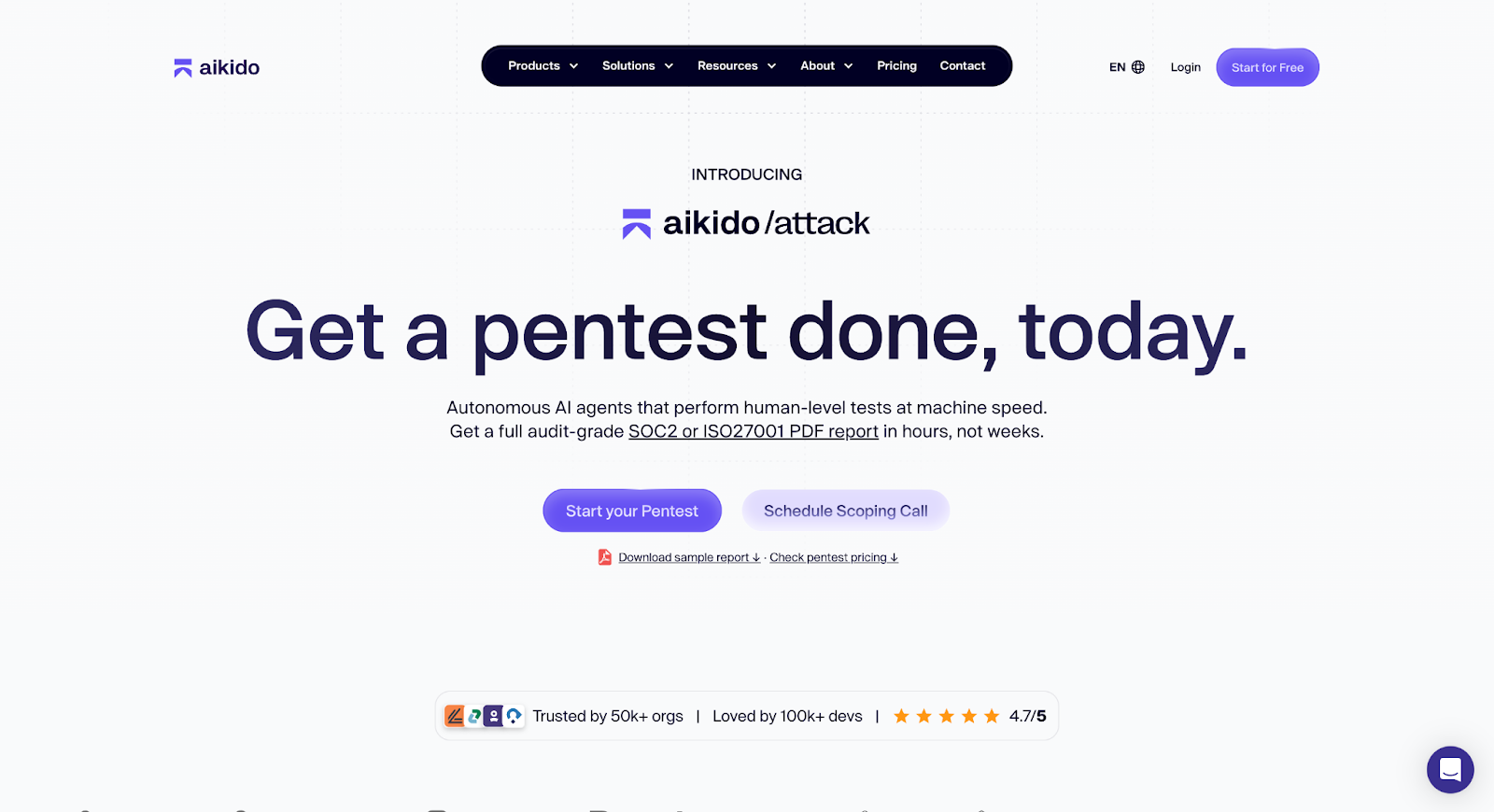
Aikido Infinite runs AI pentesting continuously so teams shipping weekly or faster can validate new code as it ships. Aikido Infinite continuously reduces exploitable risk at every software release by automatically testing applications, validating findings, and fixing issues as part of the software lifecycle.
Infinite is the continuous version of Aikido's AI Pentesting, which deploys hundreds of autonomous agents that simulate attacks like real hackers, discovering and exploiting flaws across your apps, APIs and infrastructure. It connects vulnerabilities in applications and APIs into real attack graphs, so you see how an exploit actually unfolds from entry to compromise. Its tests run whitebox by default, and findings are validated against a live system with proof-of-concept and reproduction steps. Built-in retesting features allow your team to validate whether security fixes have successfully resolved.
In phpBB, the agents uncovered a critical authentication bypass hiding since 2014, where one unauthenticated request could take over any account up to admin. In NodeBB, a whitebox test found eight high-severity flaws in about six hours, including an admin authorization bypass and a spoof exposing users' private messages.
Tyro payments adopted Aikido for AI pentesting after a test that saw Aikido's AI pentest beat their usual human pentest, ~5.5 hours vs ~15 days, finding 30 issues (9 high) vs 5 issues (1 high).
Independent testing backs this up. Doyensec, a boutique security research firm, benchmarked Aikido against XBOW at the same $4,000 price tier across two open-source applications picked at random, validating every finding by hand. Aikido surfaced 49 verified vulnerabilities to XBOW's 31, with nine high or critical against five, and was running on both apps in under 20 minutes. You can read the full Doyensec report here.
Aikido Pentesting ensures scope enforcement in a number of ways. First, it separates the control plane that plans and reasons about the pentest from the isolated sandbox where agents actually execute, and each agent operates in its own sandbox with no access to orchestration secrets or other sessions. Agents can only interact with explicitly configured domains, never production unless it's deliberately set as in-scope, and they have no open internet access, which mitigates prompt injection and data exfiltration. All requests are rate-limited and load-aware, so tests don't overwhelm target systems or trigger a barrage of alerts.
Every finding ships with proof-of-concept and reproduction steps, and reports map to what auditors expect for SOC 2 and ISO 27001, including a full log of every request and action taken during the test. RBAC and SSO let enterprise teams manage who can run tests against which assets, with audit trails across the platform. Testing runs across teams without loosening control over scope or access.
For teams in regulated industries and anyone with strict data residency requirements, Aikido Machine runs continuous AI pentesting entirely inside your own network, with no internet connection required.
Features:
- Continuous AI pentesting: Aikido Infinite directs follow-up testing at relevant application changes.
- Validated findings: Agents attack the scoped, running application and return exploitation evidence.
- Developer remediation: Findings carry reproduction details and guidance for investigating and fixing the issue.
- Finding retests: Request verification after deploying a repair to the assessment environment.
- Adoption alongside existing tools: Add pentesting without moving the rest of your security stack to Aikido Security.
See the continuous-testing setup and how finding retests work.
Can Aikido Security fit into our existing security workflow?
Yes. You can keep your current static analysis and dependency tools, along with the rest of your security stack, while adding Aikido pentesting. Continuous testing has its own setup requirements, which include a completed initial assessment, connected repositories, permission to manage pentests, sufficient credits, and a configured testing cadence. None of them involve replacing your existing tools or adopting every Aikido Security product.
Pros:
- Enterprise grade Agentic pentesting
- Developer friendly UX
- Centralized reporting and compliance templates
- Mobile and binary scanning support (APK/IPA, hybrid apps).
- Predictable pricing
- Broad language support
- AI-powered filtering
- Cross-platform support
Continuous pentesting approach:
Aikido Security’s continuous pentesting approach continuously simulates attacker workflows across the SDLC without disrupting development. It offers teams auto-remediation, AI-powered vulnerability correlation, and audit-ready reporting for all identified vulnerabilities.
Gartner Rating: 4.9/5.0
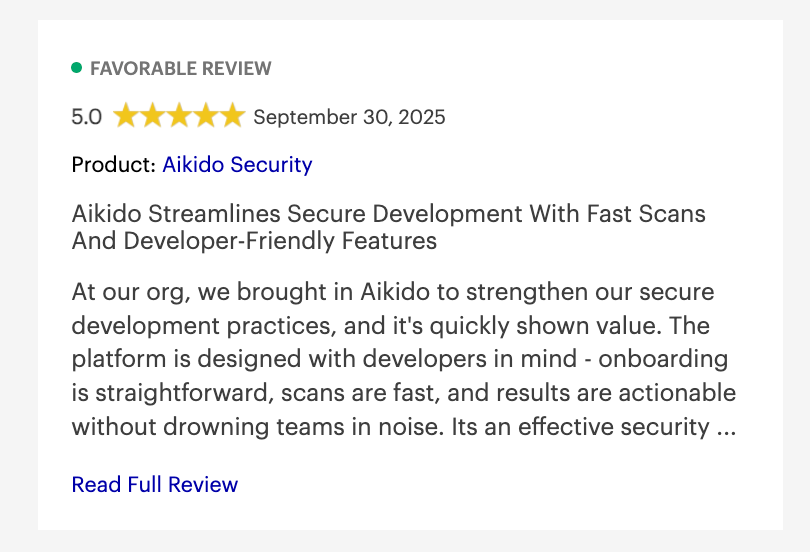
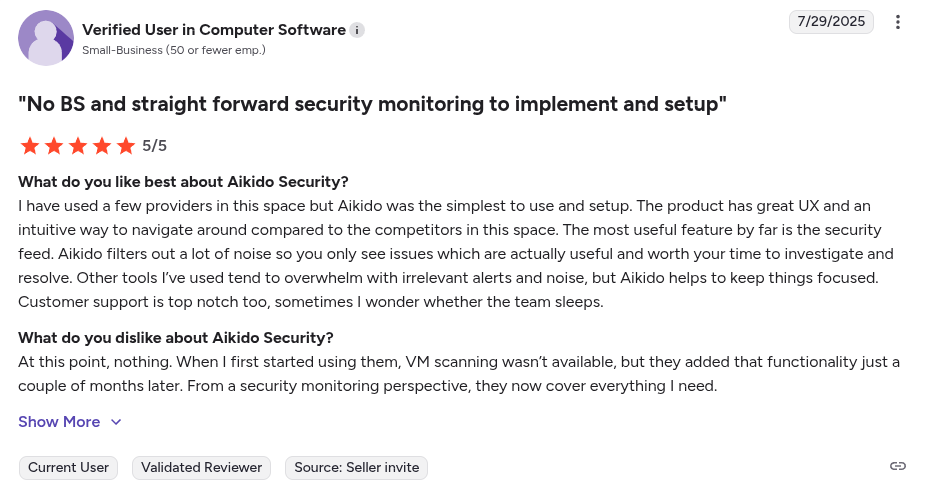
Aikido Security Reviews:
Beyond Gartner, Aikido Security also has a rating of 4.7/5 on Capterra, Getapp and SourceForge
2. CodeAnt AI
CodeAnt AI pairs SAST-driven defensive security with offensive penetration testing. Static analysis runs continuously across the IDE, CLI, and CI/CD as code is written and committed, and that same code intelligence feeds the offensive engine. As code changes, the platform re-runs testing, validates risks like IDOR, privilege escalation, JWT manipulation, and business logic flaws, and combines findings into exploit chains. External reconnaissance covers subdomain enumeration, CT log queries, cloud asset discovery, and port scanning, while deeper analysis includes JavaScript bundle inspection and source code dataflow tracing. Engagements include proof-of-exploit, unlimited retests, and a SOC 2-ready evidence package. However, reviewers note excessive false positives, a steep learning curve, and a frustrating UI.
Features:
- Authenticated validation: Validates real risks including IDOR, privilege escalation, JWT manipulation, and business logic flaws.
- External Reconnaissance: Covers subdomain enumeration, CT log queries, cloud asset discovery, and port scanning, plus JavaScript bundle inspection and dataflow tracing.
- Retests and audit evidence: Every engagement includes unlimited retests and a complete SOC 2-ready evidence package.
Pros:
- Proof-of-exploit on validated findings, not just alerts
- Broad language support (30+)
- SOC 2-ready evidence package
Cons:
- High false positives
- Steep learning curve
- Newer to the offensive testing market than established PTaaS vendors
- Strongest when connected to source code, so pure black-box-only buyers see less of its edge
- Full feature set can be more than very small teams need
Continuous Pentesting Approach:
CodeAnt AI's continuous pentesting approach is built on the link between its defensive and offensive sides. Continuous SAST analysis at commit time gives the offensive engine an always-current model of the codebase, so testing reflects the application's real behavior as it changes rather than a historical snapshot. Unlimited retests automatically revalidate previously found exploit paths and confirm that fixes hold, while proof-of-exploit and a SOC 2-ready evidence package provide an ongoing, defensible record of what was tested and validated.
Pricing:
- Basic plan: $10 per user/month
- Premium plan: $20 per user/month
- Enterprise plan (including penetration testing engagements): Custom pricing, with free access for open-source projects
Gartner Rating: 4.9/5.0
CodeAnt AI Reviews:
Rated 4.9/5 on Gartner Peer Insights based on a small number of reviews; feedback highlights the value of unifying code analysis and security testing in one platform.
3. Escape
Escape is a continuous pentesting tool focused on web applications, APIs, and business logic vulnerabilities. Running on the same platform as Escape ASM and DAST, every engagement begins with a continuous model of attack surface, and its AI agents get more expert in your business each time they run. It's aimed at security teams at mid-to-large organizations, typically lean AppSec or offensive-security teams covering frequent releases across complex, multi-repo, multi-environment stacks. Cloud or on-prem (hybrid) deployment means even internal applications can be tested without granting external consultants access. Its scope is entirely focused on web applications and APIs rather than internal network or infrastructure, and teams generally adopt it to move from periodic manual pentests toward continuous testing. However, reviews note a steep learning curve and limited features.
Features:
- Multi-agent exploit-path reasoning & intelligent memory: A team of AI agents works together to chain vulnerabilities into real attack paths, adapting each move based on what they find, and it remembers what matters across engagements (user roles, access levels, and which service handles what).
- Continuous testing & regression coverage: Turns previous findings or uploaded findings from manual pentests or bug bounty programs into automated tests that re-run on every build in combination with Escape DAST, so the same issue doesn't reappear, and you get the repeatable, documented assessments that PCI DSS, SOC 2, and ISO 27001 expect.
- Support for complex authentication & multi-user testing: Handles MFA, SSO, OAuth, SAML, and multi-user/multi-tenant scenarios natively
- Proof of exploit + framework-tailored fixes: Every finding ships with the exact request chain, visual evidence, and stack-specific remediation code (e.g. Node.js APIs, GraphQL services), so security teams and engineers can easily verify exploitability and move on to fixing.
- GraphQL- and API-native: Purpose-built for modern APIs and SPAs, sending context-aware queries.
Best for:
- Mid-to-large teams with mature security teams shipping frequently across complex, distributed stacks
- Especially API- and GraphQL-heavy teams looking to bake continuous, automated testing into their engineering workflows
Cons:
- Steep learning curve
- Unfriendly UI
Customer reviews:
As one G2 reviewer said: “The tool excels in detecting a wide range of API vulnerabilities, including business logic flaws often missed by other solutions.” Another pointed out: “Escape also has an awesome support team who work really hard to provide you with the best product they can.”
Pricing:
- Escape’s pricing is not publicly listed and is typically provided upon request.
- No free tier or self-serve trial; demo-led evaluation
Compare Aikido and Escape for continuous AI pentesting.
4. Hadrian
Hadrian is an autonomous continuous pentesting security platform that uses AI agents to perform reconnaissance, vulnerability discovery, and exploitation simulation on external attack surfaces in real time.
Features:
- Autonomous Agents: Hadrian uses AI models trained by expert pentesters to mimic real attacker thought processes and TTPs (Tactics, Techniques, and Procedures).
- Automated Attack Surface Management (ASM): Continuously scans domains, assets, subdomains, cloud services, and exposed interfaces.
- Integrations: Provides API-based integrations for ticketing tools and development workflows
Pros:
- Agentless setup
- Event-based pentests
Cons:
- Less suited for internal pentesting
- Primarily enterprise focused
- Its initial scans can be slow
- Users have reported gaps in its documentation
- Users have reported performing additional tuning to reduce noise
Continuous pentesting approach:
Hadrian continuously discovers new or changed external assets with its continuous attack surface management tool, and automatically runs AI-driven pentests against them, validating exploitable paths and updating findings in real time.
Pricing:
Custom pricing
Gartner rating:
No Gartner review
Hadrian reviews:
No independent user generated review.
5. Cobalt
Cobalt is a continuous pentesting platform that allows development teams to spin up pentests on demand, as soon as code changes or new releases occur, and provides access to a vetted community of pentesters.
Features:
- Comprehensive and Agile Testing: Teams can request full‑scope pentests or smaller, focused ones, targeting changes, new releases, or recent code updates.
- Collaboration Support: It provides a dashboard for findings, reports, retests, and communications.
- Integration: Integrates with common developers and issue‑tracking tools ,and supports API‑based workflows.
Pros:
- Attack surface management
- Strong customer support
Cons:
- Pricing can become expensive
- Lacks automated remediation
- Users have reported its API integration as lacking when compared to other solution
- Limited filtering and report export features
Continuous Pentesting Approach:
Cobalt’s continuous pentesting approach lets development teams trigger targeted pentests at every major code update or deployment. And offers a vetted community of pentesters for more comprehensive pentests
Pricing:
Custom Pricing
Gartner Rating: 4.5/5.0
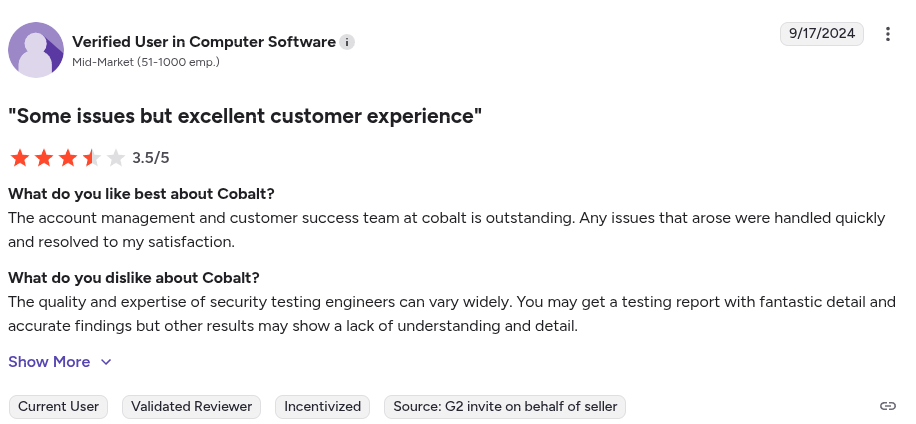
Cobalt Reviews:
6. Evolve Security
Evolve Security is a security platform that provides continuous penetration testing as a managed service (PTaaS). It is primarily known for its proprietary continuous pentesting platform, “Darwin Attack”.
Key Features:
- Collaboration Portal: Its Darwin Attack platform serves as a central hub for communication between a client's team and pentesters
- Risk Acceptance: It allows teams to mark specific, low-risk vulnerabilities as "risk accepted" preventing the same issue from being re-evaluated in future assessments.
Pros:
- Context-Aware records
- Supports common CI/CD platforms
- Strong customer support
Cons:
- High alert volume
- Steep learning curve
- Initial setup and configuration is complex
- Lacks automated remediation features
- Users have reported it as feeling more like a vulnerability scanner than a pentesting tool
Continuous pentesting approach:
Evolve Security’s continuous pentesting approach combines automated monitoring with human expertise. It constantly maps external attack surfaces to detect changes, and prompts pentesters to investigate and validate high‑impact findings.
Pricing:
Custom pricing
Gartner rating: 4.1/5.0
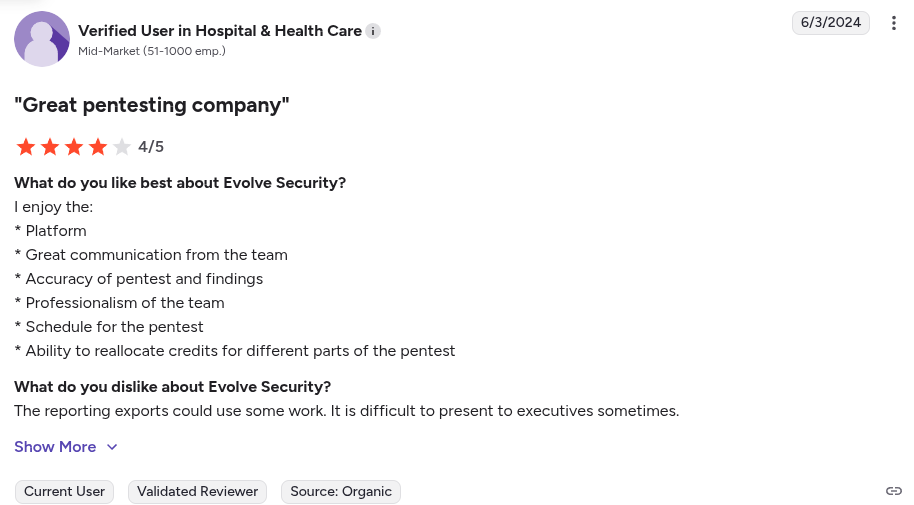
Evolve Security reviews:
7. BreachLock
BreachLock is a continuous security testing platform that uses automation scanners and expert pentesters to help organizations identify vulnerabilities across their systems.
Features
- Attack Surface Management (ASM): BreachLock continuously discovers and maps both internal and external internet-facing assets.
- Integration: Its findings can be fed into common issue trackers and CI/CD platforms
- Hybrid Testing Model: It combines AI-powered automation with certified human experts to detect complex business logic flaws and validate all findings.
Pros:
- Broad coverage
- Clear Remediation Guidance
- Compliance support
Cons:
- False positives
- It can be expensive when scaling
- It can be difficult to track attack surface monitoring findings
- Users have reported its interface as slow and clunky
- Users have reported limited customization options for reports
Continuous pentesting approach:
BreachLock’s continuous penetration testing approach combines automated monitoring and human-led validation to perform ongoing context-aware pentests of web applications, APIs, and cloud assets
Pricing:
Custom pricing
Gartner rating: 4.6/5.0
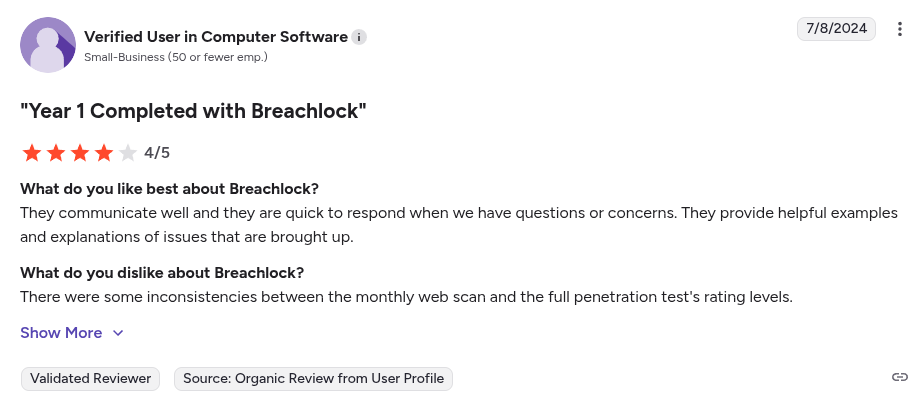
BreachLock reviews:
8. Terra Security
Terra Security is an agentic-AI powered continuous penetration-testing platform (PTaaS). It combines specialized AI agents with expert pentesters to run continuous, context-aware web application and API penetration tests.
Key Features:
- Agentic AI Swarm: Terra Security uses specialized AI agents that are designed to think and act like human ethical hackers to autonomously explore and test applications.
- Change-Based Testing: Its scans are triggered by events like deployments, code modifications, or new endpoints
Pros:
- Context-Aware tests
- Actionable remediation insights
Cons:
- Steep learning curve
- Primarily enterprise focused
- Limited scope beyond web applications
- It is a relatively new platform
Continuous Pentesting Approach:
Terra Security's continuous penetration testing approach uses a hybrid model of agentic AI and human expertise to provide real-time, context-aware web-application pentests.
Pricing:
Custom pricing
Gartner Rating:
No Gartner review
Terra Security Reviews:
No independent user generated review.
Comparing the best 8 continuous pentesting tools
To help you compare the capabilities of the continuous pentesting tools above, the table below summarizes each tool's strengths and limitations along with their ideal use case.
Conclusion
Continuous pentesting is becoming essential because static security testing no longer matches dynamic systems.
The future of penetration testing is not simply faster or cheaper assessments. It is continuous, context-aware validation of how applications behave under real attacker pressure.
By combining AI pentesting with continuous execution, platforms like Aikido Security enable security teams to move from snapshot-based assurance to ongoing understanding of risk.
Want less noise and more real protection? Start your free trial or book a demo with Aikido Security today.
FAQ
Why is continuous pentesting becoming important in modern cybersecurity?
Continuous pentesting helps teams keep up with constantly changing cloud environments, shifting attack surfaces, and rapid deployment cycles. Instead of waiting for quarterly tests, organizations get ongoing validation, real-time detection of exploitable risks, and faster remediation loops.
Modern platforms like Aikido Security make this process automatic and developer-friendly so security testing happens continuously without slowing engineering teams down.
What are the common challenges faced during continuous pentesting?
Teams often struggle with high false-positive rates, incomplete coverage, environment drift, production safety concerns, and the operational overhead of managing multiple tools. There’s also the issue of prioritizing which findings truly matter. Solutions like Aikido Security address this by using its AI engine to correlate findings, reducing noise, and focusing on truly exploitable vulnerabilities so teams work on the highest-priority issues first.
What is the difference between AI penetration testing and continuous penetration testing?
Both approaches use AI. AI penetration testing focuses on automating tasks traditionally performed by human pentesters to make individual tests more efficient and thorough. Continuous pentesting on the other hand, goes further by automating the frequency of tests, allowing organizations to continuously assess their security posture and remain secure at all times.
How do continuous pentesting tools integrate with DevOps or CI/CD pipelines?
They plug into pipelines as automated steps that run pre-merge, post-deploy, or on a scheduled basis. Results are then pushed directly into pull requests, issue trackers, or dashboards so developers can remediate within their existing workflows. Platforms like Aikido Security are designed around this workflow-first approach, offering CI/CD integrations, API triggers, and automated gating for high-risk vulnerabilities.
How do open-source continuous pentesting tools compare to commercial ones?
Open-source continuous pentesting tools offer flexibility and lower cost but require more manual configuration, tuning, and maintenance. Commercial platforms on the other hand typically provide stronger automation, deeper attack simulation, better reporting, and a cleaner developer experience. Many teams combine both approaches, using open-source tools for specific checks while relying on commercial solutions like Aikido Security for risk correlation, automation, and noise reduction.
What metrics and reports do top continuous pentesting tools provide to track vulnerabilities?
Common metrics include vulnerability counts by severity, exploitability, asset coverage, MTTR (mean time to remediate), and trend lines for new and resolved findings. Robust platforms also provide remediation guidance, compliance-ready reports, and attack-path visualizations. Tools like Aikido Security surface these insights in streamlined dashboards and development workflow so teams can track their threat landscape and prioritize effectively.
You Might Also Like:


