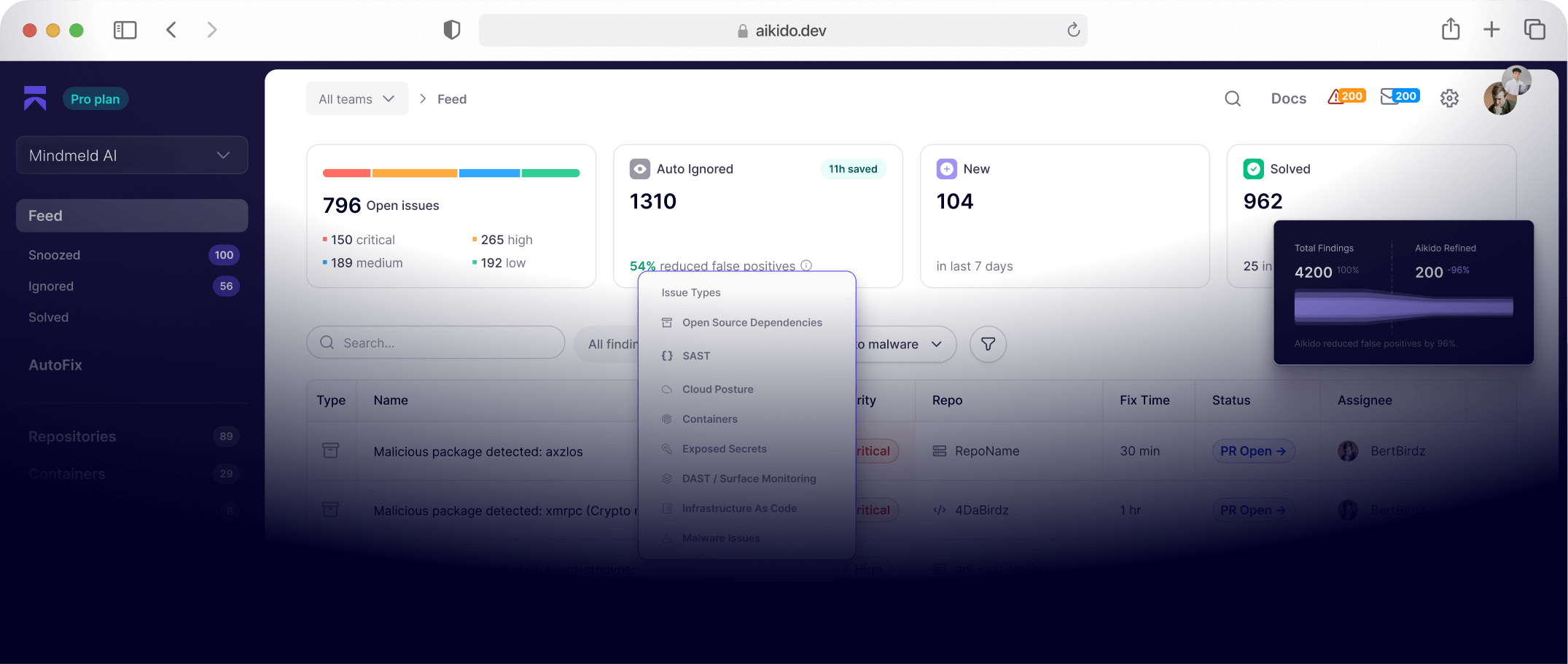
Graphite.dev (also known as Graphite) is an AI-powered code review tool designed to improve developer productivity by managing code review changes. Developers use Graphite for its ability to handle stacked “diffs” as well as traditional pull requests, allowing large changes to be broken down into smaller, logical updates.
However, despite these strengths, many developers are beginning to re-evaluate Graphite. Its limited cross-platform support, surface-level analysis, tendency to cause branch drift, lack of compliance features, and limited security capabilities, just to list a few, create friction for teams, especially as they scale.
With these limitations in mind, it is important to understand which tools can fill the gaps Graphite leaves behind.
In this guide, we explore the top Graphite alternatives for AI code review and provide in-depth comparisons to help you choose the tools that best meet your team’s needs, whether you’re a startup or an enterprise.
TL;DR
Aikido Security stands out as the top Graphite alternative thanks to its deeper analysis, stronger security insight, and flexible AI-powered code review engine. While Graphite focuses primarily on managing stacked changes and providing surface-level review assistance, Aikido Security delivers a full semantic analysis engine designed to understand code behavior, context, and exploitability.
Aikido Security performs AI-powered static analysis to reduce false positives, and correlate findings across files to identify exploitable vulnerabilities. This allows developers to focus on issues that truly matter instead of sorting through alerts.
Teams can start with Aikido Security's AI code review platform, Aikido Security Code Quality, and integrate its other modules for SAST, SCA, secrets scanning, IaC analysis, and DAST as they scale.
Across pilots and evaluations, Aikido Security consistently performs better when teams compare depth of analysis, onboarding speed, and overall signal-to-noise ratio.
Comparison Between Graphite and Aikido Security
What is Graphite?
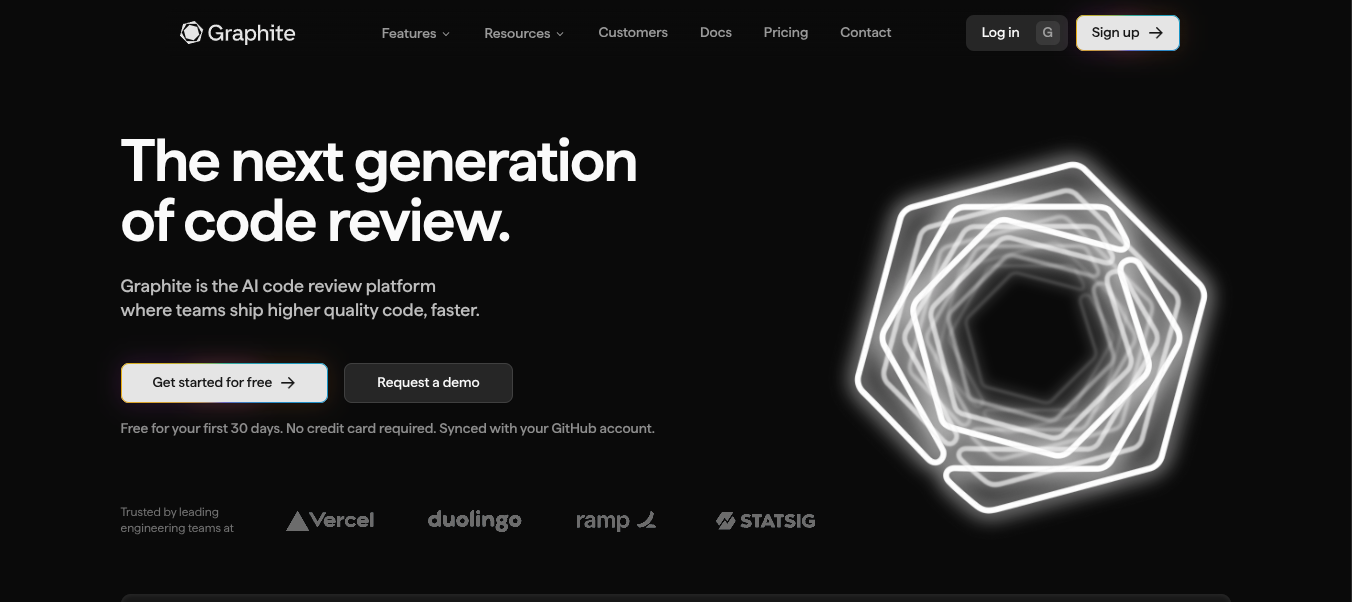
Graphite is an AI-powered code review tool built to simplify pull requests and team collaboration. Its key features include:
- Stacked Pull Requests: Lets developers break large, complex changes into smaller, manageable updates.
- AI-Powered Code Suggestions: Provides context-aware suggestions.
- Improved Code Quality: Automates review suggestions to reduce errors and speed up merges.
- Optimized for Teams: Supports collaborative workflows and consistent review practices.
Cursor Acquires Graphite
In December 2025, Graphite signed a definitive agreement to join Cursor, in a move to build an end-to-end platform for developing software with AI.
“This transaction is subject to customary closing conditions. We anticipate closing in the next few weeks, and until then, it’s business-as-usual.” — CEO, Graphite
For now, Graphite will continue to operate as an independent product and brand, while the two companies work on deepening technical integrations between Cursor’s AI-powered coding tools and Graphite’s code review and merge workflows.
As the integration progresses over the next few weeks and months, you can expect:
- Tighter integrations between Cursor and Graphite, streamlining code generation, review, and collaboration
- Improved performance and accuracy across Graphite’s AI features, driven by Cursor’s underlying AI infrastructure
Why Look for Alternatives?
Even with Graphite’s capabilities, teams often run into these friction points:
- Cursor Acquisition: Graphite’s acquisition by Cursor may lead to tighter ecosystem integration, potential pricing changes, and increased dependency on the Cursor toolchain over time.
- Continuous Integration (CI) Cost: Graphite’s stacked PR model can lead to increased CI expenses, as each pull request in a large stack may trigger its own CI run.
- Limited Platform Support: It is Primarily designed for the GitHub ecosystem.
- Surface-Level AI Analysis: While Graphite provides AI-assisted code reviews, users have reported its analysis as surface-level and restricted to the current diff rather than the entire codebase.
- Limited Security Coverage: Lacks deep vulnerability scanning (SAST), SBOM generation, and dependency/supply-chain checks.
- Lacks Compliance Support: Graphite does not offer built-in compliance mapping or governance features.
- Workflow Bottlenecks: If developers don't follow a structured, sequential process and an upstream PR in a stack changes or is re-stacked, it can lead to "branch drift" requiring multiple rebases.
Key Criteria for Choosing an Alternative
When evaluating Graphite’s alternatives you should keep these key criteria in mind:
- Integration: Does it integrate into your existing workflow; IDE, source control, CI/CD pipelines? Look for tools with minimal integration friction.
- Context-aware Risk Prioritization: How frequent are its false positives? Does it use AI to correlate risks and their reachability? Platforms like Aikido Security use AI to filter out over 90% of false positives.
- Compliance Support: Does it support common standards like NIST, SOC 2, PCI DSS and DORA?.
- Pricing: Is the pricing model transparent and predictable? Can you predict how much it will cost your team in the next 3 months?.
- Policy Enforcement: Can you create custom rules, quality gates, and enforceable policies (e.g., block merges, require fixes)? Look for tools that support policy-as-code.
- Security coverage: Does the tool combine code-quality checks with security scans?
- Scalability: Is it optimized for large repositories? Does its performance drop when handling complex codebases?
- Developer-Friendly UX: Does it provide clear remediation guidance and features, such as AI autofix, IDE plugins, inline PR comments?
Top 6 Alternatives to Graphite
1. Aikido Security
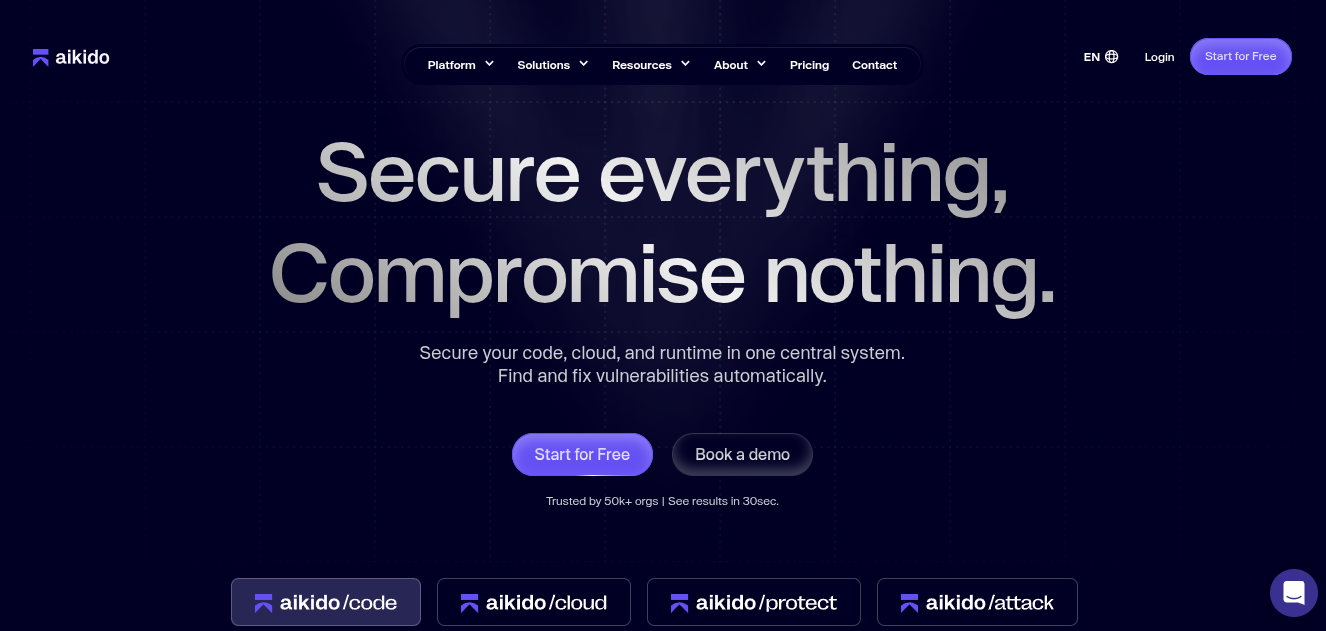
Aikido Security is an AI code review tool designed to help teams identify, prioritize, and fix issues and vulnerabilities across their codebase.
It integrates seamlessly into your existing workflows, including version control, PRs, CI/CD pipelines, and IDEs, ensuring your code is reviewed at every stage of the Software Development Lifecycle (SDLC).
Developers get everything they need to maintain high-quality, secure code, including:
- Instant, context-aware feedback in pull requests
- Adaptive learning that understands your codebase and improves with each review
- Custom rule definitions tailored to team or project standards
- Deep code context analysis to prioritize exploitable issues
Aikido Security also generates audit-ready reports for compliance and security standards, such as SOC 2 and ISO 27001, helping teams maintain governance while improving code quality and security.
As a result, developers receive only high-severity, actionable notifications, reducing noise and unnecessary context switching.
Key Features:
- Codebase-Aware Rule Generation: Aikido Security learns from your team’s past PRs and review patterns, turning “tribal knowledge” into reusable rules
- Data Privacy: Aikido Security does not use your source code to train its LLMs or store it after analysis.
- AI-Driven Static Code Analysis (SAST): Performs AI assisted scans of repositories for vulnerabilities, misconfigurations, and code quality issues.
- Business-logic awareness via LLMs: Aikido Security leverages LLMs to understand intent and context. It can flag “good-looking” code that compiles fine but could break production.
- Custom rules: Allows teams to define custom rules based on their "tribal" knowledge and coding standards.
- Secrets Detection: Identifies hardcoded credentials or API keys before they reach production.
- Compliance Monitoring: Automates SOC 2, GDPR, HIPAA, and other compliance frameworks with updated, exportable compliance reports. Suitable for teams working in highly regulated industries.
- Open Source Dependency Scanning: Identifies vulnerable open-source components, and risky licenses.
- Developer-Centric UX: Provides Instant AI powered feedback in PRs and IDEs, real-time feedback via IDE plugins, AI-powered autofix, and AI-powered remediation workflows.
- Attack path analysis: Uses its AI engine to correlate vulnerabilities, validate exploitability, prioritize real attack paths, and generate exploit proofs
Pros:
- Optimized for large repositories
- Supports custom rules
- Developer-friendly UX
- Cross-platform support (GitHub, GitLab, Bitbucket, Jenkins etc.)
- Broad language support
- Strong compliance features
- Predictable pricing
Pricing:
- Developer (Free Forever): Suited for small teams up to 2 users. Includes 10 repos, 2 container images, 1 domain, and 1 cloud account.
- Basic: Starting from $300/month for 10 users. Includes support for 10 repos, 25 container images, 5 domains and 3 cloud accounts.
- Pro: Ideal for mid-sized teams. Supports 250 repos, 50 container images, 15 domains, and 20 cloud accounts.
- Advanced: Includes 500 repos, 100 container images, 20 domains, 20 cloud accounts, and 10 VMs.
Offers are also available for startups (at a 30% discount) and enterprises
Why Choose It:
Aikido Security is ideal for startups and enterprises seeking precise, context-aware AI code review at every stage of the SDLC without added complexity. As a Graphite alternative, it offers customizable rules, semantic code review, and real-time performance insights, allowing developers to focus on truly exploitable issues.
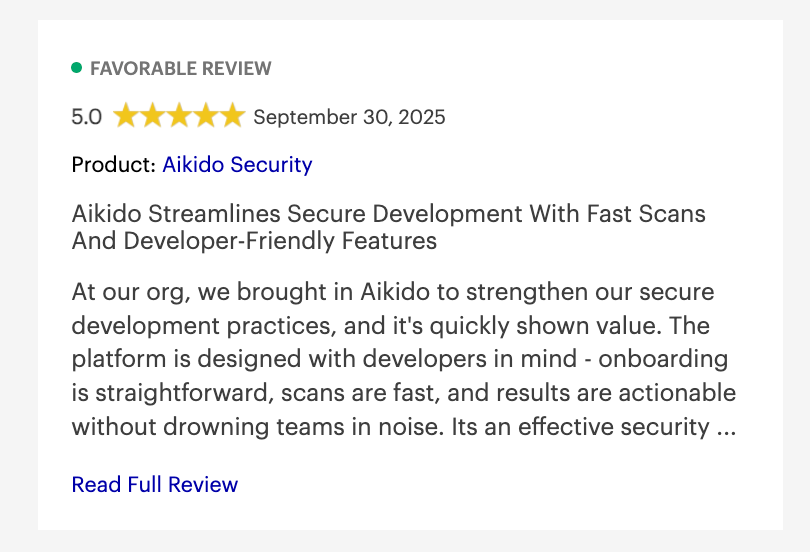
Gartner Rating: 4.9/5.0
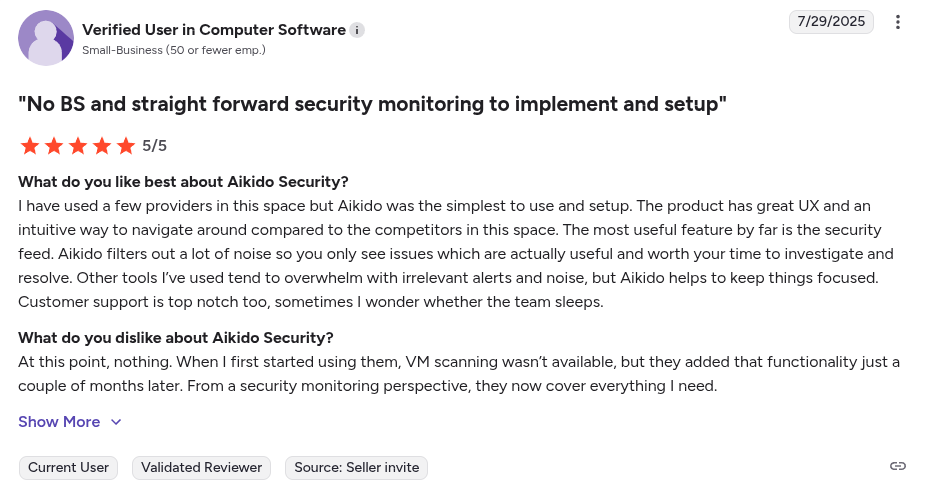
Aikido Security Reviews:
Beyond Gartner, Aikido Security also has a rating of 4.7/5 on Capterra, Getapp and SourceForge
2. CodeRabbit

CodeRabbit simplifies code reviews by automating large parts of the pull-request review workflow. It generates context-aware comments, summaries, and fixes.
Key Features:
- Context-Aware Reviews: CodeRabbit analyzes the entire codebase and architectural context, not just the changed files (diffs).
- Flow Visualization: It can generate sequence diagrams for complex code changes.
Pros:
- Broad language support
- Context-aware Suggestions
- Integrates with Git workflows and IDEs like VS Code
Cons:
- False positives
- Steep learning curve for advanced customization
- Users have reported slow performance dues to its LLM’s context window
- Users have reported performance issues in large repositories and complex PRs
Pricing:
- Free
- Lite: $15 per month/developer
- Pro: $30 per month/developer
- Enterprise: Custom pricing
Why Choose It:
CodeRabbit is ideal for teams prioritizing speed in their code review process. As a Graphite alternative, it focuses on the rapid identification of potential issues. While it may not offer the structured, in-depth analysis of stacked PRs, CodeRabbit is perfect for lightweight checks.
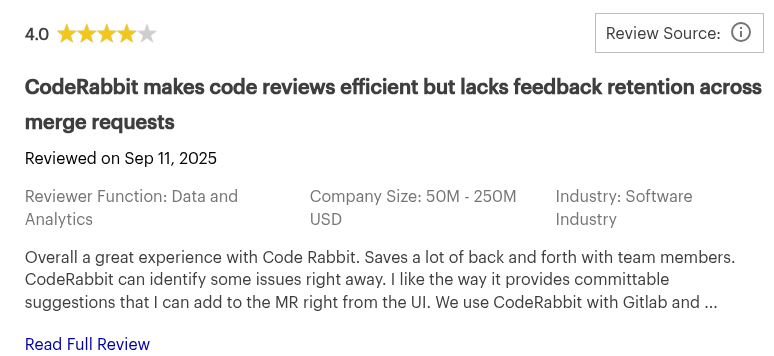
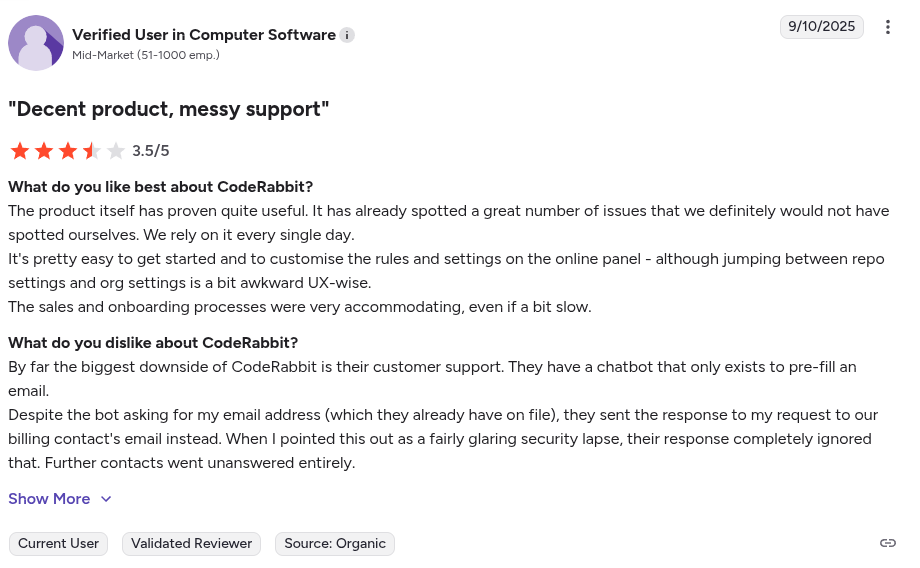
Gartner Rating: 4.0/5.0
CodeRabbit Reviews:
Also curious about CodeRabbit alternatives? Check out our article on the Top 7 CodeRabbit Alternatives for AI Code Review in 2026
3. CodeAnt AI
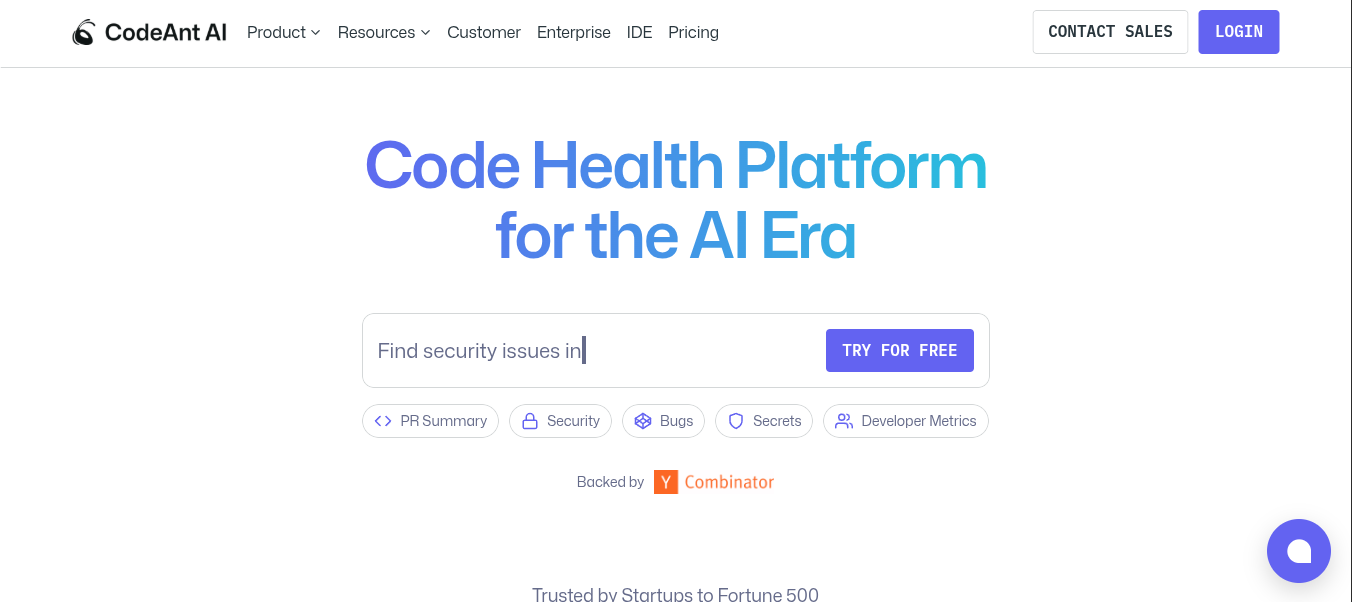
CodeAnt AI is an AI-powered code health platform used to detect, fix, and optimize code efficiently. It allows teams to define custom rules that match their teams coding standards. Developers primarily use it because of its understanding of abstract syntax trees (ASTs).
Key Features:
- Customizable Policies: Allows teams to input and enforce custom, team-specific best practices and rules.
- Integration: Integrates seamlessly with common CI/CD platforms
- Automated Documentation: Automatically generates documentation for the entire codebase.
Pros:
- Built-in security features
- Automatic PR summaries
- Automated documentation
Cons:
- False positives
- Learning curve
- It is a relatively new tool
- May require additional configuration
- Performance may degrade with very large repositories
- Users have reported customer support response times
Pricing:
- Basic plan: $12 per user/month
- Premium plan: $25 per user/month
- Enterprise plan: Custom pricing
Why Choose It:
CodeAnt AI is ideal for teams prioritizing speed, customizable rules and lightweight, automated policy enforcement. As a Graphite alternative, it provides quick feedback to catch issues early and streamline the review process.
Gartner Rating:
No Gartner review.
CodeAnt AI Reviews:
No independent user generated review.
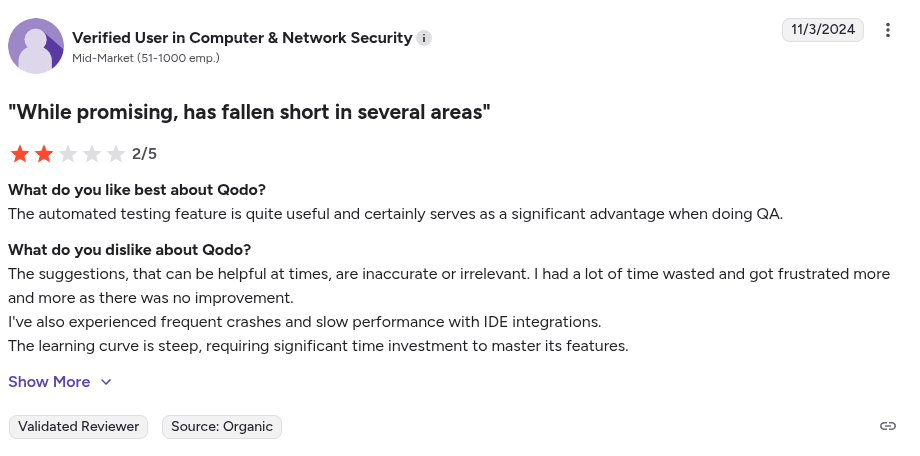
4. Qodo Merge (Formerly Codium AI)

Qodo Merge (formerly Codium AI) now part of Qodo, is an AI-driven code integrity and review platform. It automates code reviews, generates tests, and enforces team standards across the development lifecycle.
Key Features:
- Automated Test Generation: Generate unit tests, suggest coverage improvements.
- Multi-Agent Framework: Qodo is uses specialized agents for the various aspect of code reviews
Pros:
- Context-aware analysis
- Broad language support
Cons:
- False positives
- Learning curve
- May struggle with legacy codebases
- users have reported its User interface (UI) as overwhelming and cluttered.
- May struggle with complex business logic and architectures
Pricing:
- Developer: Free
- Teams: $19 per user/month
- Enterprise: Custom pricing
Why Choose It:
Qodo Merge is ideal for teams that want to enforce coding standards automatically while offering context-aware guidance. As a Graphite alternative, it provides richer rule-based controls and compliance features for teams that need more structured oversight.
Gartner Rating: 4.5/5.0
Qodo Merge(Formerly Codium AI) Reviews:
5. GitHub Copilot
GitHub Copilot is GitHub’s AI coding assistant designed to help developers by generating code snippets, offering explanations, and automating repetitive tasks.
Key Features:
- Broad Language Support: Supports a wide range of programming languages such as Python, JavaScript and Go.
- GitHub Ecosystem Integration: Integrates seamlessly with GitHub workflows.
Pros:
- Context-aware suggestions
- Zero Setup for GitHub users
Cons:
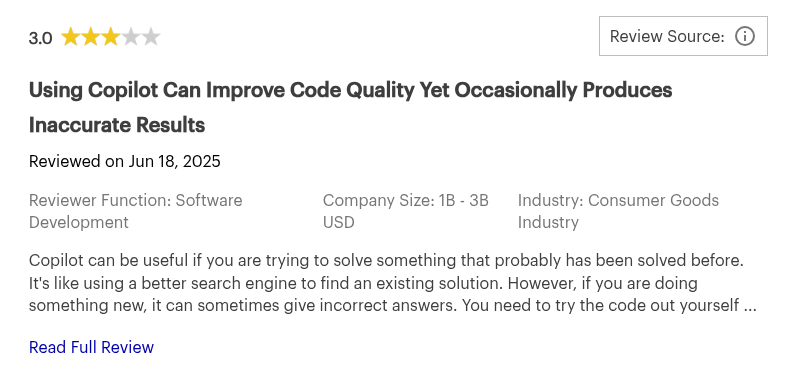
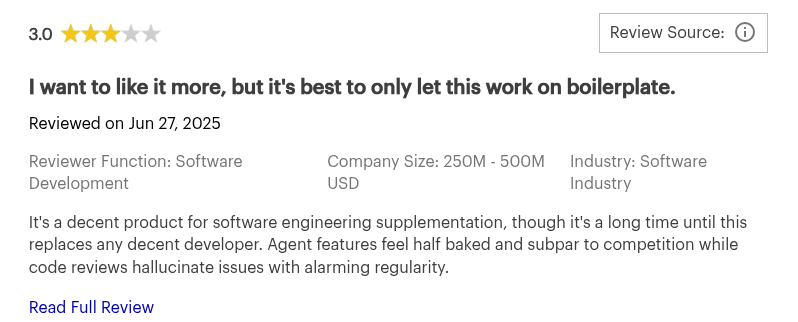
- It is more of a code assistant, than an AI code review tool
- High alert volume
- False positives
- Its pricing can become expensive when scaling
- PR review and advanced customization are only available in its paid plans
- Provides boilerplate solutions
Pricing:
- Free
- Pro: $10 per user/month
- Pro +: $39 per user/month
Why Choose It:
GitHub Copilot is ideal for teams that want real-time coding assistance and in-editor guidance. As a Graphite alternative, it emphasizes code generation, inline suggestions, and workflow acceleration rather than review depth.
Gartner Rating: 4.4/5.0
GitHub Copilot Reviews:
6. Codacy
Codacy is an AI code review tool that helps teams maintain consistent quality standards by providing real-time feedback, customizable rules, and in-depth code analysis.
Key Features:
- Custom Rules: Allows teams to define specific quality thresholds and customizable rules.
- Automated Static Code Analysis: Scans source code for issues like style violations, duplication, and bugs.
Pros:
- Automated PR reviews.
- Broad language support
- Supports common CI/CD platforms
Cons:
- False Positives
- Pricing can become expensive when scaling.
- Limited Customization for Advanced Rules
- Users report slow support response
- Users report slower analysis in large codebases
Pricing:
- Developer: Free
- Team: $21 per developer/month (billed monthly)
- Business: Custom Pricing
Why Choose It:
Codacy is ideal for teams that want automated code quality enforcement across entire repositories. As a Graphite alternative, it offers project-wide analysis, customizable rules, and consistent standards enforcement across all codebases, making it a strong choice for organizations that need visibility and governance beyond individual pull requests.
Gartner Rating: 4.4/5.0
Codacy Reviews:
No independent user generated review.
Best 4 Graphite Alternatives For Small Businesses
Key Criteria For Choosing a Graphite Alternatives For Small Businesses:
- Affordability
- Simplicity
- Developer-friendly UX
- Broad threat coverage (SAST, SCA, IaC scanning)
- Cross-platform support
- Customizability (team rules, policy enforcement)
- Automation (one-click fixes, PR reviews)
Here are The Top 4 Graphite Alternatives Tailored for Small Businesses:
- Aikido Security: Developer-friendly UX, AI powered security scans and remediation, forever free tier for small teams.
- CodeRabbit: Context-aware PR reviews, one-click fixes, IDE and CI integrations,
- CodeAnt AI: AST-based static analysis, custom rules,
- Qodo merge (Formerely Codium AI): Lightweight, context-aware suggestions
Comparing Graphite Alternatives for Small Businesses
Best 3 Graphite Alternative For Enterprises
Key Criteria For Choosing a Graphite Alternative For Enterprises:
- Broad coverage (cross-file analysis, PR analysis, Full Repository scans)
- Actionable remediation guidance
- Strong CI/CD and IDE integrations
- Built-in security and code quality checks
- Enterprise-grade reporting and compliance
- Optimized for large monorepos and teams
Here are the Top 3 Graphite Alternatives tailored for Enterprises:
- Aikido Security: Full-spectrum AI code review, automated SAST/SCA checks, actionable remediation, plug-and-play SaaS.
- GitHub Copilot: Contextual AI code completions, native GitHub support
- Codacy: Automated static code analysis, detailed compliance reporting, broad language support.
Comparing Graphite Alternatives for Enterprises
Choosing your Ideal AI Code Review Solution
Graphite is a good option for managing pull requests and stacked diffs, but as teams scale, its limitations become more apparent, from its limited surface-level analysis, to lack of cross-platform support, to lack of compliance features and much more.
Aikido Security addresses Graphites gaps with its AI-powered code review engine, delivering context-aware analysis, actionable insights, and one-click fixes directly within developer workflows. Allowing teams to perform faster and more secure code reviews.
Want faster reviews and cleaner code? Start your free trial or book a demo with Aikido Security today.
FAQ
How do Graphite alternatives compare regarding integration with popular CI/CD pipelines?
Most Graphite alternatives offer integration with major CI/CD systems like GitHub Actions, GitLab CI, Jenkins, and Bitbucket Pipelines. Tools like Aikido Security provide seamless integration with CI/CD pipelines, enabling automated checks, code quality feedback, and security scans at each stage of development. Other tools may require additional setup or lack full pipeline coverage.
How do different Graphite alternatives handle scalability and performance in large applications?
Scalability varies by platform. Some tools may struggle with very large repositories, causing slower analysis times or requiring more manual configuration. Enterprise-grade alternatives, such as Aikido Security, are designed to handle large monorepos and high-volume projects efficiently, providing parallelized analysis and performance optimizations.
Why do developers use feature flag management tools like Graphite?
Developers use feature flag tools to deploy code safely without immediately exposing features to all users. These tools allow teams to gradually roll out new functionality and monitor its impact, conduct A/B testing and experimentation, and quickly disable problematic features without redeploying. Overall, feature flag platforms help teams release faster while reducing risk, particularly in continuous delivery environments.
What are the best alternatives to Graphite for feature flag management?
The best alternatives are platforms that provide robust feature flag capabilities, including safe rollouts, experimentation, and easy integration with CI/CD pipelines. These platforms should allow teams to manage flags at scale, monitor feature performance, and quickly disable or adjust features as needed without redeploying code. For teams looking for a solution that combines feature flag management with advanced AI-driven code review and DevSecOps insights, Aikido Security is a strong option to consider.
What are common challenges when migrating from Graphite to another feature flag platform?
Migrating from Graphite can be challenging due to the need to transfer existing feature flag configurations and rollout strategies, experimentation and analytics data, and adapt CI/CD workflows to the new platform, all while minimizing disruption. Alternatives like Aikido Security helps address these challenges by providing seamless integration with existing DevOps pipelines, combining feature flag management with AI-driven code review and DevSecOps insights, allowing teams to track flag usage, monitor feature performance, and streamline the migration process.
You Might Also Like: