Introduction
GitLab Ultimate is a popular platform for DevOps that also includes integrated application security (AppSec). It offers source control, CI/CD, and built-in security tools (like SAST and DAST) under one roof. This end-to-end approach is powerful, but many teams are now looking for alternatives due to usability issues, cost, false positives, and a poor developer experience.
TL;DR
Aikido Security offers an equally comprehensive yet more effective and developer-friendly security platform than GitLab Ultimate. You get the full range of best-in-class SAST, DAST, SCA, and more in one place with far fewer false positives and easier setup, and you avoid GitLab’s steep Ultimate licensing. Aikido’s flat per-user pricing and developer-first design make it a smarter, more cost-effective choice for DevSecOps teams.
Users have reported that “for beginners its [Gitlab Ultimate's] UI feels complex and cluttered... and its premium features are costly”. Others complain about noisy scan results. One developer on Reddit noted “egregious false positives” (even “a few brackets being counted as a secret” by the scanner). Another user said “basic security features are put behind an unreasonable paywall”, reflecting frustration with GitLab’s pricing and packaging.
If you’re short on time, feel free to skip to the Top Alternatives to GitLab Ultimate for a quick overview of the tools. Below is a preview of the five alternatives we’ll cover:
- Aikido Security – Complete security platform with best-in-class coverage of the entire SDLC
- ArmorCode – Application Security Posture Management for tool aggregation and governance
- Snyk – Developer-centric SCA and container security tool
- SpectralOps – Lightweight code scanner (secrets and misconfigurations)
- Veracode – Enterprise-friendly AppSec suite for SAST/DAST and more
If you’re rethinking GitLab’s built-in security, check out our Top AppSec Tools in 2026 — a curated list of platforms built to secure your SDLC.
What Is GitLab Ultimate?
- Top-tier DevSecOps platform: GitLab Ultimate is the highest paid tier of GitLab, combining source code management, CI/CD, and security capabilities in one platform.
- Built-in security scanners: Ultimate includes integrated scanners for Static Application Security Testing (SAST), Dynamic Application Security Testing (DAST), dependency scanning (SCA), container image scanning, secret detection, and more.
- Security dashboards and management: It provides vulnerability reports and dashboards where security teams can review findings and enforce policies.
- Who it’s for: Enterprises and regulated teams that need to embed security checks into CI/CD pipelines and want out-of-the-box compliance.
Why Look for Alternatives?
Teams consider GitLab Ultimate alternatives when they encounter these pain points with its security features:
- Bloated interface & slow scans
- False positives in scans
- Limited runtime visibility – GitLab lacks integrated cloud security posture management or runtime observability.
- Confusing, opaque pricing
- Not developer-first – lacks real developer workflow integration or inline remediation.
Key Criteria for Choosing an Alternative
When evaluating GitLab Ultimate alternatives focused on AppSec, prioritize the following:
- Developer experience – IDE plugins, clear issue remediation, friendly UX
- Fast & accurate results – Avoid alert fatigue from noisy scanners
- Breadth of coverage – Support for SAST, DAST, IaC, SCA, secrets, and container security
- CI/CD integration – Works with your pipeline, not against it
- Transparent pricing – Predictable plans, no sales maze
Comparison Table
Top Alternatives to GitLab Ultimate
Based on the above needs, here are five of the best GitLab Ultimate alternatives for application security:
- Aikido Security – Complete security platform with best-in-class coverage of code, cloud, and runtime
- ArmorCode – Unified AppSec orchestration (aggregation & governance)
- Snyk – Developer-centric SCA and container security
- SpectralOps – Lightweight code scanner for secrets & misconfigs
- Veracode – Enterprise-grade AppSec suite (SAST, DAST, etc.)
Aikido Security

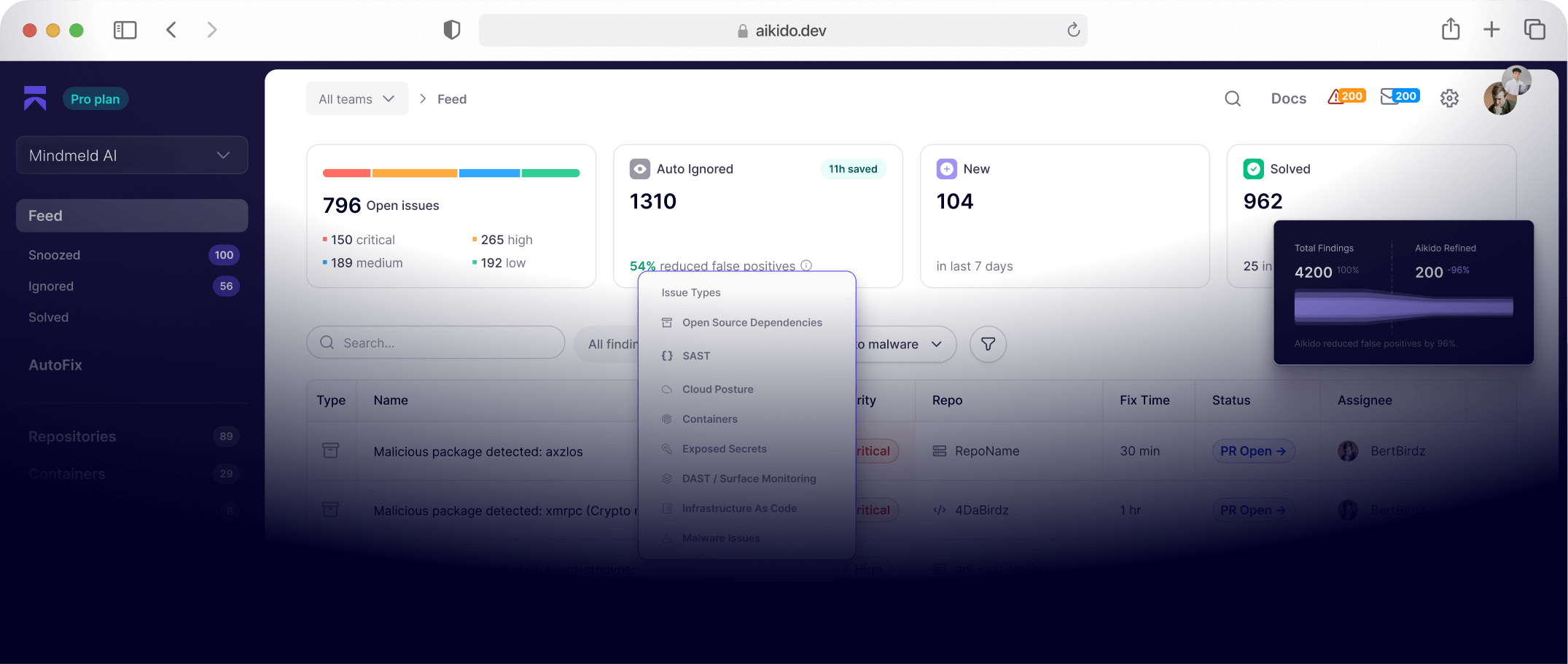
Overview: Aikido Security is a complete security platform that covers code, cloud, and runtime. It provides best-in-class products, including SAST, SCA, container and Infrastructure as Code (IaC) checks, API testing, cloud configuration scanning, and more. Aikido emphasizes accuracy and automation, using AI to reduce false positives and even offering one-click fixes for certain issues via its AI AutoFix feature.
Key Features:
- Complete platform – Best-in-class SAST, DAST, SCA, secrets detection, container and cloud scanning, covering the whole SDLC.
- AI-assisted fixes – Automated remediation via AI-powered suggestions, including merge requests.
- Developer-friendly integrations – Deep hooks into CI/CD pipelines, IDEs, Slack, and Git platforms.
Why Choose It: If your team is frustrated with GitLab Ultimate’s noise or complexity, Aikido is a strong choice. It’s ideal for teams that want comprehensive coverage of the entire SDLC but with a simpler, developer-first experience. You’ll benefit from far fewer false positives, faster triage, and more automation from code to cloud. It also offers a transparent pricing model and a free tier, making it easier to try without commitment.
ArmorCode
Overview: ArmorCode is an Application Security Posture Management (ASPM) platform focused on aggregating and orchestrating your security tools. It connects to your scanners (SAST, DAST, cloud, etc.) and centralizes all findings into one system for prioritization and governance. Unlike point scanners, it doesn’t scan code directly — it helps teams manage AppSec at scale.
Key Features:
- Unified AppSec dashboard – Aggregates SAST, DAST, cloud, and IaC scanner results across projects.
- Risk-based triage – Prioritizes alerts using business context and risk scoring.
- Automation & compliance – Streamlines workflows for policy enforcement and compliance tracking.
Why Choose It: ArmorCode is great for companies that already use multiple security tools and need a “single pane of glass” to manage them. It’s not a scanner — it’s an orchestrator. Choose it if you want better governance, visibility, and process automation on top of your existing AppSec stack, especially at enterprise scale.
Snyk
Overview: Snyk is a developer-centric security tool focused on finding vulnerabilities in open-source dependencies, container images, and IaC configs. Originally built for SCA, it has since expanded into container and IaC security, and offers SAST capabilities via Snyk Code. Its core strength lies in seamless dev workflow integrations and a huge open-source vulnerability database.
Key Features:
- Open source dependency scanning – Monitors for vulnerable packages and license issues across multiple ecosystems.
- Container and IaC scanning – Flags insecure Docker images and misconfigured Terraform, Kubernetes, and CloudFormation.
- Developer-first UX – GitHub/GitLab integration, CLI tools, and automated fix PRs for fast remediation.
Why Choose It: Snyk shines if your top concern is supply chain risk. Its dev-friendly design, CI/CD integration, and automated patch suggestions make it ideal for teams securing open-source dependencies and containers. Just note it’s more focused than a full-stack platform like Aikido.
SpectralOps
Overview: SpectralOps is a fast, lightweight scanner built to catch sensitive data and misconfigurations before they hit production. Its key strength lies in secret detection and scanning infrastructure files for insecure defaults. It’s popular with DevOps and security engineers who want speed and simplicity without sacrificing coverage on high-risk issues.
Key Features:
- Secret scanning – Finds hardcoded API keys, credentials, tokens, and certs in code, configs, and commit history.
- IaC misconfig detection – Flags risky settings in Terraform and Kubernetes files.
- Ultra-fast CI integration – Drop-in CLI scanner that runs in seconds with minimal config.
Why Choose It: Spectral is best for teams who want focused protection against the most damaging mistakes (like key leaks) and don’t need a full-blown AppSec platform. It complements GitLab or other scanners well, and works especially well in fast-moving DevOps pipelines.
Veracode
Overview: Veracode is an enterprise-grade Application Security Testing (AST) suite known for its depth and compliance readiness. It offers SAST, DAST, and SCA, delivered mostly as a cloud service. It’s widely used by large organizations with complex security and governance needs.
Key Features:
- Static and dynamic analysis – Deep scans across codebases and live apps, mapped to CWE/OWASP standards.
- Policy and compliance management – Tools to enforce org-wide security policies and track remediation SLAs.
- Reporting and training – Dashboards, analytics, and developer training to support secure SDLC adoption.
Why Choose It: Veracode is ideal if you need auditability, compliance, and scale across a large engineering org. It’s less flexible for individual developers than tools like Aikido, but excels when paired with a security team managing a centralized program.
Conclusion
GitLab Ultimate offers a lot—but it’s not always what fast-moving dev teams need. Whether it’s the noise, the cost, or the clunky experience, more teams are moving to alternatives that are faster, leaner, and more developer-first.
If you want a simpler, more accurate way to secure your code, cloud, and CI/CD without the bloat, try Aikido Security — or book a demo to see it in action.
You Might Also Like: