Conventional (although now outdated) wisdom says the way to stay clear of vulnerabilities is to keep your open source dependencies updated automatically. Dependabot and Renovate are two popular tools to do just that. Dependabot is GitHub-native, with its dependabot-core open-sourced; Renovate is fully open-source and maintained by Mend.
Either one is a reasonable baseline, but that's about it. Both tools can tell you a package has a known vulnerability, but neither tells you whether the vulnerability is reachable in your code. And their one answer to any problem is to bump the version. Blindly merging those PRs risks breaking changes, or even new vulnerabilities riding in with the update. And once you're managing real dependency risk, you usually want SCA sitting alongside SAST and secrets detection in one place.
We'll break down how the two stack up, where the auto-update model breaks down, and what to do about it.
TL;DR
For keeping dependencies current and patching known CVEs, Dependabot wins against Renovate if your code lives on GitHub and you want zero-setup simplicity. If you're willing to invest in setup, Renovate offers more configuration depth, better monorepo handling, and multi-platform reach. But both are limited because reflexively updating packages can cause breaking changes and introduce vulnerabilities into your application. Aikido Security patches the version you already run, so you fix a CVE without the breaking changes an upgrade involves, and its reachability analysis tells you which findings are actually exploitable. Its malware and threat feed finds vulnerabilities that haven't been assigned a CVE yet. SCA sits alongside SAST, DAST, and secrets detection in one software security platform.
Here's how Dependabot, Renovate, and Aikido Security compare on setup, platform support, monorepos, noise control, and security handling.
What is Dependabot?
Dependabot is GitHub's built-in dependency tool. You turn it on from a repository's settings, and it watches your manifests and lockfiles and opens pull requests to move dependencies to newer versions. It runs version updates and security updates based on known vulnerabilities.
Pros:
- Native to GitHub, with no separate account or infrastructure to stand up. A team can have working PRs the same afternoon.
- Resolves updates against your existing constraints and lockfile, running the package manager's own resolver so the proposed version installs cleanly alongside your other dependencies.
- Handles the mechanical work, regenerating manifests and lockfiles for the new version and writing PR descriptions that include the dependency's changelog and commit history.
- Security updates run on a separate track that needs no dependabot.yml. When GitHub's Advisory Database flags a vulnerable dependency, and alerts are on, Dependabot opens a fix PR to the minimum patched version automatically.
- Newer controls reduce the noise, including grouped updates that bundle related bumps into one PR, and a cooldown period that holds back brand-new releases for a set period before proposing them.
Cons:
Dependabot is free and built into GitHub, which is why most teams start there. But it's a baseline, not a full picture of dependency security.
- GitHub only. If any of your code lives on GitLab, Bitbucket, or Azure DevOps, Dependabot can't cover it.
- The config schema is deliberately small, which is the appeal for simple setups but leaves grouping and scheduling coarse.
- Monorepos mean listing paths by hand. You declare an entry per ecosystem and directory, and while a glob-capable directories field trims some of the repetition, you are still enumerating rather than getting automatic workspace discovery.
- No cross-repo view. Each repository's PRs live on their own, with nothing aggregating what's pending across an org.
- It opens a PR for everything patchable. With security updates on, Dependabot raises a pull request for every open alert that has a fix, and being selective means turning the feature off and building auto-triage rules instead. In one public walkthrough against Orca's deliberately vulnerable AI Goat repo, Dependabot returned 48 findings to work through, many of them low-priority dependencies that were never in production.
- It does one job. Dependabot updates dependencies and stops there. It doesn't offer reachability analysis or severity-based prioritization. There is also no view of your code, next to the dependency risk.
- Transitive dependencies are handled unevenly. For npm, Dependabot will update a parent or drop a sub-dependency to pull in a fixed version. For other ecosystems, it won't update an indirect dependency if that also requires updating the parent, so those transitive vulnerabilities can't be fixed by a Dependabot PR.
- Its only "will this break me" signal is a compatibility score, and that number comes from whether the same update passed CI in other public repositories, not from your codebase.
- If your team stops merging its PRs, Dependabot pauses updates until someone re-engages. Alerts keep firing, but the automatic fixes don't, so a team relying on "a PR will show up when something's wrong" can have that quietly stop being true.
Best for: Solo developers and small GitHub-only teams who want dependency automation running with near-zero setup.
What is Renovate?
Renovate is an open-source dependency tool maintained by Mend. Like Dependabot, it watches your manifests and opens pull requests to update dependencies, but it runs across GitHub, GitLab, Bitbucket, Azure DevOps, and Gitea, and it trades a heavier setup for more control over what gets updated and how updates are grouped into PRs.
Pros:
- Fully open-source and free to self-host, with a free Mend-hosted app tier.
- A large configuration surface. Rules can target dependencies by name pattern, file path, dependency type, or update type, so you can say exactly how each class of update behaves.
- Shared presets through the extends field. Define a grouping and scheduling policy once and roll it out to every repository in the org with a single line.
- Native workspace detection for monorepos, covering Yarn, npm, pnpm, Lerna, and Nx.
- 25+ ecosystems, plus customManagers that point a regex at any file with a version string, so Dockerfiles, CI configs, and infrastructure-as-code get updated alongside your application dependencies.
- A dependency dashboard that gives one running view of what's pending and pinned.
Cons:
- Learning curve. The documentation is dense, and teams commonly spend days tuning packageRules before the PR volume matches what they actually want.
- It doesn't source its own vulnerability data. Renovate can raise security-fix PRs once you turn on osvVulnerabilityAlerts, but that option is opt-in, still marked experimental, and reads the external OSV database rather than curating its own feed. Out of the box, Renovate tells you a newer version exists, nothing more.
- Noisy by default. Out of the box, Renovate is more aggressive than Dependabot, and the flood of PRs before you've tuned packageRules is the most common first impression.
- Weak on transitive dependencies,which is where the risk actually lives. Around 95% of open source vulnerabilities are found in transitive dependencies rather than the packages you chose directly. Like Dependabot, Renovate is built around the dependencies you declare, and its own maintainer has said it isn't the right tool for transitive vulnerabilities.
- Self-hosting overhead. The free self-hosted route means running and maintaining the Renovate runner and owning its scheduling.
- It does one job. Renovate updates dependencies and stops there. No reachability, no exploitability ranking, and no view of your code, containers, or cloud next to the dependency risk.
Best for: Monorepos, multi-platform orgs, and teams with enough repositories that PR noise has become a problem worth tuning away.
Limitations of auto-update
Both Dependabot and Renovate treat a newer version as a safer version. But "newer" and "safer" come apart quite often, and when they do, these tools bump you straight into the problem.
The newest release can be the compromised one
A clear example is xz-utils. In 2024, an attacker who'd spent years earning maintainer trust planted a backdoor that lived only in versions 5.6.0 and 5.6.1; anyone still on the older 5.4.x line was never exposed, and CISA's guidance afterward was to downgrade, not upgrade. The same pattern hit the compromised chalk and debug packages, pushed through the official channel so that every auto-updating pipeline pulled them in within minutes and got infected with malware
Sometimes there's no fixed version to move to.
Auto-updating to a newer version is useless when every version is affected by a vulnerability. For example, lodash spent a stretch of 2026 with disclosed vulnerabilities in every published release, the latest included. Until a maintainer ships a patch, neither Dependabot nor Renovate can help.
When the fix does ship, it can break you
When lodash finally shipped its fix in 4.18.0, it broke builds within a day. The patch swapped in an internal function that was never imported, and a working version didn't arrive until 4.18.1. The breaking changes from the upgrade were totally unrelated to the vulnerability patch. Node's CVE-2026-48937 is the same trap from another angle. Its fix came bundled with a major version bump that removed HTTP/2 priority signaling, so you couldn’t patch without introducing breaking changes too.
Even a clean upgrade can break you
A routine bump can change how a package behaves, or force half your dependency tree up with it. Sometimes it's a major release that won't install until you've done a migration first. Bump one package, and you may have to bump five more, and then one of those five breaks something downstream.
Why Aikido Security is better than Dependabot and Renovate
Both Dependabot and Renovate tie the fix you need to a version change you may not want. Aikido Security separates the two.
Aikido Libraries backports a CVE fix onto the exact version you're already running, so you close the vulnerability without having to deal with the breaking changes an upgrade drags in alongside it. Reachability analysis traces whether your code actually reaches the vulnerable path rather than just noting that a flawed version is present.
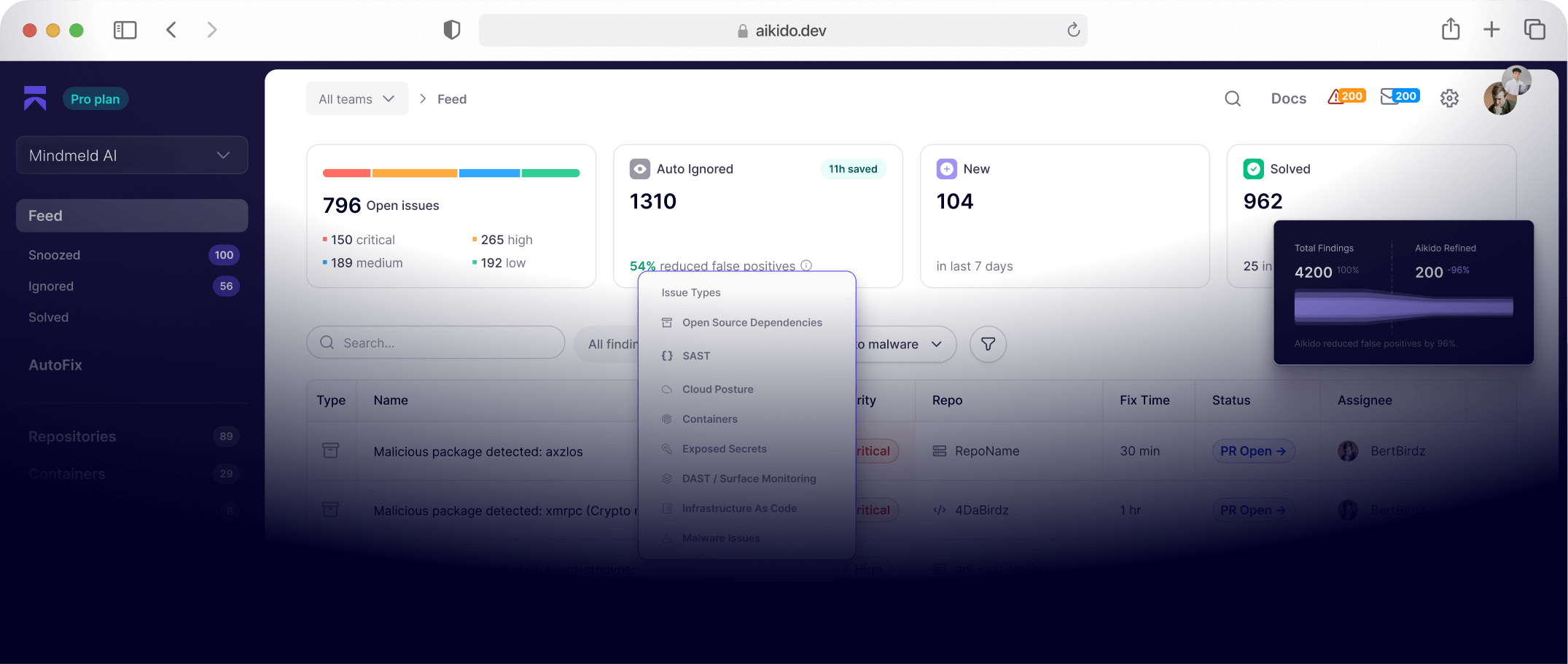
AutoFix resolves vulnerabilities in a single pull request instead of one per package. On Orca's deliberately vulnerable AI Goat repo, Aikido Security narrowed 48 findings to around 10 by filtering out what wasn't exploitable or in scope, such as dev-only dependencies outside compliance boundaries, then resolved them.
For malware, Aikido Safe Chain checks a package at install time and blocks known malicious ones before they reach your build. Behind that screening is Aikido Intel, a malware and threat feed that catches compromised releases before they've been assigned a CVE.
Across all of it, AutoTriage filters findings down to what's real and reachable, and AutoFix handles the remediation, so a queue of PRs turns into a merge decision instead of a backlog.
HeyJobs consolidated a set of scattered tools that included Dependabot into Aikido Security across 95 repositories, 31 container registries, and nine cloud environments, pointing to clearer prioritization and AutoFix as what changed day to day. As their team put it, some tools flag an issue without telling you the impact or how to fix it, and that was what they wanted in an alternative.
And it's all one platform. The same place that backports a fix and traces reachability also runs SAST, DAST, container image scanning, IaC, and secrets detection.
{{walkthrough}}
FAQ
<script type="application/ld+json">
{
"@context": "https://schema.org",
"@graph": [
{
"@type": "Organization",
"@id": "https://www.aikido.dev/#organization",
"name": "Aikido Security",
"url": "https://www.aikido.dev",
"logo": {
"@type": "ImageObject",
"@id": "https://www.aikido.dev/#logo",
"url": "https://www.aikido.dev/logo.png",
"contentUrl": "https://www.aikido.dev/logo.png",
"caption": "Aikido Security"
},
"sameAs": [
"https://www.linkedin.com/company/aikido-security",
"https://x.com/AikidoSecurity",
"https://github.com/AikidoSec"
]
},
{
"@type": "WebSite",
"@id": "https://www.aikido.dev/#website",
"url": "https://www.aikido.dev",
"name": "Aikido Security",
"publisher": { "@id": "https://www.aikido.dev/#organization" },
"inLanguage": "en"
},
{
"@type": "Person",
"@id": "https://www.aikido.dev/authors/nicholas-thomson#person",
"name": "Nicholas Thomson",
"url": "https://www.aikido.dev/authors/nicholas-thomson",
"jobTitle": "Senior SEO & Growth Lead",
"worksFor": { "@id": "https://www.aikido.dev/#organization" },
"sameAs": [
"https://www.linkedin.com/",
"https://x.com/"
]
},
{
"@type": "ImageObject",
"@id": "https://www.aikido.dev/blog/dependabot-vs-renovate#primaryimage",
"url": "https://www.aikido.dev/blog/dependabot-vs-renovate/og-image.png",
"contentUrl": "https://www.aikido.dev/blog/dependabot-vs-renovate/og-image.png",
"caption": "Dependabot vs Renovate vs Aikido Security"
},
{
"@type": "BreadcrumbList",
"@id": "https://www.aikido.dev/blog/dependabot-vs-renovate#breadcrumb",
"itemListElement": [
{
"@type": "ListItem",
"position": 1,
"name": "Home",
"item": "https://www.aikido.dev"
},
{
"@type": "ListItem",
"position": 2,
"name": "Blog",
"item": "https://www.aikido.dev/blog"
},
{
"@type": "ListItem",
"position": 3,
"name": "Dependabot vs Renovate",
"item": "https://www.aikido.dev/blog/dependabot-vs-renovate"
}
]
},
{
"@type": "WebPage",
"@id": "https://www.aikido.dev/blog/dependabot-vs-renovate#webpage",
"url": "https://www.aikido.dev/blog/dependabot-vs-renovate",
"name": "Dependabot vs Renovate (2026): Which Dependency Updater Should You Use?",
"isPartOf": { "@id": "https://www.aikido.dev/#website" },
"primaryImageOfPage": { "@id": "https://www.aikido.dev/blog/dependabot-vs-renovate#primaryimage" },
"breadcrumb": { "@id": "https://www.aikido.dev/blog/dependabot-vs-renovate#breadcrumb" },
"inLanguage": "en",
"datePublished": "2026-09-14T09:00:00+00:00",
"dateModified": "2026-09-14T09:00:00+00:00"
},
{
"@type": ["BlogPosting", "TechArticle"],
"@id": "https://www.aikido.dev/blog/dependabot-vs-renovate#article",
"isPartOf": { "@id": "https://www.aikido.dev/blog/dependabot-vs-renovate#webpage" },
"mainEntityOfPage": { "@id": "https://www.aikido.dev/blog/dependabot-vs-renovate#webpage" },
"headline": "Dependabot vs Renovate (2026): Which Dependency Updater Should You Use?",
"description": "A head-to-head comparison of Dependabot and Renovate on setup, platform support, monorepos, PR noise, and security, plus why auto-updating dependencies isn't enough and how reachability-based SCA closes the gap.",
"url": "https://www.aikido.dev/blog/dependabot-vs-renovate",
"datePublished": "2026-09-14T09:00:00+00:00",
"dateModified": "2026-09-14T09:00:00+00:00",
"author": { "@id": "https://www.aikido.dev/authors/nicholas-thomson#person" },
"publisher": { "@id": "https://www.aikido.dev/#organization" },
"image": { "@id": "https://www.aikido.dev/blog/dependabot-vs-renovate#primaryimage" },
"inLanguage": "en",
"wordCount": 2300,
"timeRequired": "PT10M",
"articleSection": "DevSec Tools & Comparisons",
"keywords": [
"Dependabot vs Renovate",
"dependency update tools",
"software composition analysis",
"SCA",
"reachability analysis",
"transitive dependencies",
"software supply chain security",
"CVE remediation",
"backporting",
"Aikido Security"
],
"about": [
{
"@type": "SoftwareApplication",
"name": "Dependabot",
"applicationCategory": "DeveloperApplication",
"operatingSystem": "Web",
"url": "https://github.com/dependabot"
},
{
"@type": "SoftwareApplication",
"name": "Renovate",
"applicationCategory": "DeveloperApplication",
"operatingSystem": "Web",
"url": "https://docs.renovatebot.com"
},
{
"@type": "SoftwareApplication",
"name": "Aikido Security",
"applicationCategory": "SecurityApplication",
"operatingSystem": "Web",
"url": "https://www.aikido.dev"
}
],
"mentions": [
{
"@type": "Organization",
"name": "Mend",
"url": "https://www.mend.io"
},
{
"@type": "Organization",
"name": "GitHub",
"url": "https://github.com"
},
{
"@type": "Thing",
"name": "GitHub Advisory Database",
"url": "https://github.com/advisories"
},
{
"@type": "Thing",
"name": "OSV (Open Source Vulnerabilities database)",
"url": "https://osv.dev"
},
{
"@type": "Thing",
"name": "CVE-2026-48937"
},
{
"@type": "Thing",
"name": "xz-utils backdoor"
},
{
"@type": "SoftwareSourceCode",
"name": "lodash",
"url": "https://www.npmjs.com/package/lodash"
},
{
"@type": "DefinedTerm",
"name": "Transitive dependency",
"description": "An indirect open source dependency pulled in automatically by a package a developer chose directly. Around 95% of open source vulnerabilities are found in transitive dependencies."
},
{
"@type": "DefinedTerm",
"name": "Reachability analysis",
"description": "Analysis that traces whether an application's code actually reaches a vulnerable code path, separating exploitable findings from vulnerabilities that are present but never called."
}
],
"speakable": {
"@type": "SpeakableSpecification",
"cssSelector": ["h1", "h2"]
}
},
{
"@type": "FAQPage",
"@id": "https://www.aikido.dev/blog/dependabot-vs-renovate#faq",
"isPartOf": { "@id": "https://www.aikido.dev/blog/dependabot-vs-renovate#webpage" },
"mainEntity": [
{
"@type": "Question",
"name": "Is Renovate better than Dependabot?",
"acceptedAnswer": {
"@type": "Answer",
"text": "Neither is better outright; they optimize for different things. Renovate wins if you have a monorepo, run across more than one Git platform, or have enough repositories that PR noise is worth tuning away. Dependabot wins if your code lives on GitHub and you want automation running with almost no setup. The real question is how much control you need and whether it's worth the configuration time to get it."
}
},
{
"@type": "Question",
"name": "Can I use Dependabot and Renovate together?",
"acceptedAnswer": {
"@type": "Answer",
"text": "You can, but running both as general version updaters on the same repository just produces duplicate, conflicting PRs. The one combination that works is narrower: let Dependabot's security updates handle automatic vulnerability-fix PRs, since they run without a dependabot.yml, and use Renovate for routine version bumps, grouping, and scheduling. Running both to do the same job is the part that goes wrong."
}
},
{
"@type": "Question",
"name": "Is Renovate free?",
"acceptedAnswer": {
"@type": "Answer",
"text": "Yes. Renovate is open-source and free to self-host, and the Mend-hosted app has a free tier that covers most teams. Cost only enters at the enterprise-hosting end, which most users never reach."
}
},
{
"@type": "Question",
"name": "Does Dependabot do security updates?",
"acceptedAnswer": {
"@type": "Answer",
"text": "Yes, and it's a separate mechanism from version updates. When GitHub's Advisory Database flags a vulnerable dependency and Dependabot alerts are on, it opens a fix PR to the minimum patched version automatically, no config file required. Worth knowing: with the feature on, it opens a PR for every open alert that has a patch, so on a large project the volume adds up."
}
},
{
"@type": "Question",
"name": "Which is better for monorepos?",
"acceptedAnswer": {
"@type": "Answer",
"text": "Renovate, clearly. It detects Yarn, npm, and pnpm workspaces along with Lerna and Nx layouts, and drives the whole tree from one config file. Dependabot needs an entry per ecosystem and directory, and while a glob-capable directories field trims some of the repetition, you're still enumerating paths rather than getting automatic workspace discovery."
}
},
{
"@type": "Question",
"name": "Do Dependabot or Renovate replace a dedicated SCA tool?",
"acceptedAnswer": {
"@type": "Answer",
"text": "No. Both can tell you a newer version exists, and Dependabot can tell you a known CVE affects your current version, but neither traces whether your code actually reaches the vulnerable path. That reachability step is what separates a real risk from a line in a report, and it's what a dedicated SCA tool like Aikido Security adds, along with fixing vulnerabilities without forcing an upgrade."
}
}
]
}
]
}
</script>