

Companies know what kinds of sensitive data they hold, but not always where all of it has ended up or who can reach it, especially at enterprise level. Personal data like names and email addresses, payment card details, health records, secrets and tokens, and now whatever gets fed into AI features are all examples of personally identifiable information (PII) and regulated data that laws like GDPR and HIPAA hold you responsible for.
The problem is that data doesn't sit still. A customer email entered in a signup form can pass through an API, arrive in Postgres, get copied into Snowflake, and later get pulled into an AI prompt.
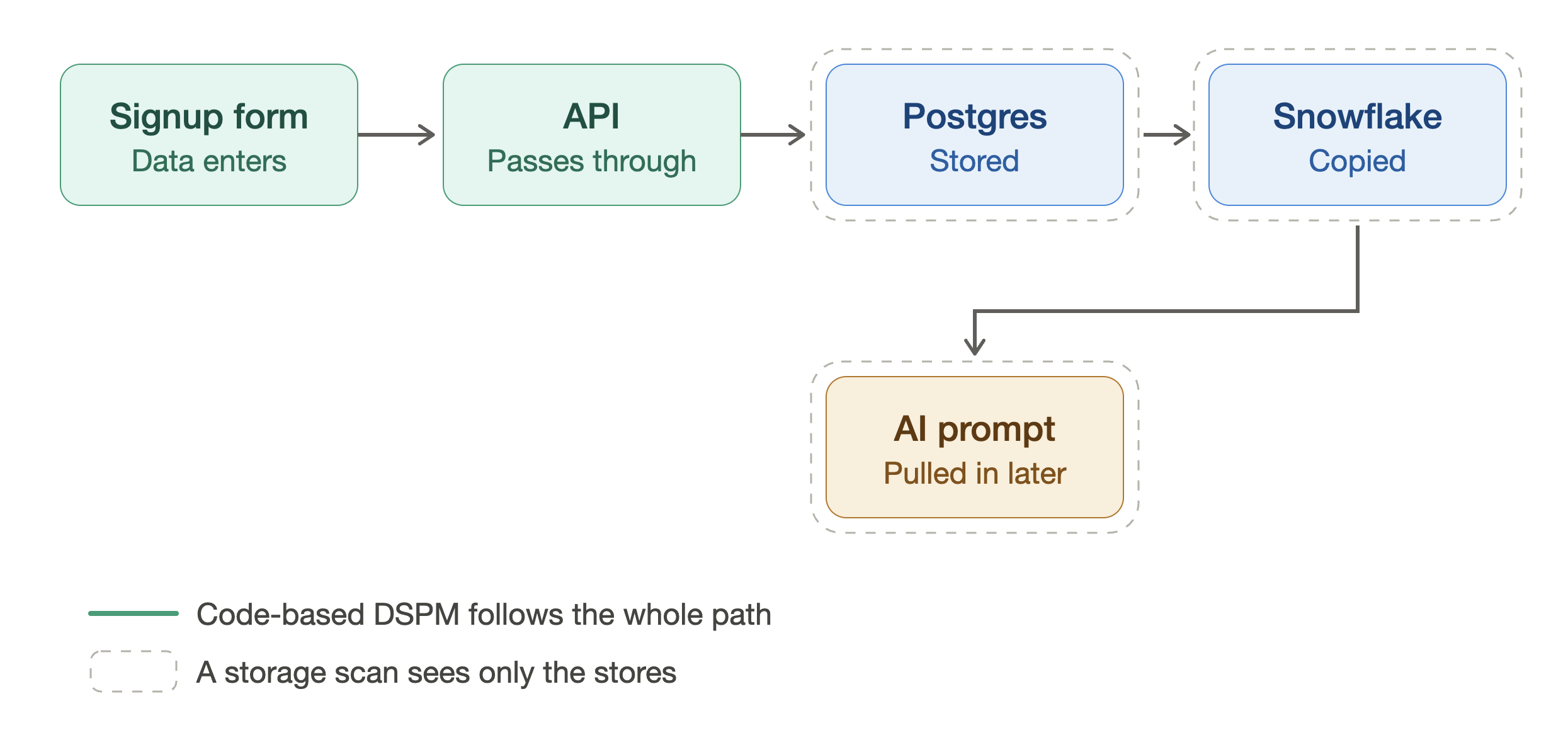
DSPM (Data Security Posture Management) tools map where your sensitive data is and where it's exposed because losing track is expensive. A breach spanning several environments runs $5.05 million on average and takes 276 days to find and contain, per IBM's 2025 Cost of a Data Breach report.
DSPM tools in 2026 split into two categories. Traditional tools connect straight to your databases, buckets, and warehouses and read what's inside, then tell you personal data is sitting somewhere it shouldn't, like an email or card number in a log. That's useful, but it stops there. It tells you the data exists, not which part of the application put it there or how to fix it.
Code-based tools read your code instead. Rather than connecting to the data, they trace how a field travels through the application that creates and moves it, without ever touching production data. So instead of "personal data was found in this log," you get the exact code path that caused it, the fields exposed, and the change that fixes it.
This post compares how the top tools do each, and how well. We look at:
- Aikido Security
- Wiz
- Cyera
- Varonis
- Orca
{{cta}}
TL;DR
If you need DSPM to find and fix how data gets exposed, Aikido is our pick. Its code-based DSPM reads your schemas and ORM models to trace how sensitive data moves through your app, without ever connecting to confidential information. Every finding names the exact file and line and comes with a pull request that fixes it, and results arrive in minutes. Aikido covers the application layer, where most exposure is actually created, and pairs it with CSPM for the storage layer. If you need to inventory the data already sitting in your system, Wiz and Orca do this as one module inside a broad cloud platform; Cyera and Varonis do it as a dedicated product.
Code-based vs storage-based DSPM
Storage-based DSPM tools connect to your databases and warehouses and read what's inside. They're good at finding data that's been copied somewhere and forgotten, like a backup full of production records sitting in a bucket nobody's checked in a year. But they need read access to your data, and because they identify sensitive data by how it looks rather than by reading the code, they stop where the data lives. A storage tool can tell you PII is in a log, but not which part of the application wrote it there or what change would stop it.
Code-based DSPM reads your application code to trace how data flows, from the APIs and ORM models that move it to the logging calls and AI integrations that can leak it. It never touches your data, and because it reads field names and schemas instead of guessing what data is from how it looks, it produces fewer false positives, and it can point at the exact code path that created the exposure, often with the fix attached.
Code-based DSPM can also catch the exposure before it happens, since a storage tool only finds sensitive data once it's already sitting in a log or a bucket, while reading the code flags the risky logging line or over-broad API response in the pull request, before it reaches production. It goes beyond exposure too, checking whether data is handled safely at every step, like whether encryption is done right or whether a flow could route sensitive fields somewhere they shouldn't go. The principle is if the code created the exposure, the fix belongs in the code.
What to look for in a DSPM tool
- Does it need access to your sensitive data? Some tools connect to your stores and read or sample the contents; others work from your code and never touch the data. Reading the data can classify what's actually there, but it means granting production access. Working from code avoids that access, but only sees data the code references.
- Can it find data where it flows, and where it rests? Store-based discovery is how you find forgotten data no code points to anymore. Code-based discovery is how you catch data in transit, like a phone number included in a webhook payload to a third party before it's ever stored. The two cover different blind spots, so you may need both.
- How much noise? Tools that guess sensitivity from patterns flag every nine-digit number as an SSN. Code-based tools that read field names and schemas know what a field is without guessing, which means fewer false positives.
- Does it map exposure and how it happened? Knowing PII sits in a log tells you there's a problem, but leaves triage to you. Look for a tool that traces back to the source, whether that's the code path that wrote it or the misconfiguration that exposed the store.
- Does it fix what it finds? The best tools suggest a fix via an actual pull request or config change you can review and apply.
- Does it connect findings to compliance obligations? A raw finding like "unsafe logging pattern" leaves compliance mapping work to be done. The more useful tools tie the issue to compliance rules. PII logged without redaction runs into data-minimization and retention requirements, and records that survive a delete request tie straight to GDPR and CCPA, which you can only fix in the deletion logic itself.
Top DSPM tools 2026
Code-based DSPM
Aikido Security
Aikido's code-based DSPM, runs as a Data Exposure Audit inside its AI Code Analysis. Instead of connecting to your data stores, it uses LLM agents to read your code and related files, mapping how sensitive data is created, moved, stored, and exposed, without ever touching production data. It traces sensitive fields from their sources, request bodies, file uploads, database reads, and config, through to their sinks, logs, third-party APIs, LLM prompts, caches, and storage. Every finding names the exact file and line, explains the data flow, and states the exposure risk.
"Most data security events are detected only after they occur. Aikido's code-first approach to DSPM allows teams to stop costly misconfigurations before they happen." — James Berthoty, Founder & Lead Analyst, Latio
What it finds
- API over-exposure. Endpoints returning more fields than the caller is entitled to, and missing tenant-ownership checks. A public profile page shows a name and avatar, but the /me endpoint behind it returns the whole user record, including date_of_birth, which ships to the browser on every load.
- Unsafe logging and exports. Unredacted PII and secrets in application logs, traces, and dumps. The checkout controller logs the full billing object on a failed payment, including email, phone, and the last four digits of the card, and ships it to Datadog.
- Over-broad third-party and AI sharing. Customer data and secrets sent to vendors, analytics, LLM prompts, and vector stores beyond what's needed.
- Credentials in URLs. Tokens and API keys in query strings, redirects, and clone URLs, where logs and browser history pick them up.
- Weak storage. Regulated data stored unencrypted, or with base64, MD5, or SHA-1 standing in for real encryption.
- Incomplete deletion. Delete flows that drop the user row but leave documents, tickets, and downstream records behind.
From finding to fix
Where the fix is code-level, AutoFix opens a pull request you review and merge, no ticket handed to another team. You can re-test any finding to confirm it's resolved. Because the audit runs against repos already connected to Aikido, there's no new data source to onboard, and each audit draws credits from your Aikido Wallet.
How it fits with cloud and compliance
Because it works from code, the audit maps what your applications do with data, so data that no code references, like a forgotten export in an old bucket, is a cloud-configuration question rather than a code one. Aikido's CSPM covers that from the same platform, along with over-permissioned IAM roles and unauthenticated data stores, so the code layer and the cloud layer sit together. And since the findings map to regulated data under GDPR, HIPAA, and PCI DSS, they connect to Aikido's Compliance product, which turns them into audit evidence.
Best for: Enterprise teams that want to find and fix data exposure at the source, without granting production data access, and to keep regulated data aligned with GDPR and PCI DSS.
{{walkthrough}}
Dedicated DSPM platforms
Cyera
Cyera offers an agentless, AI-native DSPM that connects to your cloud, SaaS, and on-prem environments to locate and classify sensitive data. It stands up fast, with users reporting broad visibility within days, and is well regarded for classification accuracy.
However, like most of the other offerings here, Cyera needs access to your sensitive data to work. It also leans toward mapping where that data lives rather than driving the fix, so how much value you get depends on your own governance maturity. Teams without a mature data-governance program can pile up findings without turning them into solutions. Reporting is the other common gripe, with custom exports often needing vendor help and executive-level reporting still underdeveloped.
Best for: Teams that need data visibility quickly, but be ready to drive remediation yourself, since Cyera is stronger at finding data than remediation.
Varonis
Varonis is known for surfacing access context. Beyond finding sensitive data, it maps exactly who and what can reach each file or record, tracing the entitlements and sharing links that add up to real access, then watching how that access gets used.
Varonis grew up in on-prem file governance, so its cloud-native data coverage doesn't match tools built cloud-first, and teams with mostly cloud estates can find it heavier than they need. The depth relies on collecting extensive activity data, which makes deployment and operationalization slower than most tools here, and reviewers cite high cost and complex pricing on top of that.
Best for: Teams whose sensitive data lives mainly in file shares and M365 and who need deep access governance over it, but a poor fit if your data is mostly cloud-native or you want something light to stand up.
Unified platforms with built-in DSPM
Wiz
Wiz offers agentless, read-only API access with fast onboarding across cloud accounts, and it places each data finding on its security graph alongside identity and network exposure, so you see who can reach sensitive data. That correlation lets teams already on Wiz weigh a data finding against its real exposure and triage it in the same place they handle the rest of their cloud risk.
As with the others, you have to give it access to your sensitive data, and Wiz samples records from production data to classify vulnerabilities. Because DSPM is a module inside the CNAPP rather than the core product, its data-store coverage is thinner than purpose-built platforms. User reviews flag room to improve on detecting sensitive and financial data along with a still-limited range of supported data stores. Remediation is graph context plus IaC snippets you apply yourself, and a finding resolves only after Wiz re-scans the resource on its next cycle.
Orca
Orca's agentless scanning discovers and classifies data across cloud stores without deploying agents, and it ties data sensitivity to access, exposure, and attack paths, so a store of real customer data outranks one holding test data. That context enables Orca to, for example, rank a publicly reachable store of real customer data ahead of well-controlled data so teams triage the real exposure.
Like the rest of this group, it needs access to your sensitive data to work. Its DSPM also sits inside a broad CNAPP, so the wide scope raises evaluation and operational overhead, and real-time protection isn't native to the agentless model, requiring you to deploy the runtime sensor.
Best for: Existing Orca users who want data findings in the same attack-path view as their other cloud risk, but not teams looking for a focused, standalone data-security tool.
Which DSPM tool you actually need in 2026
A storage tool tells you a card number is sitting in a log. A code-based tool traces it back to the logging call that put it there and hands you the pull request that removes it. Most teams need both, since forgotten data at rest and data leaking through live code paths are different blind spots. But the exposure that costs you is usually created in the application. Aikido Security reads your schemas and ORM models to catch it before it reaches production, names the exact file and line, and comes with a pull request that fixes it, mapped back to your obligations under GDPR and PCI DSS.
<script type="application/ld+json">
{
"@context": "https://schema.org",
"@graph": [
{
"@type": "Organization",
"@id": "https://www.aikido.dev/#organization",
"name": "Aikido Security",
"url": "https://www.aikido.dev",
"logo": {
"@type": "ImageObject",
"@id": "https://www.aikido.dev/#logo",
"url": "https://www.aikido.dev/logo.png",
"contentUrl": "https://www.aikido.dev/logo.png"
},
"sameAs": [
"https://www.linkedin.com/company/aikido-security",
"https://x.com/AikidoSecurity"
]
},
{
"@type": "WebSite",
"@id": "https://www.aikido.dev/#website",
"url": "https://www.aikido.dev",
"name": "Aikido Security",
"publisher": { "@id": "https://www.aikido.dev/#organization" }
},
{
"@type": "Person",
"@id": "https://www.aikido.dev/authors/nicholas-thomson#person",
"name": "Nicholas Thomson",
"url": "https://www.aikido.dev/authors/nicholas-thomson",
"jobTitle": "Senior SEO & Growth Lead",
"worksFor": { "@id": "https://www.aikido.dev/#organization" },
"sameAs": [
"https://www.linkedin.com/",
"https://x.com/"
]
},
{
"@type": "ImageObject",
"@id": "https://www.aikido.dev/blog/top-dspm-tools-2026#primaryimage",
"url": "https://www.aikido.dev/blog/top-dspm-tools-2026.png",
"contentUrl": "https://www.aikido.dev/blog/top-dspm-tools-2026.png"
},
{
"@type": "BreadcrumbList",
"@id": "https://www.aikido.dev/blog/top-dspm-tools-2026#breadcrumb",
"itemListElement": [
{
"@type": "ListItem",
"position": 1,
"name": "Home",
"item": "https://www.aikido.dev"
},
{
"@type": "ListItem",
"position": 2,
"name": "Blog",
"item": "https://www.aikido.dev/blog"
},
{
"@type": "ListItem",
"position": 3,
"name": "Top DSPM tools in 2026",
"item": "https://www.aikido.dev/blog/top-dspm-tools-2026"
}
]
},
{
"@type": "WebPage",
"@id": "https://www.aikido.dev/blog/top-dspm-tools-2026#webpage",
"url": "https://www.aikido.dev/blog/top-dspm-tools-2026",
"name": "Top DSPM Tools in 2026: Compared and Ranked",
"description": "Compare the top DSPM tools of 2026, Aikido, Wiz, Cyera, Varonis, and Orca, on data access, remediation, and how they find exposure.",
"isPartOf": { "@id": "https://www.aikido.dev/#website" },
"primaryImageOfPage": { "@id": "https://www.aikido.dev/blog/top-dspm-tools-2026#primaryimage" },
"breadcrumb": { "@id": "https://www.aikido.dev/blog/top-dspm-tools-2026#breadcrumb" },
"inLanguage": "en-US",
"speakable": {
"@type": "SpeakableSpecification",
"cssSelector": ["h1", "h2"]
}
},
{
"@type": ["BlogPosting", "TechArticle"],
"@id": "https://www.aikido.dev/blog/top-dspm-tools-2026#article",
"isPartOf": { "@id": "https://www.aikido.dev/blog/top-dspm-tools-2026#webpage" },
"mainEntityOfPage": { "@id": "https://www.aikido.dev/blog/top-dspm-tools-2026#webpage" },
"headline": "Top DSPM tools in 2026",
"description": "The top DSPM tools of 2026 compared. How code-based and storage-based tools differ on data access, accuracy, and fixing exposure at the source.",
"datePublished": "2026-09-01",
"dateModified": "2026-09-01",
"author": { "@id": "https://www.aikido.dev/authors/nicholas-thomson#person" },
"publisher": { "@id": "https://www.aikido.dev/#organization" },
"image": { "@id": "https://www.aikido.dev/blog/top-dspm-tools-2026#primaryimage" },
"inLanguage": "en-US",
"wordCount": 2600,
"timeRequired": "PT12M",
"articleSection": "DevSec Tools & Comparisons",
"keywords": [
"DSPM",
"Data Security Posture Management",
"code-based DSPM",
"storage-based DSPM",
"data exposure",
"PII",
"CSPM",
"cloud data security",
"data security tools 2026"
],
"about": [
{
"@type": "DefinedTerm",
"name": "Data Security Posture Management",
"alternateName": "DSPM",
"description": "A category of tools that find, classify, and monitor sensitive data and flag where it is exposed."
},
{ "@type": "Thing", "name": "Data exposure" },
{ "@type": "Thing", "name": "Personally identifiable information" },
{ "@type": "Thing", "name": "Cloud data security" }
],
"mentions": [
{
"@type": "SoftwareApplication",
"name": "Aikido Security",
"applicationCategory": "SecurityApplication",
"operatingSystem": "Cloud",
"url": "https://www.aikido.dev"
},
{
"@type": "SoftwareApplication",
"name": "Wiz",
"applicationCategory": "SecurityApplication",
"operatingSystem": "Cloud",
"url": "https://www.wiz.io"
},
{
"@type": "SoftwareApplication",
"name": "Cyera",
"applicationCategory": "SecurityApplication",
"operatingSystem": "Cloud",
"url": "https://www.cyera.io"
},
{
"@type": "SoftwareApplication",
"name": "Varonis",
"applicationCategory": "SecurityApplication",
"operatingSystem": "Cloud",
"url": "https://www.varonis.com"
},
{
"@type": "SoftwareApplication",
"name": "Orca Security",
"applicationCategory": "SecurityApplication",
"operatingSystem": "Cloud",
"url": "https://orca.security"
},
{ "@type": "Thing", "name": "GDPR" },
{ "@type": "Thing", "name": "HIPAA" },
{ "@type": "Thing", "name": "PCI DSS" },
{ "@type": "Thing", "name": "CCPA" }
]
},
{
"@type": "ItemList",
"@id": "https://www.aikido.dev/blog/top-dspm-tools-2026#itemlist",
"name": "Top DSPM tools in 2026",
"itemListOrder": "https://schema.org/ItemListOrderAscending",
"numberOfItems": 5,
"itemListElement": [
{
"@type": "ListItem",
"position": 1,
"name": "Aikido Security",
"url": "https://www.aikido.dev/cloud/dspm"
},
{
"@type": "ListItem",
"position": 2,
"name": "Wiz",
"url": "https://www.wiz.io"
},
{
"@type": "ListItem",
"position": 3,
"name": "Cyera",
"url": "https://www.cyera.io"
},
{
"@type": "ListItem",
"position": 4,
"name": "Varonis",
"url": "https://www.varonis.com"
},
{
"@type": "ListItem",
"position": 5,
"name": "Orca Security",
"url": "https://orca.security"
}
]
},
{
"@type": "FAQPage",
"@id": "https://www.aikido.dev/blog/top-dspm-tools-2026#faq",
"mainEntity": [
{
"@type": "Question",
"name": "What is DSPM?",
"acceptedAnswer": {
"@type": "Answer",
"text": "DSPM stands for Data Security Posture Management. These tools work out where an organization stores sensitive data, what type it is, and whether it is at risk, for example because it is not encrypted or the wrong people can access it. Most do this by connecting to your databases and cloud storage and reading what is inside."
}
},
{
"@type": "Question",
"name": "What is code-based DSPM?",
"acceptedAnswer": {
"@type": "Answer",
"text": "Instead of scanning your data stores, code-based DSPM analyzes the application that handles the data: your code, ORM models, API definitions, infrastructure as code, and CI/CD pipelines. From those it works out where sensitive data is created, stored, exposed, and leaked, and which code change fixes each problem."
}
},
{
"@type": "Question",
"name": "How can Aikido do DSPM without accessing my data?",
"acceptedAnswer": {
"@type": "Answer",
"text": "Your repos already contain the information other tools try to find by scanning data. Schemas and ORM models describe what you store. Storage calls and infrastructure config describe where it goes. Encryption logic describes how it is protected. Aikido reads all of this with the same read-only access as its other products."
}
},
{
"@type": "Question",
"name": "Why does code-based analysis produce fewer false positives?",
"acceptedAnswer": {
"@type": "Answer",
"text": "Tools that scan data contents have to guess what a piece of data is based on how it looks, and wrong guesses become false positives. Code-based tools read your field names and schemas instead, so they know what the data is without guessing."
}
},
{
"@type": "Question",
"name": "Which compliance frameworks does DSPM help with?",
"acceptedAnswer": {
"@type": "Answer",
"text": "Any framework that requires you to know where regulated data lives and prove it is handled safely. That includes GDPR and CCPA for personal data, HIPAA for health data, and PCI DSS for cardholder data, all of which expect data minimization, controlled access, and proper deletion. A code-based approach helps by tying each finding to the obligation it touches, and Aikido's Compliance product turns those findings into audit evidence."
}
},
{
"@type": "Question",
"name": "What about data that no code touches, like old buckets or forgotten exports?",
"acceptedAnswer": {
"@type": "Answer",
"text": "Code-based DSPM maps what your applications do with data. If an old bucket exists but no code references it, this will not see it. That is a cloud configuration problem, and CSPM covers it."
}
},
{
"@type": "Question",
"name": "How does this relate to CSPM and ASPM?",
"acceptedAnswer": {
"@type": "Answer",
"text": "They answer different questions about different layers. CSPM checks whether your cloud is configured safely, flagging things like a public bucket or an over-permissioned role. ASPM tracks vulnerabilities across your application security tools and helps you prioritize them. Aikido's code-based DSPM sits alongside both, tracing how your application creates, moves, and exposes sensitive data, and how to fix it in the code."
}
}
]
}
]
}
</script>


