When a new supply chain vulnerability drops, every team asks the same question at once: are we affected? Answering it means knowing exactly what is inside your applications, down to the transitive dependencies buried several layers deep. Modern applications pull in hundreds of open-source libraries, containers, and packages, and without a reliable inventory, checking your exposure turns into a slow manual hunt. This is why more teams now generate SBOMs as a matter of course.
Recent supply chain vulnerabilities like Shai-Hulud have shown that when a new issue emerges, teams are racing not just to patch, but to identify whether a vulnerable package or version exists anywhere in their environment. Without an accurate Software Bill of Materials (SBOM), that process is slow, manual, and error-prone.
SBOMs provide a machine-readable inventory of software components, enabling faster exposure analysis, incident response, and audit readiness. As regulatory requirements increase and supply chain attacks become more common, SBOMs are moving from compliance artifacts to everyday security tooling.
In this guide, we review the top 6 SBOM generation tools for developers in 2026, covering both open-source and enterprise options, and highlighting the tools developers actually want to use.
In this article we split these tools in open source and enterprise offerings, here’s a list of the top 6 SBOM tools for 2026:
- Aikido Security
- Syft by Anchore
- Trivy
- FOSSA
- Tern
- Mend.io
TL;DR
Among the SBOM tools reviewed, Aikido Security stands out as the strongest enterprise-grade solution for software supply chain visibility and license compliance. It allows teams to instantly generate, analyze, and export SBOMs in CycloneDX, SPDX, or CSV formats, with built-in VEX analysis to focus on what is actually exploitable rather than listing everything blindly. Beyond generation, Aikido turns SBOMs into something actionable. Its LLM-powered license analysis cuts through license noise, surfaces risky or non-compliant licenses, and explains obligations in plain language. Teams can tune license risk scoring, mark internal licenses, assign remediation tasks, and progressively clean up their SBOMs without slowing development. With full license coverage across source code, containers, and virtual machines, Aikido helps teams meet growing regulatory and audit requirements around software transparency, from a single project to a large portfolio. By combining instant SBOM generation, clear copyright attribution, and practical license insights, Aikido makes SBOMs useful for developers, security teams, and legal stakeholders.
Want to see this in action? Generate your SBOM now.
What is an SBOM?
A Software Bill of Materials (SBOM) is a complete, machine-readable inventory of everything that makes up an application. It lists all components your application depends on, including open-source libraries, frameworks, containers, and transitive dependencies, along with key details such as names, versions, licenses, sources, and checksums. Standard SBOM formats like SPDX and CycloneDX make this data easy to share, analyze, and integrate with other security and compliance tools.
Beyond simple inventory, SBOMs provide deep visibility into how software is assembled and how its components relate to one another. This visibility becomes critical when a new vulnerability, malicious package, or license issue emerges.
Teams can query their SBOMs to confirm exposure in seconds, even when a risky dependency lives several layers deep in the stack. While SBOMs are not meant to be manually reviewed line by line, they act as a foundational data source that powers vulnerability scanning, license analysis, and incident response across large codebases.
What are SBOMs used for?
SBOMs serve multiple purposes beyond basic inventory management. Here are the primary ways organizations use them to strengthen security and maintain compliance.
- Vulnerability response: When zero-day vulnerabilities appear, SBOMs let you identify affected software libraries and packages immediately. Organizations can search their component inventory to determine exposure across all projects.
- Compliance requirements: Regulations like Executive Order 14028 and the EU Cyber Resilience Act require SBOMs. Automated generation ensures you meet these requirements without manual documentation.
- License management: SBOMs reveal licensing obligations for every dependency. This prevents legal issues from incompatible licenses in your codebase.
- Supply chain security: SBOMs provide visibility into your software supply chain. They help track component sources and identify potential security risks from third-party code.
What to look for in SBOM tools
Not all SBOM tools offer the same capabilities. Focus on these features when evaluating options for your team.
- Integration in your stack: The tool should integrate with your CI/CD pipelines and build systems. This allows automatic SBOM generation during development, keeping inventories up-to-date with the latest code changes and reducing manual effort.
- Standard format support: Choose tools that support industry-standard formats like CycloneDX, SPDX, and SWID tags. These formats ensure compatibility across tools, simplify data sharing, and meet regulatory requirements. Standard formats also improve collaboration with partners and customers.
- Dependency visibility: A good SBOM tool provides clear insights into complex dependency chains and transitive relationships. This helps developers understand potential vulnerabilities and manage updates across all dependencies.
- Risk and compliance analysis: Consider tools that integrate with vulnerability and license databases. This enables timely risk assessments, helps prioritize remediation efforts, and helps maintain legal compliance.
- User-friendly interface: A clear interface makes SBOM management practical. Features like comparison, editing, and merging make collaboration easier and help developers access information quickly.
Top 6 SBOM Tools
Top Commercial and Enterprise SBOM Tools
Commercial tools extend beyond basic inventory generation with license compliance, and professional support. These solutions are designed for teams needing enterprise integration and dedicated assistance.
1. Aikido Security
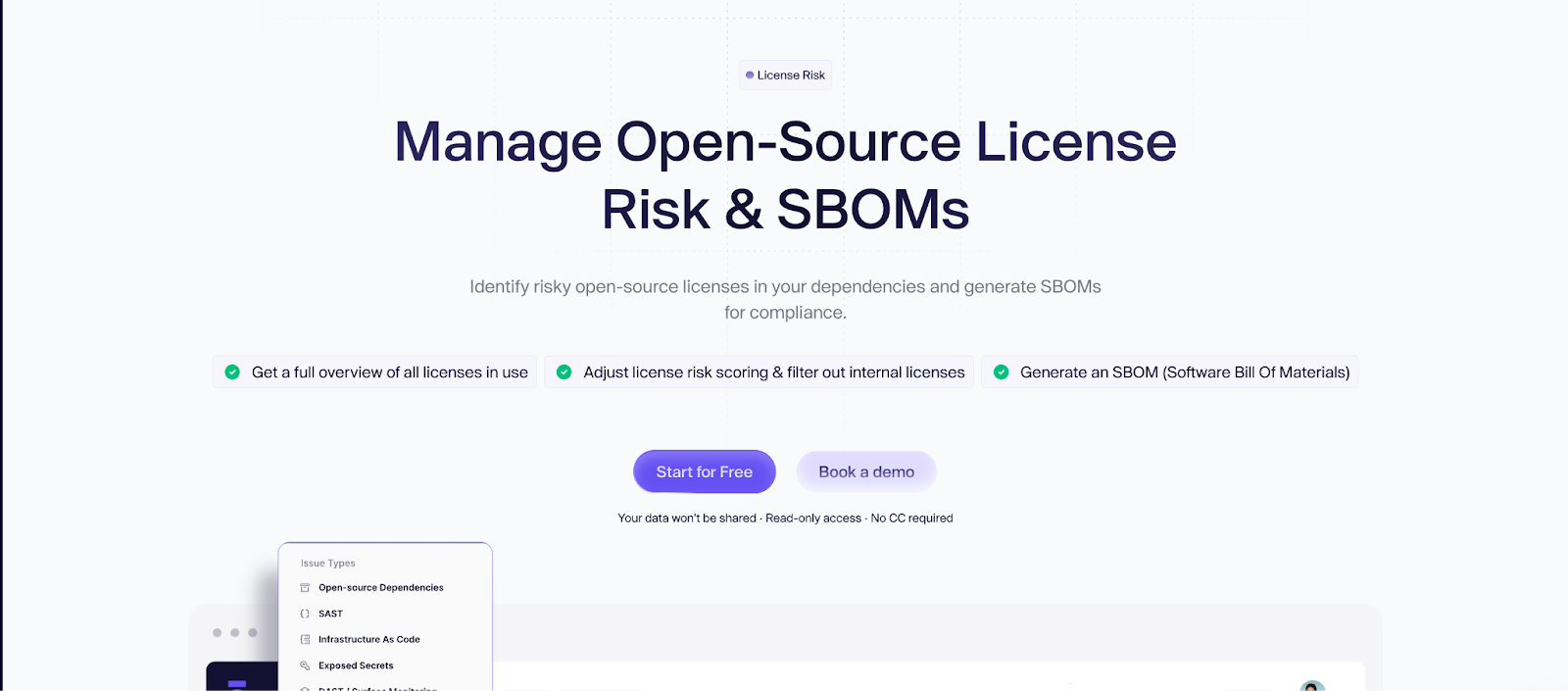
Aikido Security is a mature software security platform that makes SBOMs practical and actionable. Aikido lets teams generate, analyze, and continuously manage SBOMs across source code, containers, and virtual machines, all from one platform. Developers can instantly generate SBOMs in CycloneDX, SPDX, or CSV formats, enriched with license data, copyright attribution, and built-in VEX analysis to assess real-world exploitability.
Beyond generation, Aikido turns SBOM data into something teams can actually act on. Its LLM-powered license analysis filters out noise, scores license risk using multiple data sources, and surfaces only the licenses that matter. Developers and security teams get clear, plain-language explanations of license obligations, making it easier to assign remediation tasks, clean up risky dependencies, and maintain compliance as applications evolve.
Aikido integrates directly with GitHub, GitLab, Bitbucket, and CI/CD pipelines using an agentless, read-only setup. Teams can start generating up-to-date SBOMs in minutes without disrupting development workflows or introducing additional tooling.
Key features
- Instant SBOM generation: Generate SBOMs on demand in CycloneDX, SPDX, or CSV formats for repositories, containers, and virtual machines.
- Built-in VEX analysis: Assess exploitability to focus on vulnerabilities that actually affect your application.
- Actionable license insights: LLM-powered license analysis prioritizes risky licenses and suppresses low-impact noise.
- Plain-language license explanations: Translates complex legal terms into clear, actionable guidance for developers.
- Flexible license risk controls: Customize how license risk is scored and mark internal licenses to reduce reporting noise.
- Full coverage, including containers: Scans licenses and components inside container images and source repositories.
- Clear copyright attribution: Automatically includes accurate copyright data for every component.
- Compliance-ready SBOMs: Supports regulatory and audit requirements around software supply chain transparency.
- Workflows developers already use: Assign tasks, track fixes, and clean up SBOMs incrementally as part of normal development.
Pros
- Comprehensive SBOM generation and management
- Strong license intelligence with low noise
- Actionable insights delivered in workflows developers already use
- Supports industry-standard SBOM formats
- Covers source code, containers, and VMs
- Fast onboarding with predictable pricing
2. FOSSA
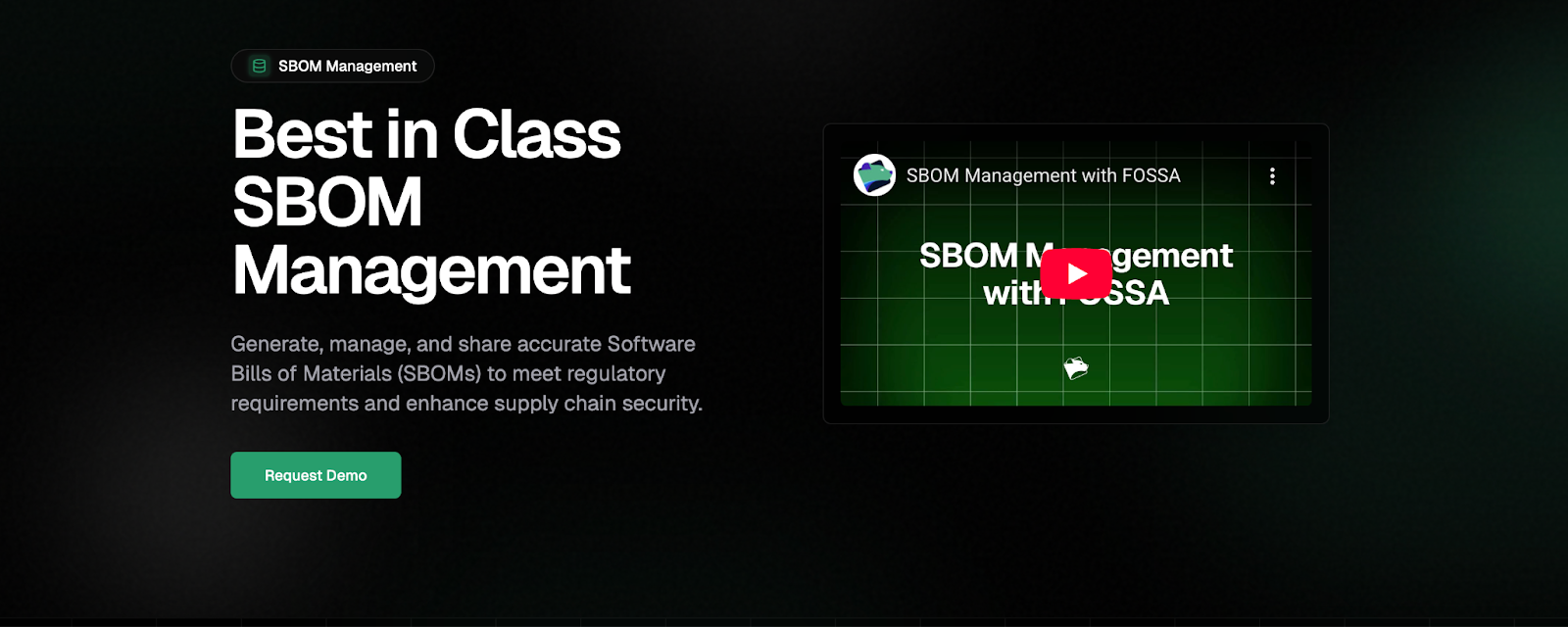
FOSSA is a commercial platform focused on SBOM lifecycle management, helping organizations generate, manage, and distribute Software Bills of Materials to meet regulatory, customer, and audit requirements.
It provides centralized SBOM creation and hosting, supports industry-standard formats like CycloneDX and SPDX, and places a strong emphasis on compliance with government and enterprise regulations. FOSSA is particularly well-suited for organizations that need formal SBOM governance and reporting, although its approach is more compliance- and policy-driven than developer-first.
Key Features
- SBOM lifecycle management: Create, import, export, store, and version SBOMs in a centralized repository.
- SBOM generation: Produces SBOMs with full visibility into direct and transitive dependencies, including historical versions.
- Regulatory compliance support: Meets NTIA minimum elements and aligns with Executive Order 14028, CISA guidance, and NIST requirements.
- CI/CD integration: Automates SBOM generation and validation in pipelines using GitHub and GitLab integrations.
- Secure SBOM sharing: Enables controlled distribution of SBOMs to customers, partners, and regulators.
Pros
- Strong SBOM governance and lifecycle management capabilities
- Designed specifically for regulatory and audit-driven use cases
- Centralized storage and versioning of SBOMs
- Broad support for compliance standards and reporting
Cons
- Heavily compliance-oriented, with less focus on day-to-day developer workflows
- Limited real-time, context-aware exploitability or reachability analysis
- Remediation guidance is less actionable for developers
- UI and workflows may feel heavy for smaller teams or fast-moving startups
- Less emphasis on reducing security noise through intelligent prioritization
- SBOMs often function as compliance artifacts rather than active developer tools
3. Mend.io
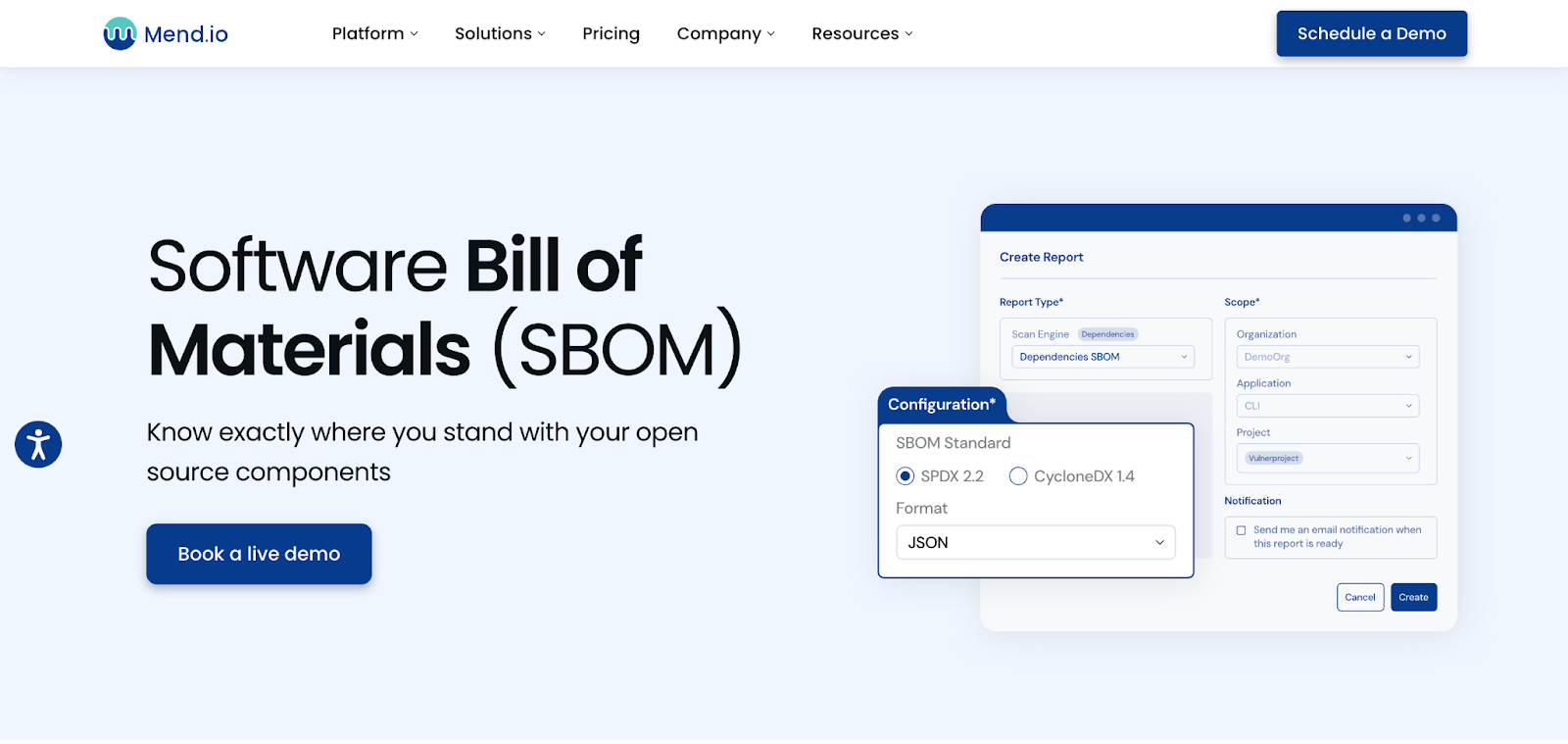
Mend.io is a commercial Software Composition Analysis (SCA) platform that generates and maintains Software Bills of Materials as part of a broader open source risk management strategy.
Its SBOM capabilities are tightly coupled with dependency tracking, vulnerability prioritization, and policy enforcement, making it a strong fit for organizations that already rely on SCA tooling to manage open source risk at scale.
While Mend offers advanced automation and risk analysis, its SBOMs are primarily designed for security and compliance teams rather than as developer-first artifacts.
Key Features:
- Automated SBOM generation: Produces accurate and comprehensive SBOMs across applications and dependencies.
- VEX support: Incorporates VEX data to add context around vulnerability exploitability.
- Advanced reachability analysis: Helps identify which vulnerabilities can actually be triggered in running applications.
- Risk-based prioritization: Focuses remediation on the most critical open source risks.
- Third-party SBOM ingestion: Imports external SBOMs for consolidated analysis.
Pros
- Strong automation for open source dependency tracking
- Mature vulnerability prioritization and reachability analysis
- Well-suited for large organizations with complex dependency graphs
- Effective at reducing manual effort in SBOM maintenance
Cons
- SBOMs are tightly coupled to Mend’s SCA workflows, limiting flexibility
- Less intuitive for developers who just want fast, actionable SBOM insights
- Can feel heavy for teams that only need SBOM generation and analysis
- Policy and configuration overhead may slow adoption for smaller teams
- SBOMs often serve security and compliance needs more than developer workflows
Best Open Source and Free SBOM Generators
Open-source SBOM tools provide a cost-effective solution for teams prioritizing transparency and community-driven development. These tools offer strong SBOM generation capabilities without licensing costs.
4. Syft by Anchore
Syft is an open-source CLI tool and Go library developed by Anchore for generating SBOMs from container images, filesystems, and archives. It scans targets by inspecting package managers and file metadata across many ecosystems, producing SBOMs that enumerate software components and their versions.
Syft is commonly used as part of security workflows, especially when paired with Anchore’s Grype scanner, but on its own it focuses purely on SBOM generation rather than risk analysis or remediation.
Key Features
- Multi-target SBOM generation: Generates SBOMs for container images, directories, filesystems, and archives.
- Broad ecosystem support: Detects packages across many languages and OS package managers including Alpine, Debian, RPM.
- Grype integration: Designed to work seamlessly with Grype for vulnerability scanning.
- CLI-first design: Optimized for local use, CI pipelines, and automation.
Pros
- Open-source and actively maintained
- Supports a wide range of ecosystems and scan targets
- Strong ecosystem integration with Grype for vulnerability scanning
Cons
- SBOM generation only; no built-in risk prioritization or remediation guidance
- Vulnerability insights depend entirely on pairing with Grype or other tools
- No native UI for visualization, collaboration, or reporting
- Requires manual setup to manage SBOM storage, versioning, and history
- Limited compliance or audit-focused workflows out of the box
- CLI-driven approach can be challenging for non-security or non-platform teams
- Does not contextualize findings based on runtime usage or exploitability
5. Trivy
Trivy is an open-source security scanner developed by Aqua Security that can generate SBOMs as part of its broader vulnerability scanning capabilities. It supports SBOM generation for container images, filesystems, root filesystems, and virtual machine images, producing outputs in standard formats such as CycloneDX and SPDX.
While Trivy can both generate SBOMs and scan them for vulnerabilities, SBOM creation is tightly coupled to its scanning workflows and CLI usage, making it more suitable for engineers integrating security checks into CI pipelines than for teams looking for a dedicated SBOM management or governance solution.
Key Features
- SBOM generation: Produces SBOMs in CycloneDX and SPDX (including SPDX JSON) formats.
- Multiple scan targets: Supports container images, filesystems, rootfs, VM images, and SBOM files as inputs.
- SBOM as input: Can scan existing SBOM documents directly for vulnerabilities.
- SBOM discovery: Automatically detects embedded SBOM files inside container images.
Pros
- Open-source and widely adopted in cloud-native ecosystems
- Combines SBOM generation and vulnerability scanning in a single tool
- Supports standard SBOM formats like CycloneDX and SPDX
Cons
- SBOM generation is CLI-driven and tightly coupled to scanning workflows
- Limited SBOM lifecycle management, storage, or historical tracking
- No built-in UI for visualization, collaboration, or reporting
- Requires explicit flags and configuration to include vulnerabilities in SBOM outputs
- Lacks contextual risk prioritization or exploitability analysis
- Compliance and audit workflows are largely manual
- Can become complex to operate as SBOM usage scales across teams and repositories
6. Tern
Tern is an open-source inspection tool designed to generate SBOMs for container images. It works by analyzing container layers sequentially to identify installed packages, operating system details, and associated metadata.
Using a combination of layer inspection and package manager interrogation, Tern produces detailed reports that explain what software is included in an image and how it was introduced, making it useful for engineers who want low-level visibility into container contents during build, integration, or inspection workflows.
Key Features
- Container-focused SBOM generation: Generates SBOMs by inspecting Docker container images layer by layer.
- Layer-by-layer analysis: Shows how each container layer contributes to the final image contents.
- Dockerfile correlation: Can map filesystem layers back to Dockerfile instructions when a Dockerfile is provided.
- CLI-driven workflows: Operates via command-line tooling for local, CI, or scripted use.
- Extensible via external tools: Can integrate with tools like Scancode for file-level license detection.
Pros
- Open-source and free to use
- Provides detailed, transparent insight into container image composition
- Supports industry-standard SBOM formats
Cons
- Limited strictly to container images (no repository, VM, or cloud scanning)
- No native license risk analysis or prioritization
- No built-in vulnerability or exploitability context
- Requires external tools for license or CVE enrichment
- CLI-only with no native UI or collaboration features
- Manual effort required to store, aggregate, and track SBOMs over time
- Not designed for compliance workflows or audit reporting
Choosing the right SBOM tool in 2026
Consider these factors when selecting an SBOM tool that matches your team's technical environment and security processes.
- Evaluate your technology stack: Select a tool that fits your development and deployment processes. Look for integrations with your build systems and automation frameworks to keep SBOMs current automatically.
- Understand your requirements: Identify the SBOM formats required for your industry or regulations. Choose tools supporting standardized formats like CycloneDX and SPDX to support compliance and collaboration.
- Assess your risk management needs: Select tools that provide clear reports on vulnerabilities and licensing issues. A user-friendly interface makes it easier for teams to address risks quickly and maintain security.
- Consider scalability: If you manage a large software portfolio, choose tools that can handle high volumes of components efficiently. Scalable tools keep oversight reliable as your development grows.
- Compare open-source vs. commercial options: Open-source tools offer flexibility and cost savings. Commercial solutions provide advanced features, support, and integrations. Match the tool to your organization's requirements and resources.
Conclusion
The right SBOM tool depends on how you build and how far you need it to scale. A team that just needs container SBOMs generated in CI has very different needs from one tracking license compliance across hundreds of repositories. Both should be able to produce a machine-readable inventory the moment a new supply chain issue breaks.
For teams that want SBOMs as part of a broader, automated security setup, Aikido Security goes beyond simple inventory generation. It combines SBOM creation with vulnerability management, reachability analysis, and remediation built into workflows developers already use, so SBOMs become something teams actually act on.
Want clearer visibility into your software supply chain? Start your free trial or book a demo with Aikido Security today.
FAQ
What is an SBOM and why is it important?
A Software Bill of Materials (SBOM) is a detailed, machine-readable inventory of all the components, libraries, and dependencies used in an application, including direct and transitive dependencies. SBOMs are critical for identifying vulnerable components, responding quickly to new security disclosures, meeting regulatory requirements, and improving overall supply chain transparency.
How do SBOM tools help improve application security?
SBOM tools provide visibility into the software supply chain, making it easier to detect vulnerable or malicious dependencies, track outdated components, and understand the impact of newly disclosed vulnerabilities. When combined with vulnerability databases and reachability analysis, SBOMs help teams focus on issues that actually affect their applications rather than chasing noise.
Are SBOMs only useful for compliance?
No. While SBOMs are increasingly required for regulatory compliance and customer due diligence, their real value goes beyond audits. SBOMs help engineering and security teams troubleshoot incidents faster, assess risk proactively, detect supply chain attacks, and make better dependency decisions throughout the software lifecycle.
What SBOM formats should teams standardize on?
Most teams standardize on industry-recognized formats like CycloneDX or SPDX, as these formats are widely supported by security tools, regulators, and partners. Using standardized formats makes SBOMs easier to share, scan, and integrate into existing security workflows.
How do tools like Aikido Security differ from standalone SBOM generators?
Standalone SBOM tools focus primarily on generating inventories, often through CLI-based workflows. Platforms like Aikido Security integrate SBOM generation directly into a broader AppSec platform, enriching SBOMs with vulnerability data, reachability analysis, prioritization, and remediation guidance. This allows teams to move from inventory to action without stitching together multiple tools.
You Might Also Like: