

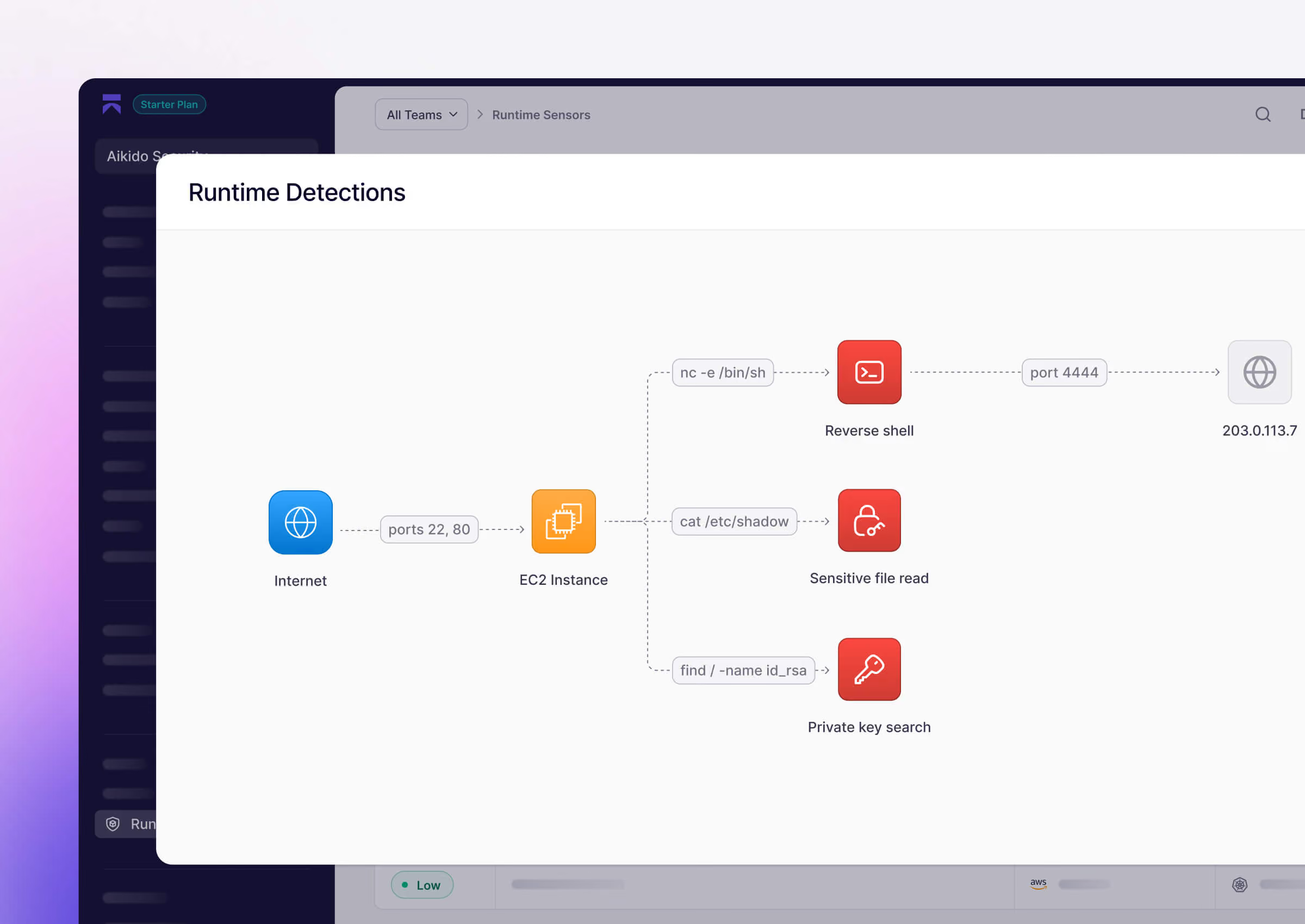





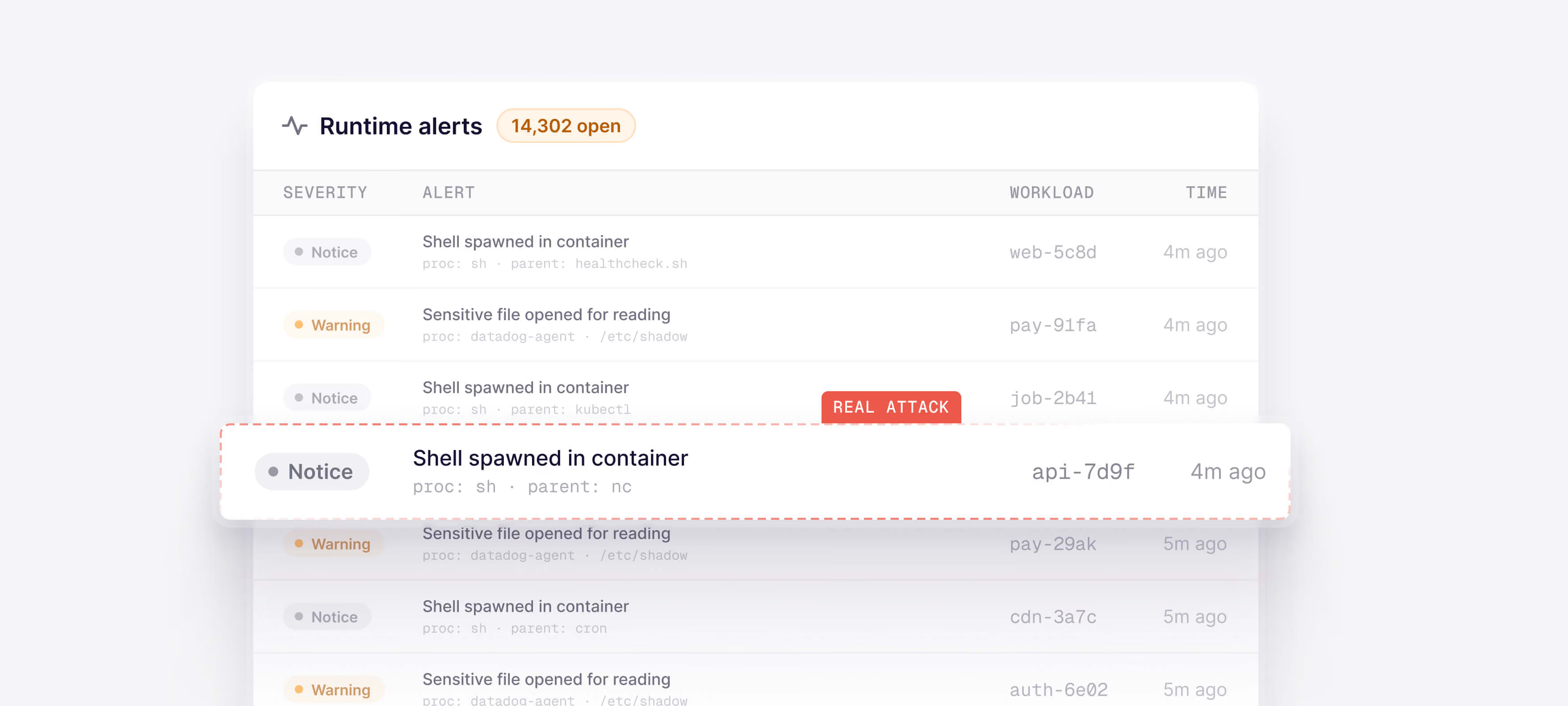
Runtime detection tools are noisy and difficult to run
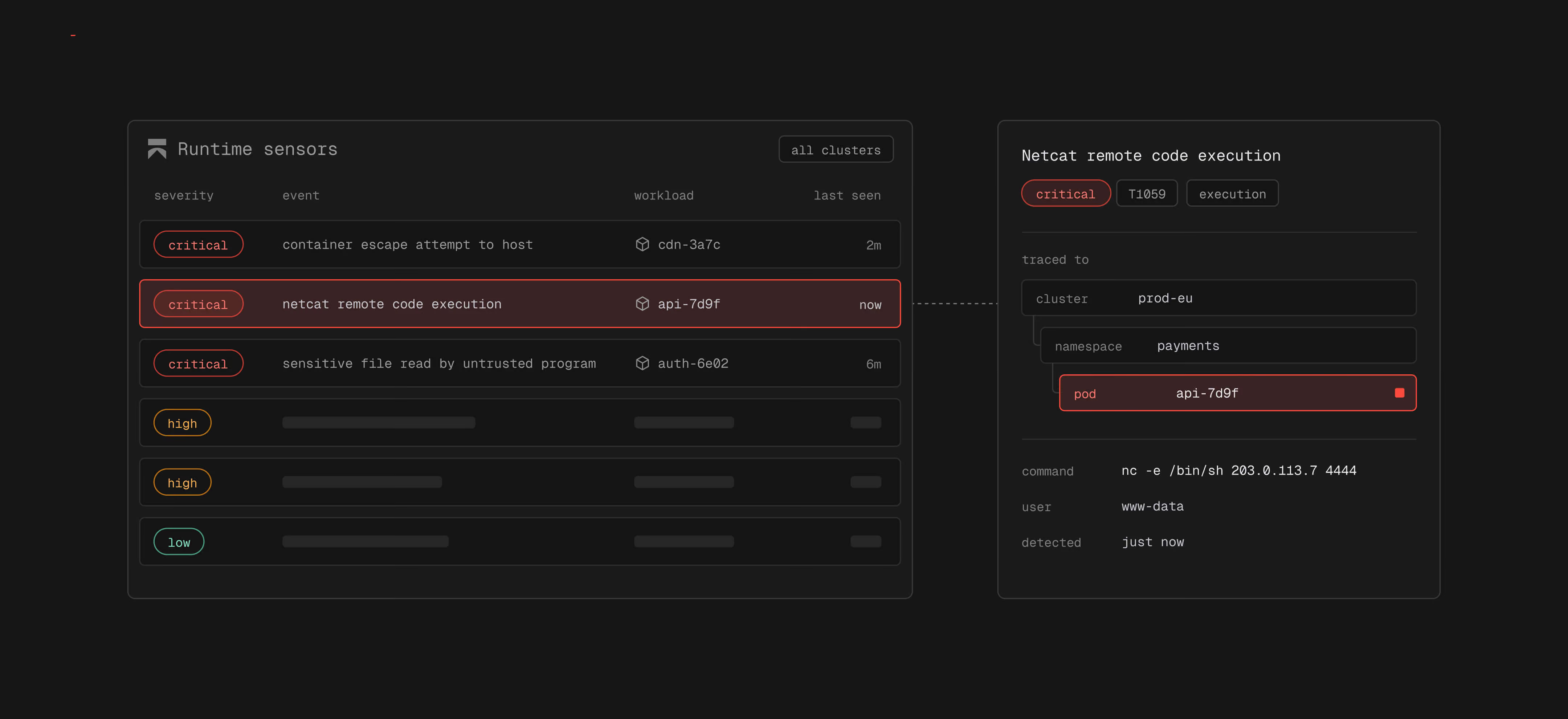
Every detection shows the VM or pod where it ran
Where runtime sensors work





Why teams use Runtime Sensors
Runs in the Aikido agent
Low noise
Silence false positives
Runtime findings, same platform
Detect live attacks across your production fleet
Runtime Sensors flag attacker-like behavior across your Kubernetes clusters and Linux VMs, with the workload and commands in one view.


Frequently Asked Questions

Runtime Sensors monitor your Kubernetes clusters and Linux VMs while they run. They use eBPF to observe workload activity from the kernel and flag behavior that matches Aikido's detection rules, such as container escapes or unexpected binaries.
eBPF (extended Berkeley Packet Filter) lets a program observe kernel activity safely, without kernel modules. The sensor runs in the Aikido agent on each node or VM. Your application code and container images stay unchanged.
Aikido ships and maintains the detection rules. They cover behaviors such as container escapes and binaries running in a container that weren't part of its image. Each rule maps to a MITRE ATT&CK technique and tactic. You can turn any rule on or off for your workspace.
Kubernetes clusters connected to Aikido, and Linux VMs that run the Aikido agent with systemd and kernel 5.8 or later. Windows VMs aren't supported. Agentless scanning of AWS, Azure and Google Cloud VMs doesn't include runtime detection, because it doesn't install the agent.
For a cluster, turn on threat detection in its settings and run a Helm upgrade with runtimeDetection.enabled=true. For a VM, set RUNTIME_DETECTION_ENABLED=true when you install the agent. See the setup docs for details.
Open the detection and click Add Rule Exception. Aikido pre-fills the conditions from the event, and uses wildcards for generated pod names so the exception survives restarts. Exceptions apply across your whole workspace.
Not today. Runtime Sensors detect and give you the context to respond. For blocking attacks inside your application, see Runtime Protection.
Zen is an in-app firewall that runs inside your application and blocks attacks like injection against it. Runtime Sensors run on the host and watch containers and processes from the kernel. They catch what happens after something gets in, regardless of the language or app.
Runtime Sensors cover runtime threat detection for workloads, the detection side of cloud workload protection (CWPP). They don't analyze cloud provider audit logs.
Draft for PM review: Wiz sells its runtime sensor as an add-on to its detection and response product. Aikido Runtime Sensors put runtime detections in the same workspace as your code and cloud findings, triaged by the same team. (Needs a second, sharper point: price, setup time or detection quality. Coverage alone won't hold up, since Wiz covers more environments today.)