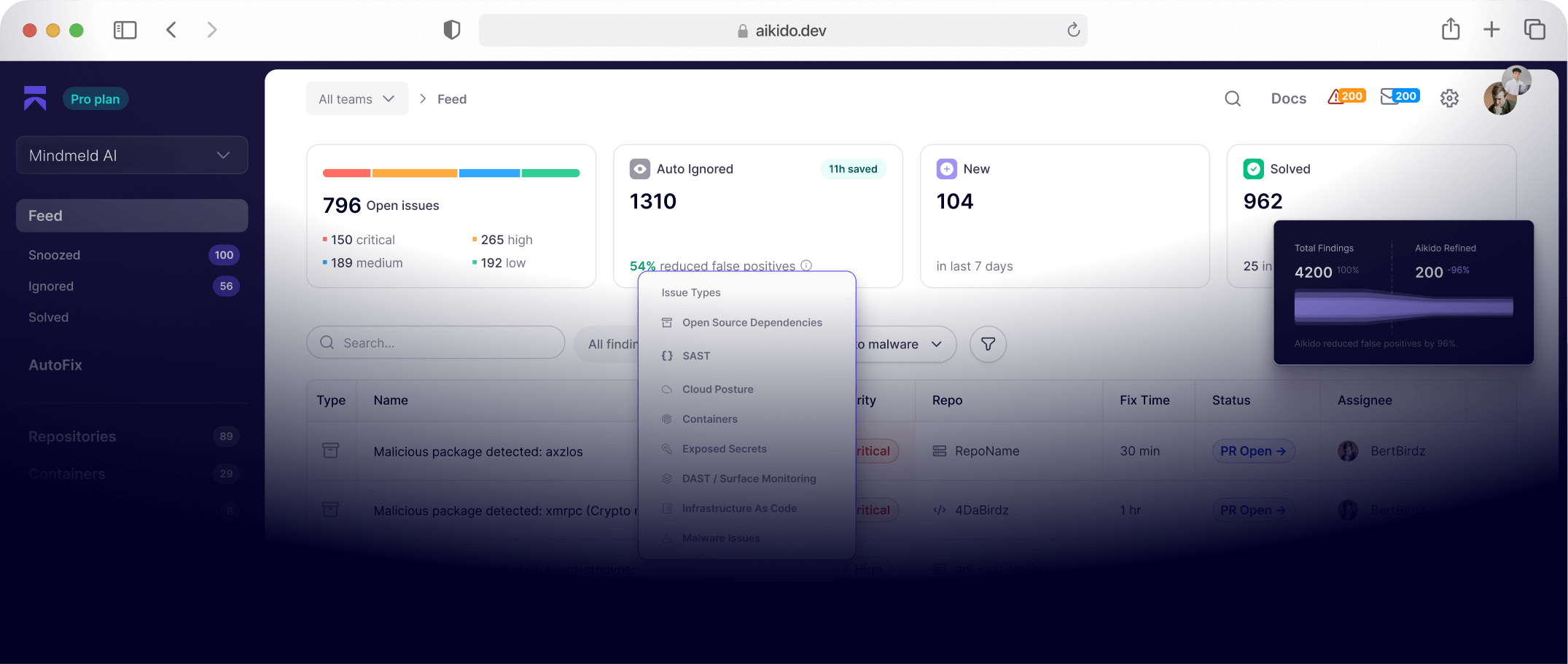
Static Application Security Testing (SAST) is one of the core defenses against shipping vulnerable code, but the tools vary in what they actually catch. AI has compounded the problem by radically increasing the velocity of code being shipped.
According to Aikido's 2026 State of AI in Security & Development report, nearly 70% of organizations say they’ve uncovered flaws tied to AI-generated code, and 1 in 5 organizations reported serious incidents linked to AI code. The report also found that engineers spend 6.1 hours per week triaging security findings, with 72% of that time wasted on false positives. Human review is struggling to keep up with code output, which makes the quality of your SAST tooling even more important.
{{cta}}
The tools below all analyze source code for vulnerabilities, but they differ significantly in detection strategy, noise levels, how remediation actually reaches developers, and whether they hold up as your codebase and team grow. We cover:
- Aikido Security
- Checkmarx
- Snyk Code
- SonarQube
- GitHub Advanced Security
- Semgrep
TL;DR
Aikido Security is the strongest option on the list because it pairs an enterprise-grade deterministic engine with AI in triage, prioritization, and autofix. You get the speed and predictability of rule-based detection without the alert fatigue that usually comes with it. Aikido's SAST engine cuts false positives by up to 95% through AI-powered noise reduction and reachability analysis, and customers consistently report 90%+ noise reduction in production.
Legacy platforms like Checkmarx scan slowly on large codebases, are cost-prohibitive, and were built for a security team-first workflow that predates modern developer tooling. Developer-first tools like Snyk Code and Semgrep are faster and easier to adopt but have elevated noise and hit ceilings on enterprise governance, language coverage, or per-product pricing that stacks quickly at scale. And SonarQube works for code quality but treats security as a secondary use case.
What is SAST?
SAST analyzes source code before it runs, checking for issues in the code's syntax, structure, and logic to uncover potential security vulnerabilities. It's a deterministic engine that matches known vulnerability patterns, the OWASP regulars, which makes it fast and cheap enough to run on every commit. Detection is predictable and repeatable, which is exactly what you want in CI. The tradeoff is that it only catches what its rules cover, and raw rule output tends to be noisy.
Most tools in 2026 add AI for things like triage and prioritization, so real findings surface above the noise, coverage extension to languages the rules don't support, and autofix, so a finding arrives with a suggested patch. The AI does not change the detection method, but it makes the output usable at scale. This is sometimes called AI SAST, but that gets conflated with fully agentic AI SAST. You can learn more about these terms here.
Aikido offers fully agentic SAST, sometimes called AI code analysis, but that is outside the scope of this comparison.
How to choose a SAST tool
Triage and prioritization
Raw output from a SAST tool is a list of things that might be wrong. What you actually want is a ranked queue of things worth fixing. Look for severity scoring that accounts for reachability rather than just CWE and CVSS, and deduplication across branches so the same issue doesn't reappear on separate merges.
Fix guidance
A finding without a fix adds work to your already busy engineers' queues. The strongest tools create a PR with a fix you can validate and apply with one click. Line number plus CWE reference is the floor. Test autofix quality on your own repo before trusting the marketing claim, since fix quality varies across vendors and across languages within the same vendor.
Accuracy and noise
False positives waste engineering time and train developers to ignore the scanner. False negatives ship to production as vulnerabilities. Look for how the tool handles reachability, because a vulnerability in dead code is not the same as one in a hot path, and any scanner that treats them identically will generate useless noise.
AI-augmented (effectively)
Almost every SAST tool in 2026 has added AI somewhere in the pipeline. Triage is the highest-value place to put it, since a deterministic engine will surface real findings alongside a lot of noise, and AI is well-suited to filtering the noise before a developer sees it. Fix suggestions, either as inline remediation guidance or as an applied patch on a PR is another valuable capacity. Some tools also use AI to extend coverage to languages the rule set doesn't formally support.
Integration into existing workflows
A SAST tool that doesn't run where developers work will get ignored, no matter how accurate it is. The floor is IDE feedback and PR comments, with results flowing into whatever ticketing system your team already uses. Watch for tools that require developers to log into a separate dashboard to see findings, which is a fast way to get a tool quietly abandoned.
Top SAST tools 2026
Aikido Security
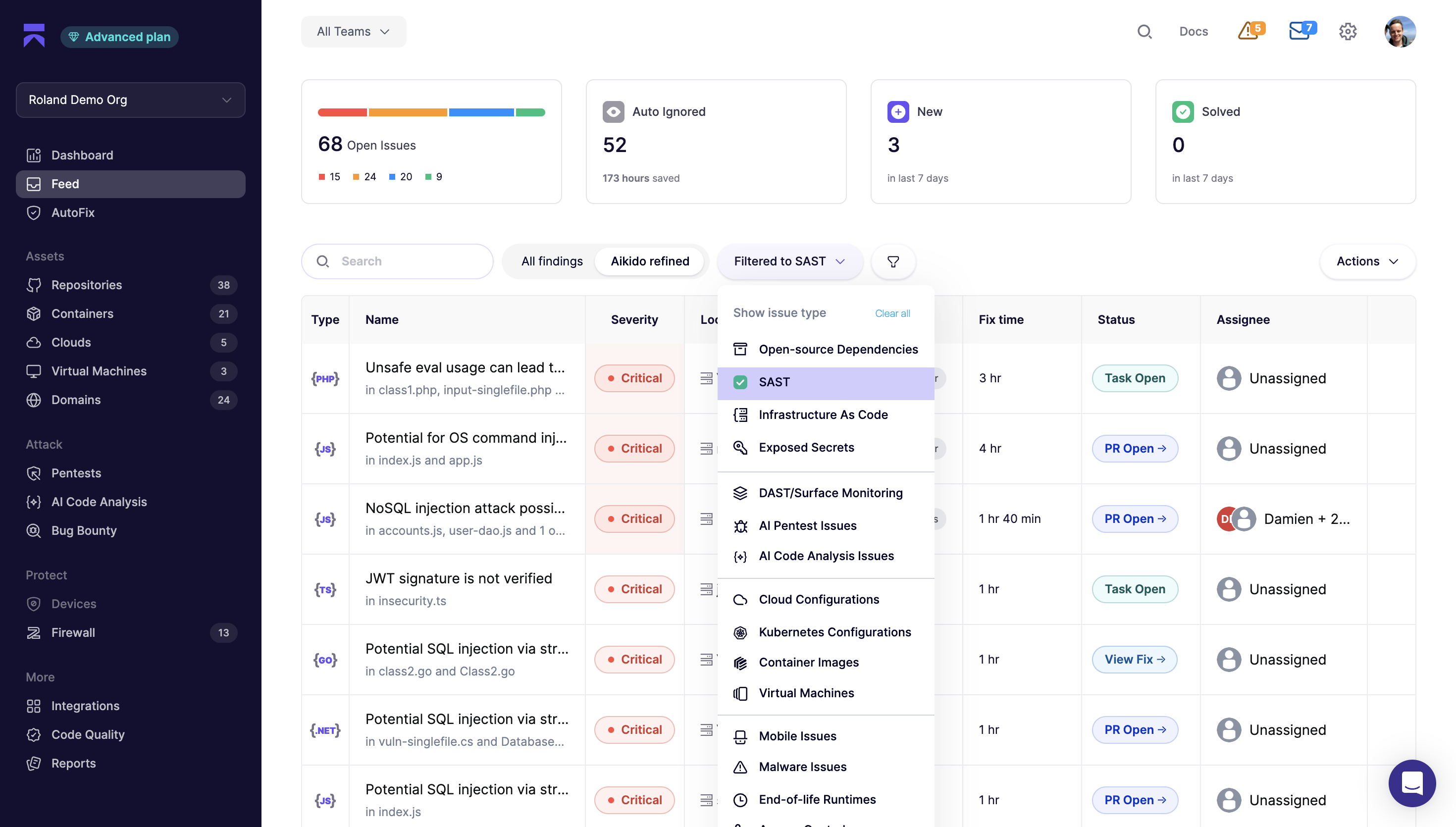
Aikido ships a deterministic SAST engine designed to run on every commit. It integrates with LLMs to reduce noise and false positives compared to other SAST tools by over 90%. When SAST finds a vulnerability and a fix is available, AI AutoFix attaches the suggested diff to the comment so you can review and commit it at once, or opens a dedicated PR whose metadata you can fine-tune to match your contribution guidelines. You can adjust any generated fix with natural-language follow-ups so it matches your standards, and write custom code checks in plain English instead of regex.
The IDE plugins for VS Code and other editors scan on file open and save, highlight issues inline, and list them in an Aikido panel. Hovering a finding lets you assess its impact with AutoTriage, and AutoFix shows a side-by-side preview you apply in place, after which the file is rescanned to confirm the issue is resolved. Everything routes into tools teams already use. Aikido connects to Jira Cloud, Linear, Slack, Bitbucket, and Azure DevOps, and can insert Jira ticket IDs into AutoFix PR titles for traceability between fixes and tickets.
Going beyond SAST, Aikido also ships an agentic AI Code Analysis product that reasons about source code the way a pentester would and extends coverage to all languages. To set it up, you just need to give it repo access. Multiple security agents work through your codebase together, chaining context across files and modules to surface the kinds of issues that pattern-based scanners structurally can't see.
For teams that want runtime validation too, Aikido AI Pentest runs the same agentic engine against a live target as AI Code Analysis, and the two products complement each other. Use Code Audit for source-level reasoning on demand and Pentest for live exploitability proof when you have a running test environment.
Aikido is also a best fit for many enterprises, with CI gates, custom policies and rules, data privacy, private deployment options, and audit logs. It supports large monorepos and legacy languages, as well as organizational reporting, support SLAs, and named deployment evidence.
Best for: Teams that want enterprise-grade SAST alongside best-in-class AI code analysis and AI pentesting for compliance and auditing, with fast setup and hands-on support that developer teams actually get to talk to.
{{walkthrough}}
Checkmarx
The Checkmarx platform bundles SAST, DAST, SCA, IaC, API security, container security, secrets detection, and ASPM into a single product. Checkmarx SAST's core detection runs on CxQL (Checkmarx Query Language), its proprietary language for writing SAST detection rules. Checkmarx SAST offers broad language support, including legacy stacks like COBOL and RPG. They released an AI code audit tool in July 2026, but it is not yet battle-tested.
Full Checkmarx SAST scans take 25 to 45 minutes per application, which is orders of magnitude slower than other deterministic SAST tools that return results in seconds. It also requires a team to manage it and is less dev-focused than other options in the market. Implementing Checkmarx in an organization can often take six weeks or more, and pricing is opaque and quote-based through sales, licensed per contributing developer, with each module billed separately. Multiple Gartner Peer Insights reviewers note that the tool can feel dated in its developer experience, and users have specifically requested more advanced AI-powered auto-remediation comparable to what newer tools offer.
If your security program already revolves around Checkmarx, it still does the job. If you're evaluating fresh, the total cost of ownership and scan speed are worth scrutinizing.
Best for: Large companies with big budgets that already have AppSec engineering staff and are willing to accept slower analysis and higher costs for breadth of coverage.
Snyk Code
Snyk started as an SCA tool, and SAST came later. Snyk Code is the SAST product within the broader Snyk AppSec platform. The SAST engine uses more traditional machine learning, instead of an LLM, for noise reduction, specifically when it comes to well-known vulnerability classes like command injection and hardcoded secrets. Snyk is known to still produce noisier SAST findings than its competitors. If you want an LLM involved in code triage and prioritization, you’ll have to go with a different SAST vendor.
Snyk's autofix, now called Snyk Agent Fix, pulls human-written fix examples for that CWE from a database of thousands of handwritten pairs, feeds them to an LLM as few-shot prompts, generates candidate fixes, and re-runs static analysis on each one to verify the fix actually worked. If verification fails, the error feeds back to the model, and it retries.
Pricing scales per contributing developer with a cliff into Enterprise at 15,000 dollars or more per year past 10 developers. The engine is closed with custom rules Enterprise-gated. Snyk claims support for 19 languages.
Best for: Developer-first teams that value a mature, scanning experience integrated across IDE, CLI, and CI/CD, that can absorb the per-developer pricing model and don’t mind having to tune to avoid noise.
SonarQube
SonarQube started as a code quality platform and layered security analysis on top. The Enterprise edition's SAST tool supports 35+ languages (including COBOL and ABAP), adds taint analysis for tracking injection vulnerabilities across methods and classes, and provides portfolio-level reporting for organizations managing hundreds of repos. Quality gates that block merges based on configurable thresholds are well understood by developers, and the SonarQube IDE extension provides local feedback.
But SonarQube's DNA is code quality, not security. The majority of its rules target code smells, bugs, and maintainability, with security being the secondary use case. Advanced SAST with taint tracking across third-party libraries is currently limited to Java, C#, JavaScript, and TypeScript. Custom SAST rule authoring is Enterprise-only. Self-hosting requires a PostgreSQL (or Oracle/MSSQL) database, Java runtime, and regular upgrades. Budget 5 to 15 hours of admin time per month. And pricing is LOC-based, which gets unpredictable as codebases grow, especially with AI-generated code expanding line counts faster than headcount. Reviewers report running SonarQube for quality enforcement and layer a dedicated SAST tool on top for security depth, which says something about its SAST capabilities.
Best for: Engineering organizations that want unified code quality and baseline SAST in one platform. However, teams might need a dedicated SAST tool for deeper security.
GitHub Advanced Security
CodeQL is GitHub's proprietary semantic code analysis engine that powers GHAS’s SAST capabilities, which works for standard use cases. CodeQL works differently from other SAST scanning methods by treating code like data in a database. It creates a database representation of your codebase, then you run queries against that database to find vulnerabilities.
Copilot Autofix generates fix suggestions for CodeQL alerts on pull requests and the default branch. Detection itself stays deterministic, and CodeQL queries are open source and extensible for teams willing to learn QL.
However, it only works on GitHub, and, to a lesser extent, Azure DevOps, so it's a non-starter for teams on GitLab or Bitbucket. Language coverage sits around a dozen, which is narrower than the enterprise incumbents. Per-active-committer billing also fluctuates month to month with team activity, which makes budgeting less predictable than a flat license. And reviewers report difficulties writing custom CodeQL queries.
Best for: GitHub-native teams that want deep semantic analysis and AI-assisted fixes without leaving their existing workflow, and can live with GitHub (or Azure DevOps) as a hard dependency.
Semgrep
Semgrep offers a couple of different SAST options. Semgrep Community Edition is an open source, lightweight SAST scanner with rules under open source licenses. Semgrep Code, its paid SAST product, uses cross-file and cross-function analysis for improved results over Community Edition, and the AI layer, Semgrep Assistant, handles triage. The signature feature is custom rules, where Semgrep's pattern syntax looks like the code it matches, with no separate query language to learn. The Team plan runs $35 per contributor per month and unlocks cross-file analysis, the AI Assistant, and 20,000+ proprietary rules on top of the roughly 3,000 community ones.
The limitations mostly concern what the platform doesn't include. The deepest analysis and the AI features are all paid, so the free tier that made Semgrep famous is a much smaller product than the name suggests. Semgrep's own documentation is blunt that Community Edition will miss many true positives since it can only analyze code within a single function or file. The 2024 license change that restricted how vendors can use Semgrep rules also spawned the Opengrep fork and some community friction.
Best for: Teams with security engineers who want to write and tune their own rules, and who value fast scans over mature platforms with deeper coverage of the complete SDLC.
<script type="application/ld+json">
{
"@context": "https://schema.org",
"@graph": [
{
"@type": "BlogPosting",
"@id": "https://www.aikido.dev/blog/top-sast-tools-2026#blogposting",
"isPartOf": {
"@id": "https://www.aikido.dev/blog/top-sast-tools-2026#webpage"
},
"mainEntityOfPage": {
"@id": "https://www.aikido.dev/blog/top-sast-tools-2026#webpage"
},
"headline": "Top SAST Tools 2026: A Comparison of the Leading Static Application Security Testing Platforms",
"description": "A comparison of the top SAST tools in 2026, covering Aikido Security, Checkmarx, Snyk Code, SonarQube, GitHub Advanced Security, and Semgrep. Includes detection strategy, noise levels, remediation, and enterprise fit.",
"datePublished": "2026-07-29T09:00:00+00:00",
"dateModified": "2026-07-29T09:00:00+00:00",
"inLanguage": "en-US",
"wordCount": 1650,
"timeRequired": "PT8M",
"articleSection": "Application Security",
"keywords": [
"SAST",
"static application security testing",
"SAST tools 2026",
"Aikido Security",
"Checkmarx",
"Snyk Code",
"SonarQube",
"GitHub Advanced Security",
"CodeQL",
"Semgrep",
"AI-assisted SAST",
"AI code analysis",
"application security",
"vulnerability detection",
"AutoFix",
"AutoTriage",
"reachability analysis",
"false positive reduction",
"enterprise SAST"
],
"author": {
"@id": "https://www.aikido.dev/authors/nicholas-thomson#person"
},
"publisher": {
"@id": "https://www.aikido.dev/#organization"
},
"image": {
"@id": "https://www.aikido.dev/blog/top-sast-tools-2026#primaryimage"
},
"about": [
{
"@type": "Thing",
"name": "Static Application Security Testing",
"sameAs": "https://en.wikipedia.org/wiki/Static_application_security_testing"
},
{
"@type": "Thing",
"name": "Application Security",
"sameAs": "https://en.wikipedia.org/wiki/Application_security"
},
{
"@type": "Thing",
"name": "Vulnerability (computing)",
"sameAs": "https://en.wikipedia.org/wiki/Vulnerability_(computing)"
}
],
"mentions": [
{
"@type": "SoftwareApplication",
"name": "Aikido Security",
"applicationCategory": "SecurityApplication",
"operatingSystem": "Cloud",
"url": "https://www.aikido.dev"
},
{
"@type": "SoftwareApplication",
"name": "Checkmarx",
"applicationCategory": "SecurityApplication",
"operatingSystem": "Cloud",
"url": "https://checkmarx.com"
},
{
"@type": "SoftwareApplication",
"name": "Snyk Code",
"applicationCategory": "SecurityApplication",
"operatingSystem": "Cloud",
"url": "https://snyk.io/product/snyk-code/"
},
{
"@type": "SoftwareApplication",
"name": "SonarQube",
"applicationCategory": "SecurityApplication",
"operatingSystem": "Cloud, On-Premises",
"url": "https://www.sonarsource.com/products/sonarqube/"
},
{
"@type": "SoftwareApplication",
"name": "GitHub Advanced Security",
"applicationCategory": "SecurityApplication",
"operatingSystem": "Cloud",
"url": "https://github.com/security/advanced-security"
},
{
"@type": "SoftwareApplication",
"name": "Semgrep",
"applicationCategory": "SecurityApplication",
"operatingSystem": "Cloud, CLI",
"url": "https://semgrep.dev"
},
{
"@type": "DefinedTerm",
"name": "SAST",
"description": "Static Application Security Testing analyzes source code before it runs to uncover potential security vulnerabilities in syntax, structure, and logic.",
"inDefinedTermSet": "https://owasp.org/www-community/Source_Code_Analysis_Tools"
},
{
"@type": "DefinedTerm",
"name": "AI-assisted SAST",
"description": "SAST tooling that keeps a deterministic detection engine and adds AI for triage, prioritization, and fix generation."
},
{
"@type": "DefinedTerm",
"name": "AI Code Analysis",
"description": "Fully agentic SAST that replaces pattern-matching with AI agents that reason about code across files and services to surface issues rule-based engines cannot see."
}
],
"citation": [
{
"@type": "CreativeWork",
"name": "2026 State of AI in Security & Development Report",
"author": {
"@id": "https://www.aikido.dev/#organization"
},
"url": "https://www.aikido.dev/state-of-ai-security-development-2026"
}
],
"speakable": {
"@type": "SpeakableSpecification",
"cssSelector": ["h1", "h2", ".tldr", ".best-for"]
}
},
{
"@type": "WebPage",
"@id": "https://www.aikido.dev/blog/top-sast-tools-2026#webpage",
"url": "https://www.aikido.dev/blog/top-sast-tools-2026",
"name": "Top SAST Tools 2026: A Comparison of the Leading Static Application Security Testing Platforms",
"isPartOf": {
"@id": "https://www.aikido.dev/#website"
},
"primaryImageOfPage": {
"@id": "https://www.aikido.dev/blog/top-sast-tools-2026#primaryimage"
},
"datePublished": "2026-07-29T09:00:00+00:00",
"dateModified": "2026-07-29T09:00:00+00:00",
"inLanguage": "en-US",
"breadcrumb": {
"@id": "https://www.aikido.dev/blog/top-sast-tools-2026#breadcrumb"
},
"potentialAction": [
{
"@type": "ReadAction",
"target": ["https://www.aikido.dev/blog/top-sast-tools-2026"]
}
]
},
{
"@type": "WebSite",
"@id": "https://www.aikido.dev/#website",
"url": "https://www.aikido.dev",
"name": "Aikido Security",
"publisher": {
"@id": "https://www.aikido.dev/#organization"
},
"inLanguage": "en-US"
},
{
"@type": "BreadcrumbList",
"@id": "https://www.aikido.dev/blog/top-sast-tools-2026#breadcrumb",
"itemListElement": [
{
"@type": "ListItem",
"position": 1,
"name": "Home",
"item": "https://www.aikido.dev"
},
{
"@type": "ListItem",
"position": 2,
"name": "Blog",
"item": "https://www.aikido.dev/blog"
},
{
"@type": "ListItem",
"position": 3,
"name": "Top SAST Tools 2026",
"item": "https://www.aikido.dev/blog/top-sast-tools-2026"
}
]
},
{
"@type": "ImageObject",
"@id": "https://www.aikido.dev/blog/top-sast-tools-2026#primaryimage",
"url": "https://www.aikido.dev/blog/top-sast-tools-2026/cover.png",
"contentUrl": "https://www.aikido.dev/blog/top-sast-tools-2026/cover.png",
"width": 1200,
"height": 630,
"caption": "Top SAST Tools 2026 comparison cover image"
},
{
"@type": "Organization",
"@id": "https://www.aikido.dev/#organization",
"name": "Aikido Security",
"url": "https://www.aikido.dev",
"logo": {
"@type": "ImageObject",
"url": "https://www.aikido.dev/logo.png",
"width": 512,
"height": 512
},
"sameAs": [
"https://www.linkedin.com/company/aikido-security",
"https://x.com/AikidoSecurity",
"https://github.com/AikidoSec"
]
},
{
"@type": "Person",
"@id": "https://www.aikido.dev/authors/nicholas-thomson#person",
"name": "Nicholas Thomson",
"jobTitle": "Senior SEO & Growth Lead",
"url": "https://www.aikido.dev/authors/nicholas-thomson",
"worksFor": {
"@id": "https://www.aikido.dev/#organization"
},
"sameAs": [
"https://www.linkedin.com/",
"https://x.com/"
]
},
{
"@type": "ItemList",
"@id": "https://www.aikido.dev/blog/top-sast-tools-2026#itemlist",
"name": "Top SAST Tools 2026",
"description": "Ranked list of the top SAST tools for 2026, evaluated on detection strategy, noise levels, remediation workflow, and enterprise scalability.",
"numberOfItems": 6,
"itemListOrder": "https://schema.org/ItemListOrderAscending",
"itemListElement": [
{
"@type": "ListItem",
"position": 1,
"name": "Aikido Security",
"url": "https://www.aikido.dev",
"item": {
"@type": "SoftwareApplication",
"name": "Aikido Security",
"applicationCategory": "SecurityApplication",
"operatingSystem": "Cloud",
"description": "Enterprise-grade SAST with deterministic detection, AI-powered AutoFix and AutoTriage, and agentic AI Code Analysis for pentest-depth reasoning.",
"url": "https://www.aikido.dev"
}
},
{
"@type": "ListItem",
"position": 2,
"name": "Checkmarx",
"url": "https://checkmarx.com",
"item": {
"@type": "SoftwareApplication",
"name": "Checkmarx",
"applicationCategory": "SecurityApplication",
"operatingSystem": "Cloud",
"description": "Legacy enterprise SAST with broad language support and a proprietary query language (CxQL), often chosen by regulated industries with dedicated AppSec staff."
}
},
{
"@type": "ListItem",
"position": 3,
"name": "Snyk Code",
"url": "https://snyk.io/product/snyk-code/",
"item": {
"@type": "SoftwareApplication",
"name": "Snyk Code",
"applicationCategory": "SecurityApplication",
"operatingSystem": "Cloud",
"description": "Developer-focused SAST integrated into the broader Snyk AppSec platform, with ML-based noise reduction and Agent Fix autofix."
}
},
{
"@type": "ListItem",
"position": 4,
"name": "SonarQube",
"url": "https://www.sonarsource.com/products/sonarqube/",
"item": {
"@type": "SoftwareApplication",
"name": "SonarQube",
"applicationCategory": "SecurityApplication",
"operatingSystem": "Cloud, On-Premises",
"description": "Code quality platform with layered SAST capabilities, taint analysis, quality gates, and IDE feedback via SonarQube for IDE."
}
},
{
"@type": "ListItem",
"position": 5,
"name": "GitHub Advanced Security",
"url": "https://github.com/security/advanced-security",
"item": {
"@type": "SoftwareApplication",
"name": "GitHub Advanced Security",
"applicationCategory": "SecurityApplication",
"operatingSystem": "Cloud",
"description": "GitHub-native SAST powered by CodeQL semantic analysis, with Copilot Autofix for AI-assisted remediation on pull requests."
}
},
{
"@type": "ListItem",
"position": 6,
"name": "Semgrep",
"url": "https://semgrep.dev",
"item": {
"@type": "SoftwareApplication",
"name": "Semgrep",
"applicationCategory": "SecurityApplication",
"operatingSystem": "Cloud, CLI",
"description": "Pattern-based SAST platform with a lightweight Community Edition and a commercial AppSec Platform featuring cross-file analysis and AI-powered triage."
}
}
]
},
{
"@type": "FAQPage",
"@id": "https://www.aikido.dev/blog/top-sast-tools-2026#faq",
"mainEntity": [
{
"@type": "Question",
"name": "Can SAST detect vulnerabilities in AI-generated code?",
"acceptedAnswer": {
"@type": "Answer",
"text": "Yes, and it matters more than ever. According to Aikido's 2026 State of AI in Security & Development report, nearly 70% of organizations say they've uncovered flaws tied to AI-generated code. AI-generated code enters the same repos and pipelines as human code, so any SAST tool scanning on commit covers it. The volume increase is the real problem, which makes noise reduction the deciding factor."
}
},
{
"@type": "Question",
"name": "What is the difference between deterministic and AI-assisted SAST?",
"acceptedAnswer": {
"@type": "Answer",
"text": "Deterministic SAST matches known patterns with predictable, repeatable results. AI-assisted SAST keeps that engine and adds AI for triage, prioritization, and fix generation. Nearly every commercial tool in 2026 is AI-assisted to some degree."
}
},
{
"@type": "Question",
"name": "What is fully AI SAST?",
"acceptedAnswer": {
"@type": "Answer",
"text": "AI SAST replaces pattern-matching with AI agents that reason about code the way a security engineer would, tracing intent and data flow across files and services to surface issues rule-based engines can't see (IDORs, broken auth logic, business logic flaws). It's more expensive per run than deterministic SAST, so most teams use it for deep on-demand reviews rather than on every commit. Aikido's AI Code Analysis is an example."
}
},
{
"@type": "Question",
"name": "How do you reduce false positives in SAST?",
"acceptedAnswer": {
"@type": "Answer",
"text": "Reachability analysis, AI-powered triage, and tuning rules to your codebase. Look for tools that distinguish vulnerabilities in dead code from ones in hot paths."
}
},
{
"@type": "Question",
"name": "How much do SAST tools cost?",
"acceptedAnswer": {
"@type": "Answer",
"text": "Ranges from free (open source) to $200k+ per year (legacy enterprise platforms). Common models are per-developer, per-committer, and lines-of-code pricing, each with different failure modes as you scale."
}
},
{
"@type": "Question",
"name": "What is the difference between SAST and DAST?",
"acceptedAnswer": {
"@type": "Answer",
"text": "SAST tools examine your source code before your application is deployed, to catch issues such as insecure functions, hardcoded credentials, or logic flaws during development. DAST tools run security tests while the application is live, probing it like an attacker would to identify exploitable weaknesses such as SQL injection, XSS, or authentication bypasses. Both matter, but they serve different purposes at different stages of the SDLC."
}
}
]
}
]
}
</script>