Google Cloud Platform (GCP) provides an incredibly powerful suite of services for building and scaling modern applications. Its innovative tools for data analytics, machine learning, and container orchestration have made it a favorite among developers. However, this power and flexibility also introduce a complex security landscape. Misconfigurations, software vulnerabilities, and identity-based threats can easily expose your GCP environment to significant risk.
Securing your GCP assets is non-negotiable, but navigating the crowded market of security tools can be a daunting task. You need solutions that provide deep visibility into your cloud posture without overwhelming your teams with a flood of alerts. More importantly, these tools must integrate seamlessly into your existing workflows, empowering your developers to build securely without slowing them down.
This guide cuts through the complexity, offering an honest and actionable comparison of the top GCP security tools for 2026. We will break down their strengths, weaknesses, and ideal use cases to help you find the perfect solution for your team, whether you're a fast-moving startup or a large, regulated enterprise.
How We Chose the Top GCP Security Tools
To create a useful and balanced review, we evaluated each tool against several key criteria that are critical for modern cloud security:
- Comprehensiveness: Does the tool offer broad coverage across the full application lifecycle, from code to cloud infrastructure?
- Actionability and Accuracy: How effective is the tool at identifying real threats while minimizing false positives and providing clear remediation guidance?
- Ease of Integration: How smoothly does it fit into developer workflows and existing CI/CD pipelines?
- Multi-Cloud Capabilities: Can the tool consistently secure assets across GCP and other cloud environments?
- Pricing and Scalability: Is the pricing model transparent, and can the tool scale effectively with your business?
The 6 Best GCP Security Tools
Here is our curated list of the top tools to help you gain visibility and control over your GCP environment.
1. Aikido Security
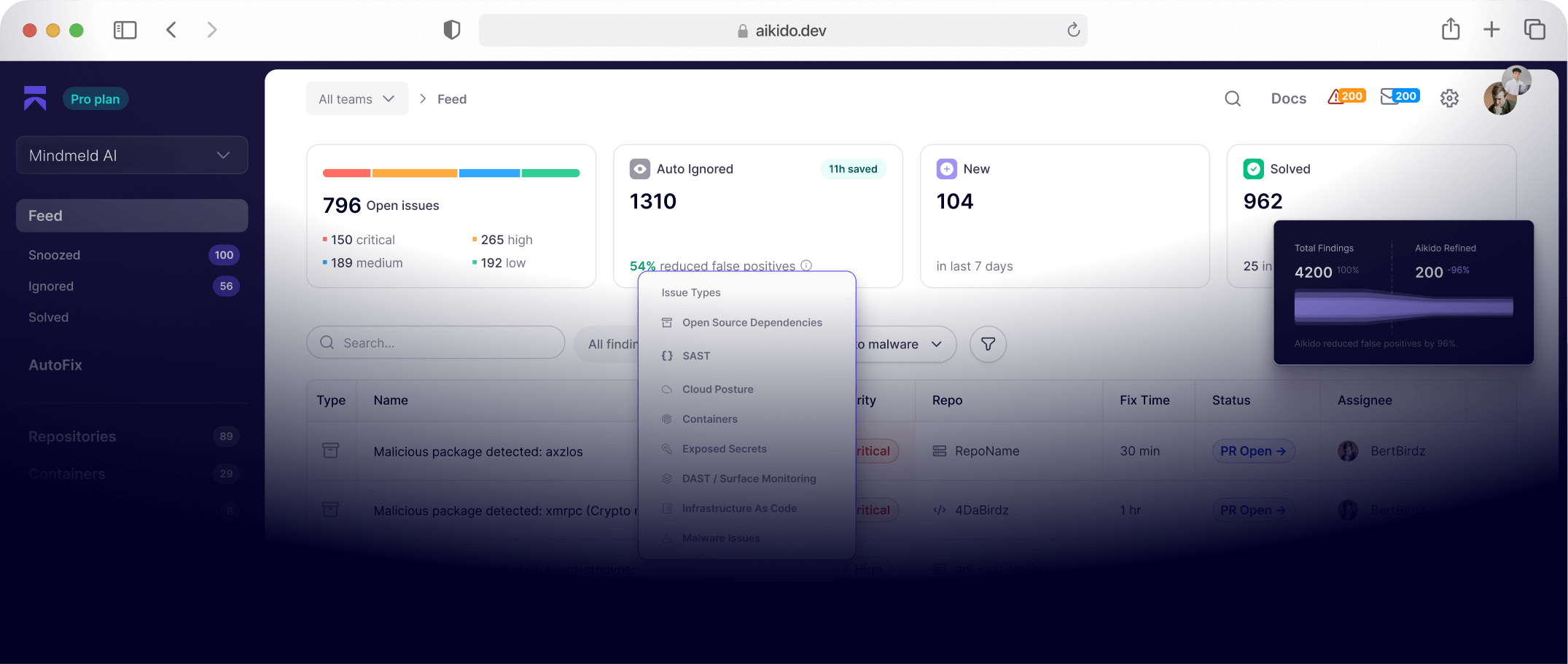
Aikido Security is a developer-first security platform designed to unify security across the entire software development lifecycle. It stands apart by integrating security directly into the development process, consolidating findings from code, dependencies, containers, and cloud infrastructure into a single, manageable view. Its primary focus is on eliminating noise by focusing on what’s truly exploitable and providing developers with AI-powered, actionable fixes. Learn more about the platform's unique approach here.
Key Features & Strengths:
- Unified Code-to-Cloud Security: Combines nine security scanners (SAST, SCA, IaC, secrets, etc.) to provide a holistic view of vulnerabilities from code to your GCP cloud environment, all in one place.
- Intelligent Triaging: Automatically prioritizes issues by identifying which vulnerabilities are actually reachable and pose a real threat, allowing teams to focus their efforts on the most critical risks.
- AI-Powered Autofixes: Delivers automated code suggestions to resolve vulnerabilities directly within pull requests, dramatically speeding up remediation times.
- Seamless Developer Workflow Integration: Natively integrates with GitHub, GitLab, and other developer tools, embedding security monitoring into the CI/CD pipeline without causing friction.
- Enterprise-Ready Scalability: Built to handle the demands of large organizations with robust performance, while its straightforward, flat-rate pricing model simplifies budgeting and scales predictably.
Ideal Use Cases / Target Users:
Aikido is the best overall solution for any organization—from fast-moving startups to large enterprises—that wants to embed security into its development culture. It's perfect for development teams taking ownership of security and for security leaders who need a scalable, efficient platform that enhances collaboration.
Pros and Cons:
- Pros: Exceptionally easy to set up and use, significantly reduces alert fatigue by focusing on reachable vulnerabilities, consolidates the functionality of multiple tools, and offers a generous free-forever tier to get started.
- Cons: Focuses on application and cloud security, so teams needing deep, old-school network packet inspection may require a supplementary tool.
Pricing / Licensing:
Aikido offers a free-forever tier with unlimited users and repositories for its core features. Paid plans are available with simple, flat-rate pricing to unlock advanced capabilities, making it accessible and predictable for businesses of all sizes.
Recommendation Summary:
Aikido Security is the top choice for organizations seeking a comprehensive and efficient security platform for their GCP environment. Its developer-centric approach and intelligent automation make it a powerful tool for building secure software at scale, making it a premier option for both agile teams and established enterprises. For more details about how Aikido can help your organization, visit their main site.
2. Check Point CloudGuard
Check Point CloudGuard is an enterprise-grade cloud security platform providing unified security and compliance management for multi-cloud environments, including extensive support for GCP. It combines Cloud Security Posture Management (CSPM), Cloud Workload Protection (CWPP), and network security capabilities into a single solution.
Key Features & Strengths:
- Comprehensive Posture Management: Delivers deep visibility into security misconfigurations and compliance gaps across your GCP environment, supporting standards like PCI DSS, HIPAA, and NIST.
- Advanced Workload Protection: Offers runtime protection, vulnerability scanning, and threat prevention for virtual machines, containers (GKE), and serverless functions in GCP. For further reading on common container threats, check out Docker container security vulnerabilities and how to prevent container privilege escalation.
- Cloud Network Security: Extends Check Point's industry-leading network security features to the cloud, including an advanced firewall, intrusion prevention (IPS), and traffic analysis.
- Multi-Cloud Consistency: Provides a single console to manage security policies and view threats across GCP, AWS, Azure, and other platforms.
Ideal Use Cases / Target Users:
CloudGuard is built for large enterprises with complex, multi-cloud environments and stringent regulatory requirements. It is best suited for central security teams needing a powerful, all-in-one solution for managing cloud security at scale.
Pros and Cons:
- Pros: Extensive feature set covering posture, workload, and network security. Strong multi-cloud support and powerful compliance automation.
- Cons: Can be complex to configure, and its enterprise-focused pricing model can be expensive for smaller teams.
Pricing / Licensing:
CloudGuard is a commercial product with pricing based on the number of protected assets and the specific modules licensed. A free trial is available.
Recommendation Summary:
For large organizations requiring a feature-rich platform to manage compliance and protect multi-cloud assets, Check Point CloudGuard is a top-tier choice that offers deep security controls for GCP.
3. Lacework
Lacework is a data-driven cloud security platform that uses a patented machine learning engine to build a baseline of normal behavior in your GCP environment. It then identifies anomalies and threats across accounts, workloads, and containers in near real-time, focusing on threat detection based on behavior rather than static rules. For teams exploring advanced detection, you may also be interested in how AI-driven penetration testing is shaping the future of security.
Key Features & Strengths:
- Behavioral Anomaly Detection: Its Polygraph machine learning engine builds a deep understanding of your environment's activities to detect novel threats, zero-day attacks, and insider threats. This AI-focused approach reflects trends seen in AI-powered security tools for code generation and analysis.
- End-to-End Visibility: Provides a single platform for CSPM, CWPP, container security, and compliance across GCP and other major cloud providers.
- Automated Investigation: Generates highly contextualized alerts that group related events into a clear narrative, significantly reducing investigation time for security teams.
- Shift-Left Capabilities: Integrates with developer tools to scan for vulnerabilities and misconfigurations in the CI/CD pipeline, embedding security earlier in the lifecycle.
Ideal Use Cases / Target Users:
Lacework is ideal for security-forward organizations that prioritize threat detection based on behavior. It’s well-suited for security analysts and DevOps teams who need deep visibility and context to respond quickly to threats in dynamic cloud environments.
Pros and Cons:
- Pros: Powerful machine learning provides unique insights and can detect threats that other tools miss. The unified platform simplifies security management across multi-cloud setups.
- Cons: It is a premium-priced product, and the machine learning engine requires a learning period to stabilize. It can be overwhelming for smaller teams without a dedicated security function.
Pricing / Licensing:
Lacework is a commercial solution with custom pricing based on the size and complexity of the monitored cloud environment.
Recommendation Summary:
Lacework is a powerful choice for mature security programs seeking advanced, behavior-based threat detection for their GCP and multi-cloud infrastructure. For further inspiration and comparisons, check out Aikido's blog for insights on leveraging AI for proactive security.
4. Orca Security
Orca Security provides an agentless cloud security platform that gives you 100% visibility into your GCP environment within minutes. Its SideScanning™ technology works by reading your cloud configuration and workload block storage out-of-band, allowing it to detect vulnerabilities, malware, misconfigurations, and lateral movement risk without any performance impact.
Key Features & Strengths:
- Agentless SideScanning™: Scans the entire cloud estate without requiring agents, enabling rapid deployment and comprehensive visibility with zero performance overhead on your workloads.
- Unified Risk Context: Combines findings from across different layers—from workload vulnerabilities to cloud misconfigurations—to prioritize the most critical risks in your GCP environment.
- Full-Stack Visibility: Provides a single platform for CSPM, CWPP, vulnerability management, and compliance across GCP, AWS, and Azure.
- Attack Path Analysis: Identifies toxic combinations of risks that could create a viable attack path, helping teams focus remediation efforts on the most dangerous threat vectors.
Ideal Use Cases / Target Users:
Orca is excellent for organizations that want deep, comprehensive visibility into their cloud security posture without the operational burden of managing agents. It’s highly valuable for security teams who need to consolidate tools and prioritize risks effectively.
Pros and Cons:
- Pros: Extremely fast and easy to deploy, provides deep visibility with no performance impact, and its contextual risk prioritization is highly effective.
- Cons: As an agentless solution, it may not provide the same real-time runtime protection as agent-based tools for certain use cases. It is a premium, enterprise-focused product.
Pricing / Licensing:
Orca Security is a commercial platform with pricing based on the number of assets scanned.
Recommendation Summary:
Orca Security is a leading choice for teams that prioritize ease of deployment and context-aware visibility. Its agentless approach is a major advantage for securing large and dynamic GCP environments.
5. Prisma Cloud
Prisma Cloud by Palo Alto Networks is a comprehensive Cloud-Native Application Protection Platform (CNAPP) that provides security from code to cloud. It offers broad security and compliance coverage for applications, data, and the entire cloud-native technology stack, including deep support for Google Cloud.
Key Features & Strengths:
- Full Lifecycle Security: Secures applications and infrastructure across the entire development lifecycle, from code scanning in the pipeline to protecting workloads in production.
- Broad CNAPP Capabilities: Integrates CSPM, CWPP, cloud network security, and cloud infrastructure entitlement management (CIEM) into a single platform.
- Deep GCP Integration: Offers extensive visibility into Google Cloud services and configurations, helping to enforce security policies and maintain compliance.
- Supply Chain Security: Provides tools to secure your software supply chain, including container image scanning and open-source dependency analysis.
Ideal Use Cases / Target Users:
Prisma Cloud is designed for large enterprises that require a comprehensive, end-to-end security solution for their cloud-native applications and multi-cloud environments. It's ideal for organizations looking to consolidate multiple point solutions into a single platform.
Pros and Cons:
- Pros: One of the most comprehensive feature sets on the market, strong multi-cloud support, and backed by the reputation of Palo Alto Networks.
- Cons: Can be very complex and expensive, potentially leading to a high total cost of ownership. The vast number of features can be overwhelming to implement and manage.
Pricing / Licensing:
Prisma Cloud is a commercial platform with a credit-based licensing model that can be complex. Pricing depends on the number of workloads and features used.
Recommendation Summary:
For enterprises that need an all-encompassing security platform and have the resources to manage it, Prisma Cloud offers unparalleled depth and breadth of features for securing GCP and other cloud environments.
6. Wiz
Wiz is another market-leading agentless cloud security platform that has gained massive popularity for its ability to provide full-stack visibility across multi-cloud environments. It scans your entire GCP stack to build a graph of risks, connecting vulnerabilities in code to misconfigurations in the cloud, giving a clear picture of toxic combinations.
Key Features & Strengths:
- Agentless Deep Scanning: Similar to Orca, Wiz connects to your cloud environment and scans workloads without requiring agents, ensuring full coverage and rapid onboarding.
- Security Graph Analysis: Creates a visual graph that maps all cloud resources and their relationships, revealing complex attack paths and prioritizing risks based on context.
- Comprehensive Coverage: Unifies CSPM, CWPP, container security, and IaC scanning into a single, integrated platform with strong support for GCP services.
- Developer Collaboration: Integrates with CI/CD pipelines and provides actionable insights for developers, helping to embed security earlier in the lifecycle.
Ideal Use Cases / Target Users:
Wiz is targeted at enterprises and high-growth companies that need to secure complex, multi-cloud environments. It is highly valued by security teams, risk managers, and DevOps leaders who need a single source of truth for cloud risk.
Pros and Cons:
- Pros: Provides powerful contextual insights through its security graph, very easy to set up, and offers comprehensive visibility across the entire tech stack.
- Cons: It is a premium-priced solution aimed at the enterprise market. The sheer volume of data and insights can be overwhelming for smaller organizations.
Pricing / Licensing:
Wiz is a commercial product with custom pricing based on the size of the cloud environment.
Recommendation Summary:
Wiz is an exceptional platform for organizations that can invest in a premium solution for unparalleled visibility and contextual risk analysis. Its security graph is a powerful tool for understanding and mitigating complex threats in GCP.
Making the Right Choice for GCP Security
Choosing the right security tool for your GCP environment depends heavily on your organization's scale, maturity, and security philosophy.
For large enterprises with dedicated security teams and complex multi-cloud needs, comprehensive agentless platforms like Wiz, Aikido Security, and Orca Security offer incredible visibility with rapid deployment. For those needing deep, feature-rich platforms that cover everything from network to workload, Prisma Cloud and Check Point CloudGuard are powerful contenders.
However, the most effective modern security strategy is one that is embedded into the development process, not bolted on after the fact. This is where Aikido Security delivers unmatched value. By unifying security monitoring from code to cloud and empowering developers with AI-driven fixes, Aikido eliminates the noise and friction that plague traditional security tools. It offers the comprehensive visibility enterprises need with the simplicity and speed agile teams require.
By selecting a tool that brings security closer to your developers, you can move beyond simple monitoring and foster a proactive security culture that protects your GCP applications from the ground up.