Introduction: When was the last time you scrutinized your web application’s security beyond just making it work? Here’s the scary truth: every form field, API endpoint, third-party script, and configuration file in your app could be an attack vector if left unchecked. Modern web apps are richer and more complex than ever – and that means a growing surface area for attackers. In fact, recent data shows that web applications are involved in nearly half of security incidents. From the infamous OWASP Top 10 risks to freshly uncovered CVEs, web vulnerabilities are not abstract theory – they’re behind real breaches happening to organizations of all sizes.
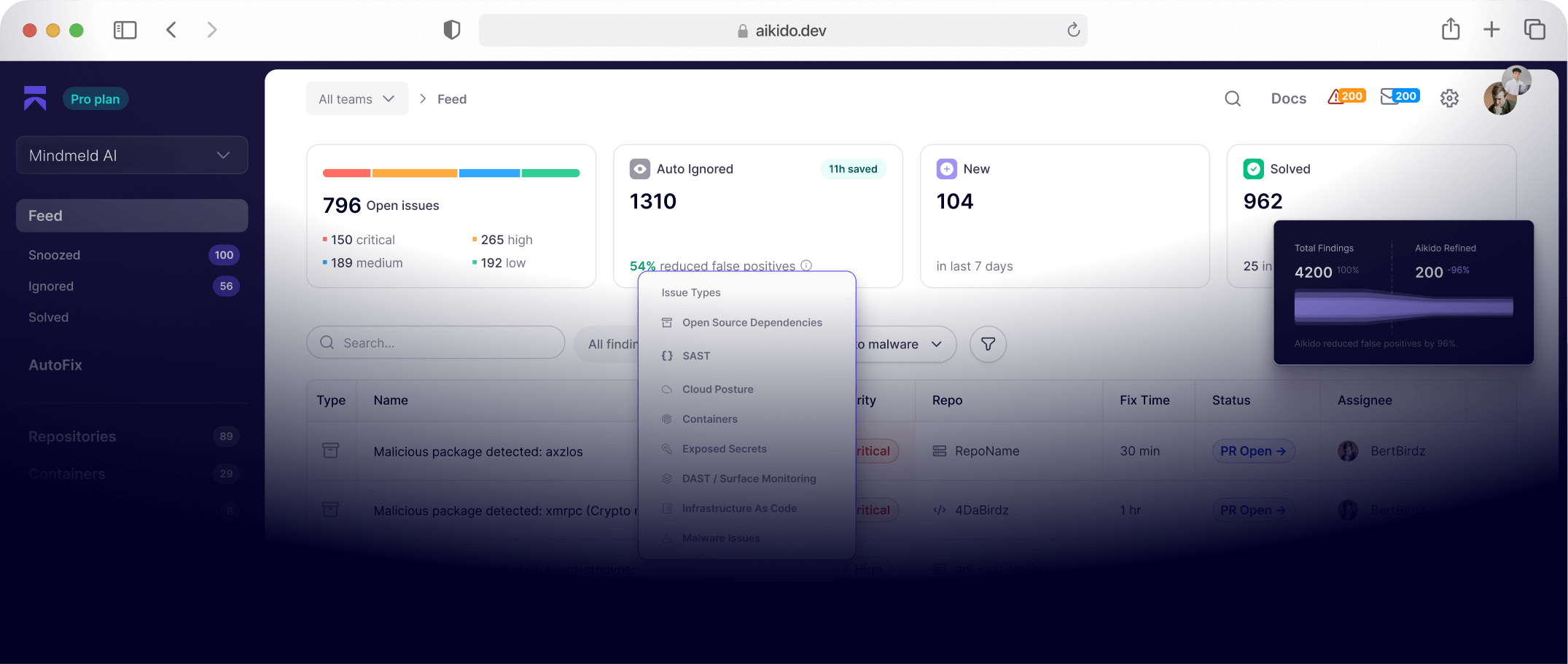
The goal of this article is to shine a light on the most critical web application vulnerabilities from both frontend and backend perspectives. We’ll cover well-known OWASP Top 10 risks alongside high-profile exploits (like Log4Shell and others) and common coding mistakes developers make in real-world projects. For each vulnerability, we’ll explain what it is, give a real example or incident, and outline how to mitigate it. You’ll also see – highlighting how Aikido’s developer-first security platform (with features like code scanning, secrets detection, SAST, and IaC scanning) can help detect or prevent these issues before they bite you in production.
The List:
1. Injection Attacks (SQL, Command, LDAP)
2. Cross-Site Scripting (XSS)
3. Broken Authentication
4. Broken Access Control
5. Security Misconfigurations
6. Sensitive Data Exposure & Secrets Leakage
7. Using Components with Known Vulnerabilities
8. Cross-Site Request Forgery (CSRF)9. Server-Side Request Forgery (SSRF)
10. Insecure Deserialization
What Are Web Application Vulnerabilities?
Web application vulnerabilities are weaknesses or flaws in the design, implementation, or configuration of a web app that attackers can exploit to compromise the system. These can range from coding bugs like injection flaws, to misconfigurations like leaving an admin console open, to logic issues that let users bypass security checks. Some vulnerabilities allow attackers to steal data or take over user accounts; others enable full server compromise or the spread of malware to your users. Many of the “classic” bugs have been known for years (and are summarized by the OWASP Top 10 list), yet they remain widespread due to evolving tech stacks and simple human error.
Below, we’ll dive into the top web application security vulnerabilities that every developer and DevSecOps team should be aware of. This isn’t an exhaustive list of every bug out there, but rather the most common and dangerous issues we see in the wild today – along with tips to avoid them.
The Top Web Application Vulnerabilities (Frontend & Backend)
The following vulnerabilities are drawn from the OWASP Top 10 and recent real-world exploits. Each one represents a serious risk to web applications. Let’s explore them one by one:
1. Injection Attacks (SQL, Command, LDAP, etc.)
What it is: Injection flaws occur when untrusted data is sent to an interpreter as part of a command or query. The most notorious are SQL injection (malicious input in SQL queries) and OS command injection (malicious input executed on the server). When an application directly includes user input in database queries, shell commands, LDAP queries, or ORM filters without proper validation, attackers can “inject” their own commands. This can lead to data theft, data corruption, or complete host takeover. According to OWASP, injection is a top-tier risk, and it now even subsumes cross-site scripting in their classification.
Example: One high-profile example is the 2023 MOVEit Transfer breach. Attackers exploited a zero-day SQL injection (CVE-2023-34362) in the MOVEit file-sharing web app, allowing them to execute remote code on the server. The Clop ransomware gang used this flaw to steal data from hundreds of organizations, demonstrating how a single injection bug can escalate to a massive breach. This incident showed that SQLi is not just an “old school” issue – it’s still very much alive and can be catastrophic.
Impact: Successful injection attacks can be devastating. An SQL injection can dump user passwords, personal records, or business data. OS command injection can give an attacker a shell on your server, leading to full infrastructure compromise. In short, injection vulnerabilities often lead to severe data loss, account compromise, or remote code execution – making them a favorite among attackers.
Prevention: The key is to never mix untrusted input directly with commands. Use parameterized queries or prepared statements for database access (so the SQL interpreter never confuses input with code). For OS commands, avoid building command strings; use safe APIs or whitelist expected values. Input validation and output encoding are also important defensive layers. Aikido’s AI-powered SAST (static code analysis) can help catch dangerous injection patterns in your code before deployment. For instance, Aikido’s code scanning will flag occurrences where user input is concatenated into SQL statements or passed to system calls without sanitization. By integrating such scanners into your CI/CD or IDE, you can automatically detect and fix injection flaws. With Aikido, you could have caught that vulnerable SQL query long before attackers did!
2. Cross-Site Scripting (XSS)
What it is: Cross-Site Scripting is a type of injection targeting users’ browsers. An XSS vulnerability allows an attacker to inject malicious client-side scripts (usually JavaScript) into web pages viewed by other users. Unlike SQLi, which targets your database, XSS lets an attacker manipulate the content seen by users – potentially stealing session tokens, defacing the UI, or delivering malware. XSS comes in flavors like reflected XSS (the malicious script comes from a request and is reflected in the response), stored XSS (the script is stored on the server, e.g. in a database comment field, and served to every viewer), and DOM-based XSS (the vulnerability is in client-side code that modifies the page).
Example: One of the most famous XSS incidents was the British Airways breach of 2018. The Magecart hacker group injected a malicious script into a third-party JS library (Feedify) used on BA’s website. This script skimmed credit card details from the payment page, sending data to an attacker-controlled server. The attackers managed to steal personal and credit card information from about 380,000 transactions before the breach was discovered. In essence, an XSS vulnerability in a supply chain component led to a massive data theft – and costly fines for BA. Other real-world XSS examples include a Fortnite webpage bug that could have exposed millions of accounts, and an XSS in eBay’s site that attackers exploited to hijack high-value seller accounts.
Impact: XSS primarily compromises users, but it can indirectly affect your application’s security (and definitely your reputation). Attackers can steal session cookies (to impersonate users), perform actions as the victim (like fund transfers or password changes if CSRF protections are lacking), or display phishing forms to trick users. If an admin user’s session is hijacked via XSS, the attacker may gain full control of the application. Even non-sensitive sites should care about XSS – nobody wants their site serving up fake login prompts or redirecting users to exploit kits.
Prevention: Defending against XSS involves output encoding and content security policies. Any time your app displays user-supplied data in a webpage, it must properly escape/encode that data for the context (HTML, JavaScript, CSS, etc.) so that it can’t be interpreted as code. Most web frameworks have templating or encoding libraries – use them consistently (avoid creating HTML from raw strings). Implement a strong Content Security Policy (CSP) to limit what scripts can run on your pages (though CSP is a second line of defense). Aikido’s code scanning can detect areas where user input is inserted into the page without proper sanitization. For example, if you inadvertently use innerHTML or string concatenation to inject user data into the DOM, Aikido’s static analyzer will flag it. Aikido can also identify missing HTTP-only flags or Content Security Policy headers via its configuration scanning. By catching these issues early, you prevent the next Magecart-style attack on your users. (Bonus: Aikido’s integrated vulnerability knowledgebase can even suggest secure coding practices, like using textContent over innerHTML to avoid DOM XSS.)
3. Broken Authentication
What it is: Broken Authentication refers to weaknesses in the way a site handles login and session management – things like user credentials, session IDs, password reset, and account recovery. If attackers can readily compromise passwords, keys, or session tokens due to poor implementation, that’s broken auth. Common pitfalls include weak password policies (or no rate limiting on login, enabling brute force), failing to store passwords securely (e.g. storing plain-text or unsalted hashes), using predictable or insecure session IDs, not invalidating sessions on logout, and flawed “remember me” or password reset logic. Any flaw that lets an attacker either pretend to be someone else (by guessing or stealing credentials/session) or log in without proper credentials falls in this category. According to OWASP, these authentication failures can lead to account takeovers and significant data breaches.
Example: One need not look far for examples – a huge portion of breaches stem from compromised credentials. In fact, 81% of hacking-related breaches in 2022 were due to weak or stolen passwords. A specific incident: in early 2023, Uber disclosed that a contractor’s account was compromised because the contractor reused a password found in a prior breach. Attackers got into Uber’s internal systems using that account – essentially an authentication failure (password reuse and lack of MFA). Another example: a 2024 breach at a financial services firm where an absence of multi-factor authentication (MFA) allowed attackers to use leaked passwords to access accounts, affecting millions (this was noted in the context of the Snowflake customer data incident – while Snowflake’s platform wasn’t directly hacked, weak auth on user side led to the breach). These cases show that even if your app’s code is solid, weak auth practices (by users or developers) can open the door wide.
Impact: Broken authentication can lead to full account compromise for any user in the system – from regular customers to administrators. If an attacker obtains user credentials (via brute force, credential stuffing using leaked passwords, or exploiting a flaw in your auth logic), they can impersonate that user and access all their data. Particularly severe is if admin or privileged accounts are compromised – the attacker could steal all data, change settings, or further pivot into internal networks. Even at a smaller scale, compromised user accounts can result in fraud, privacy violations, and loss of user trust.
Prevention: Robust authentication defenses are a must. Enforce strong password requirements and use hashing (with a strong algorithm like bcrypt or Argon2) plus salting for stored passwords – never store raw passwords. Implement multi-factor authentication for sensitive accounts or actions; MFA can thwart many password-based attacks. Use secure session management: make session IDs random and unguessable, set them to expire, and invalidate sessions on logout. Avoid exposing session IDs in URLs (use cookies with Secure and HttpOnly flags). Implement brute-force protection (lockouts or CAPTCHAs after several failed logins) and monitor for credential stuffing.
Aikido’s platform can assist by detecting common authentication weaknesses in your code and configuration. For example, Aikido’s scanner will warn you if you’re using a weak password hashing method (or worse, storing passwords in plain text). It can also catch if session cookies aren’t marked Secure/HttpOnly, or if your web framework’s security settings (like Django’s or Express’s) are misconfigured for session management. In addition, Aikido’s secrets detection might alert you if you accidentally hard-code an API key or service account password in your code (preventing those secrets from becoming an attacker’s backdoor login). By catching these issues early, you enforce a stronger authentication scheme from the get-go.
4. Broken Access Control (Authorization Flaws & IDOR)
What it is: Broken access control is currently the #1 most critical web app risk according to OWASP. It refers to failures in enforcing authorization – i.e., the rules about what authenticated users are allowed to do. Even if a user is who they say they are (authentication succeeded), the app must restrict them to only permitted data and functions. Common access control failures include not checking user roles/permissions on certain actions, trusting client-side enforcement (which attackers can bypass), or exposing references to internal objects without verifying ownership. An extremely common variant is IDOR (Insecure Direct Object Reference), where an app uses user-supplied IDs (like account numbers, document IDs, etc.) to fetch data without confirming the current user is allowed to access the specified object. For example, if GET /api/orders/12345 returns order #12345 for any user who hits it, an attacker could simply change the ID to 12346 and retrieve another user’s order – a textbook IDOR scenario. Other examples include missing access checks on “hidden” admin endpoints, or privilege escalation bugs where a regular user can become an admin by tweaking a parameter or JWT token.
Example: The prevalence of broken access control is staggering – one study found 94% of applications tested had some form of access control weakness. As for real incidents, consider the Kia Motors API vulnerability (2024): Researchers found that by supplying only a car’s VIN or license plate number, they could call certain Kia/Hyundai API endpoints and remotely execute vehicle commands (like unlocking doors), without any authentication token. This critical flaw boiled down to an access control failure in an API – the system didn’t ensure that the request was coming from an authorized owner. Another example is the MOVEit breach we mentioned earlier: while primarily a SQLi issue, it was noted that a lack of authentication on the vulnerable endpoint allowed attackers to exploit it directly. We also regularly see IDOR bugs in web apps where one user can view or modify another’s data: for instance, a 2021 vulnerability in a popular social media platform’s API let attackers enumerate user profile IDs to fetch private profile info that should have been restricted. In short, broken access controls often lead to vertical privilege escalation (user becomes admin) or horizontal escalation (user A can act as user B).
Impact: When access control breaks, the consequences range from data leaks to complete system takeover. An attacker might read other users’ sensitive data (violating confidentiality) or modify data they shouldn’t (violating integrity). In severe cases, broken access control can let an external party gain admin privileges – which is game over for the application. For example, an IDOR in an e-commerce site could let someone see other customers’ orders or personal info; a missing admin check could let a regular user hit an /admin/deleteUser endpoint and wipe out data. These flaws directly lead to breaches of confidentiality and are often very easy for attackers to exploit once discovered (no fancy payloads needed – just a changed URL or parameter).
Prevention: The mantra here is “deny by default.” Every request that accesses a sensitive operation or data record should be subject to server-side access control checks. Use frameworks or middleware that centralize the enforcement of roles/permissions. For example, if you have user roles, ensure every admin function verifies the user’s role on the server (never rely solely on client-side checks like hiding admin buttons in the UI). For object-level access (like viewing or editing a resource by ID), implement ownership checks – e.g., confirm that the orderId requested belongs to the authenticated user making the request. Automated tests can help verify that unauthorized access is properly blocked.
Aikido helps you catch broken access control in a couple of ways. First, Aikido’s Autonomous Pentesting (Aikido Attack) can dynamically probe your running app for these flaws – for example, it can simulate an attacker with a normal user account trying to access admin APIs or other users’ data, and it will report any successful privilege bypass. On the code side, Aikido’s static analysis can identify routes or controllers with missing auth checks (especially in frameworks where routes should be annotated with roles). If your codebase uses infrastructure-as-code or configuration for access policies (say, API gateway rules or cloud IAM), Aikido’s scanners can evaluate those as well. By using Aikido to continuously test authorization logic, you catch those “oops, forgot to enforce login on that endpoint” mistakes before attackers do. Always remember: except for truly public resources, everything should require proper authorization – Aikido can help verify you’re adhering to that principle.
5. Security Misconfigurations
What it is: Even a perfectly coded application can be undone by insecure configuration. Security misconfiguration is a broad category covering any insecure setting or setup in the infrastructure or application stack. This includes things like: leaving default credentials active on servers (e.g. admin/admin), using default config files or secrets, leaving sensitive endpoints (like database admin panels or cloud dashboards) publicly accessible, not disabling directory listings on a web server, having misconfigured HTTP headers (e.g. missing security headers), or forgetting to set proper permissions on cloud storage. Misconfigurations often arise from dev/test settings not being hardened for production, or simply human error in deployment. In cloud environments, a classic misconfig is leaving an S3 bucket or Azure blob storage publicly readable when it contains private data. Essentially, it’s when your system is saying “Welcome attackers, the door is open!” due to an oversight in settings.
Example: Unfortunately, misconfigurations cause many real breaches. A striking case from 2024: 1.3 million patient records were left exposed on a public server for two weeks because of a simple server misconfiguration. No exploit needed – the data was essentially published to the world due to an oversight. Another example: an incident at Prudential Financial (2024) where a single misconfiguration in an access control system allowed attackers to quietly access 2.5 million customer records. And who can forget the Capital One breach (2019) – while it involved SSRF as the attack mechanism, the root cause was a misconfigured web application firewall in their AWS environment, which let the attacker reach internal resources. In the Capital One case, an AWS S3 storage bucket with sensitive data was accessible once the WAF misconfig was exploited – leading to over 100 million customer records stolen. These examples underscore that often “small” configuration mistakes (like an open port, a forgotten credential, or a disabled security control) can have enormous consequences.
Impact: The impact varies depending on what was misconfigured. At the low end, a misconfiguration might “only” leak some non-critical info (for example, a verbose error page revealing software versions – useful for attackers but not a breach by itself). At the high end, a misconfiguration can lead directly to full compromise: an open admin interface could let attackers log in (especially if default creds weren’t changed), an open cloud storage bucket can expose millions of records, or a disabled security setting might allow trivial exploits. Misconfigurations are among the leading causes of data breaches in cloud services. They’re also easily scanned for by attackers – there are search engines and bots continuously looking for things like open Elasticsearch/Kibana dashboards, exposed database ports, or public buckets. In short, misconfigs can turn your secure app into a “hacker’s playground” if you’re not careful.
Prevention: Diligence and automation are key. Always change default passwords and keys (nothing should run with “admin/admin” or similar defaults). Harden your server and framework configurations: for example, turn off debug modes and sample apps in production, ensure directory browsing is off, and apply recommended security headers (Content Security Policy, X-Frame-Options, etc.). Use the principle of least privilege for cloud resources – if a service or bucket doesn’t need public access, lock it down (and for those that need to be public, ensure they only expose what’s intended). Regularly review your infrastructure-as-code or environment settings against security benchmarks.
Aikido’s IaC scanning and configuration auditing can be a lifesaver here. If you use Terraform, CloudFormation, Kubernetes YAML, or similar, Aikido can scan those for insecure settings (like open security groups, public S3 buckets, or missing encryption settings). It can also check your running cloud environment for misconfigurations. For web servers and apps, Aikido’s scanners will flag missing security headers or overly verbose error messages. Additionally, Aikido’s runtime protection features can monitor for abnormal usage that might indicate someone exploiting a misconfig. The takeaway is to make configuration checks part of your pipeline – Aikido can automate that, catching the “oops, I left that bucket public” mistakes before deployment. And always keep an eye on new patches and updates; sometimes misconfigurations stem from running outdated software with known default weaknesses.
6. Sensitive Data Exposure & Secrets Leakage
What it is: This category covers failures to properly protect sensitive information – both user data and secret keys. “Sensitive data exposure” (also called cryptographic failures) means an application does not adequately secure data in transit or at rest. Examples include not using HTTPS for sensitive communications, using weak or no encryption for stored data (like unsalted hashes for passwords, or plaintext personal data in a database backup), or accidentally exposing data through debugging or logs. Closely related is secrets leakage – when developers inadvertently expose if you’re not careful.
Prevention: Diligence and automation are key. Always change default passwords and keys (nothing should run with “admin/admin” or similar defaults). Harden your server and framework configurations: for example, turn off debug modes and sample apps in production, ensure directory browsing is off, and apply recommended security headers (Content Security Policy, X-Frame-Options, etc.). Use the principle of least privilege for cloud resources – if a service or bucket doesn’t need public access, lock it down (and for those that need to be public, ensure they only expose what’s intended). Regularly review your infrastructure-as-code or environment settings against security benchmarks.
Aikido’s IaC scanning and configuration auditing can be a lifesaver here. If you use Terraform, CloudFormation, Kubernetes YAML, or similar, Aikido can scan those for insecure settings (like open security groups, public S3 buckets, or missing encryption settings). It can also check your running cloud environment for misconfigurations. For web servers and apps, Aikido’s scanners will flag missing security headers or overly verbose error messages. Additionally, Aikido’s runtime protection features can monitor for abnormal usage that might indicate someone exploiting a misconfig. The takeaway is to make configuration checks part of your pipeline – Aikido can automate that, catching the “oops, I left that bucket public” mistakes before deployment. And always keep an eye on new patches and updates; sometimes misconfigurations stem from running outdated software with known default weaknesses.
6. Sensitive Data Exposure & Secrets Leakage
What it is: This category covers failures to properly protect sensitive information – both user data and secret keys. “Sensitive data exposure” (also called cryptographic failures) means an application does not adequately secure data in transit or at rest. Examples include not using HTTPS for sensitive communications, using weak or no encryption for stored data (like unsalted hashes for passwords, or plaintext personal data in a database backup), or accidentally exposing data through debugging or logs. Closely related is secrets leakage – when developers inadvertently expose secrets like API keys, database passwords, credentials or tokens, whether by hardcoding them in code, leaving them in config files pushed to repos, or storing them in client-side code. A staggering amount of secrets get leaked by developers each year (often on public GitHub). In short, if your app doesn’t properly encrypt what should be encrypted, or if you’re careless with confidential info and keys, you’re inviting attackers to obtain that data without much effort.
Example: One side of this issue is unencrypted data. A simple but illustrative example: Many years ago, websites would sometimes accept login credentials over plain HTTP – those days are largely gone, but even now missteps happen. In 2023, a major API integration was found transmitting personal health data without proper encryption (due to a misconfigured TLS certificate chain), exposing private info on the wire. Another example: if a database backup file is stored in an unsecured cloud bucket (tying into misconfiguration), all the personal data within might be exposed – this happened to an airline in 2022, leaking hundreds of thousands of customer records because the backup wasn’t encrypted or access-controlled.
On the secrets side, the problem is endemic. In 2024 alone, researchers detected nearly 23.8 million new hardcoded secrets in public GitHub commits – a 25% increase from the previous year. This “secret sprawl” has led to real breaches. For instance, in 2023 an attacker leaked all of the New York Times’ source code from a private repo, reportedly by exploiting leaked credentials. In another case, a business intelligence company (Sisense) had an internal credential leaked on a public forum, which attackers used to access sensitive customer data. Closer to home for developers: how often have we heard of an AWS secret key accidentally pushed to GitHub, only for crypto-miners or worse to use it within minutes? These examples show that failing to protect data with encryption and failing to keep secrets secret can lead directly to data breaches and unauthorized access.
Impact: If sensitive user data (personal information, financial data, health records, etc.) is exposed, the impact is usually felt by both the users (privacy violations, identity theft risk) and the company (regulatory penalties, reputational damage). For instance, exposed healthcare records can lead to HIPAA fines and lawsuits. Exposed passwords or credit card numbers obviously lead to fraud. Meanwhile, leaked secrets (like API keys or tokens) can be an attacker’s golden ticket: for example, a leaked database password could let an attacker connect and dump your entire database; a leaked cloud API key could let them spin up servers (on your bill) or access sensitive cloud data. One leaked admin credential can sometimes compromise an entire application or even a fleet of systems. It’s no surprise that the IBM Cost of a Data Breach Report consistently finds breaches involving compromised credentials and sensitive data to be among the costliest (both in dollars and in lost trust).
Prevention: There are two aspects here: protect sensitive data and manage secrets properly. For sensitive user/business data, always use HTTPS (enforce TLS for all traffic, and use modern protocols/configs). Never transmit sensitive info like passwords or tokens in plaintext – even in internal communications. At rest, encrypt critical data fields (many databases and cloud storage services offer encryption at rest – use it, and consider application-level encryption for extremely sensitive fields). Avoid excessive data exposure: don’t unnecessarily store data you don’t need, and purge sensitive data when no longer required. As for secrets management: never hardcode secrets in code or config that goes to source control. Use environment variables, secret management services (like HashiCorp Vault or cloud secret stores), or at least store secrets in secured config files that aren’t in the repo. If you must commit some config, use tools to scan for secrets before pushing. Rotate keys regularly so that if something does leak, it’s only valid for a short window.
Aikido’s security platform has strong features to help on both fronts. Its Secrets Detection capability will scan your code and config for API keys, passwords, private certs, and other credentials. For example, if someone accidentally leaves an AWS key or a database connection string in a committed file, Aikido will flag it immediately – potentially saving you from an AWS account takeover. Aikido can even monitor your repositories continuously to catch secret leaks in real-time. On the data protection side, Aikido’s scanning can identify weak cryptography usage (like use of outdated hash functions or encryption algorithms). It can also verify certain compliance checks (e.g., ensuring you have TLS enabled on all endpoints by scanning infrastructure-as-code or API definitions). By integrating Aikido, you gain an automated watchman that yells “Hey, that’s an API key – remove it!” before it ever hits production. And if your organization has lots of private repos or developer teams, this kind of automated secret scanning is essential – as evidenced by the ever-growing number of secrets found in code each year.
7. Using Components with Known Vulnerabilities (Supply Chain Risks)
What it is: Modern web apps are built on countless third-party components – frameworks, libraries, packages, container images, and services. Using components with known vulnerabilities means your application includes a dependency (or runs on a server) that has a publicly known security flaw, and you haven’t patched or updated it. This is essentially the “supply chain” problem: a vulnerability in a library you use can compromise your app even if your own code is perfect. Examples abound: a vulnerable version of a web framework, an outdated OpenSSL library, a leaky debug tool, etc. Attackers actively scan for applications using specific vulnerable versions of software to exploit them. OWASP Top 10 has emphasized this risk (previously “Using Components with Known Vulnerabilities”, now folded into a broader category in 2021), and the industry has learned hard lessons from incidents like Log4Shell where a single library flaw had a ripple effect globally.
Example: The poster child is indeed Log4Shell (CVE-2021-44228). This was a critical RCE vulnerability in the popular Log4j logging library (widely used in Java applications). When it was disclosed in December 2021, it set off alarm bells everywhere because thousands of applications were indirectly vulnerable – if they included a certain version of Log4j. Attackers quickly began exploiting it in the wild, leading to incidents across many companies. As one report put it, “the Log4j vulnerability demonstrated how a single widely-used component can create organization-wide exposure”. Another example: Apache Struts 2 had a known RCE flaw (CVE-2017-5638) which famously led to the Equifax breach in 2017 – Equifax hadn’t updated the framework, and attackers exploited it to steal data on 147 million people. More recently, in 2022-2023 we saw Spring4Shell (CVE-2022-22965) – a Spring Framework vulnerability that echoed Log4Shell (though less severe) – and various npm/PyPI package vulnerabilities that allowed attackers to run code or steal data if you used those packages. Even front-end libraries aren’t exempt: e.g., a vulnerability in the DOMPurify library in 2021 could undermine XSS protection if not updated. All these illustrate that known CVEs in your stack are ticking time bombs.
Impact: The impact is entirely dependent on the specific vulnerability in the component, but it can be as severe as it gets – remote code execution, data leakage, authentication bypass, you name it. The trouble is that these vulnerabilities are public knowledge, and often exploit code is readily available, so attackers can automate scans to find any server that hasn’t patched. A single unpatched component can lead to mass compromise if wormable (like the 2021 MS Exchange ProxyShell/ProxyLogon vulns did – not exactly “web app” but similar concept of known vulns exploited en masse). For your app, using a vulnerable component could mean an attacker doesn’t need to find a bug in your code – they just exploit the library. The result can be the same as other categories: data breach, server takeover, etc., but it’s particularly frustrating because a fix may have been available and just not applied.
Prevention: This comes down to dependency management and patching discipline. Maintain an inventory of all components (including their versions) used in your application – this is often called a Software Bill of Materials (SBOM). Subscribe to vulnerability feeds or use automated tools to alert you when a library you use has a known CVE. Many package managers have audit commands (e.g., npm audit, pip-audit) to identify known vulns in your dependency tree. Keep your dependencies up to date – upgrade to patched versions promptly. Where possible, use tools to apply virtual patches or workarounds if you can’t immediately upgrade. For components like your OS, web server, or database server, apply security updates regularly. Also beware of malicious packages in the open-source ecosystem – occasionally attackers publish a compromised library (or hijack a maintainer account) so that the next time you npm install, you might be pulling in a backdoored update. Using reputable sources and locking dependency versions (and verifying integrity via checksums/signatures) can help mitigate that.
Aikido makes managing this risk much easier through its Software Composition Analysis (SCA) and dependency scanning features. Aikido’s Dependencies (SCA) scanner will automatically detect the open-source libraries and versions your code is using, cross-reference them against vulnerability databases, and alert you to any known CVEs. For example, if your project is pulling in, say, Log4j 2.14.0 (which is vulnerable to Log4Shell), Aikido would flag that with details about the CVE and even suggest the fixed version you should upgrade to. It can do this directly in your IDE or CI pipeline. Even better, Aikido provides AI AutoFix suggestions – in many cases, it can automatically open a pull request to bump a dependency to a safer version, or apply a needed patch. The platform can also scan container images for outdated components (ensuring your base images and OS packages are up to date). By integrating Aikido, you essentially outsource the tedious job of tracking CVEs to an automated system that never sleeps. This means faster remediation – critical when exploits are often in the wild days or hours after a vulnerability is announced. In summary: keep everything updated, and use tools like Aikido SCA to stay ahead of attackers on the component front.
8. Cross-Site Request Forgery (CSRF)
What it is: Cross-Site Request Forgery is an attack where a malicious website tricks a user’s browser into making unintended requests to your web application. It exploits the fact that browsers automatically include credentials (like session cookies) with requests. If a user is logged into your site, and then visits a malicious site, that malicious site could, say, load an image or hidden form that sends a request to your site (the target) – and the browser will include the user’s session cookie. Without proper defense, your server thinks the user legitimately made that request and will execute it. In essence, CSRF “hijacks” a user’s authenticated session to perform an action the user didn’t intend. Classic example: a user is logged into their bank. They visit an attacker’s page which has some hidden code that issues a funds transfer request to the bank site – the bank sees a valid session cookie and processes the transfer. CSRF doesn’t steal data directly; it tricks the victim’s browser into being the attacker’s accomplice. Many modern frameworks have CSRF protections built-in (usually via tokens), and modern browsers added SameSite cookie attributes to mitigate CSRF, but it’s far from eradicated. In 2025, CSRF is “not dead, just different” – especially with single-page apps and APIs using cookies for auth where developers might forget to implement the usual protections.
Example: A real-world instance: Reddit (2023) had a CSRF vulnerability on a settings page that allowed attackers to silently change a user’s preferences and even link the victim’s account to a spam account. While toggling notification preferences isn’t as dire as money transfers, it shows CSRF was alive in a major site’s functionality. Another noted example involves cryptocurrency wallet apps – attackers have used CSRF to change default payout addresses or initiate small transactions by exploiting the wallet’s web interface, effectively draining funds without the user realizing it. Historically, there have been more devastating CSRF attacks too: Gmail had a CSRF back in 2007 that allowed attackers to change users’ email forwarding addresses (spying on emails), and there was the famous Samy Worm on MySpace in 2005 which was actually a self-propagating CSRF (combined with XSS) that made Samy Kamkar’s profile rack up a million “friends”. These examples range from mischief to significant breaches, but all underscore the idea: if you don’t have CSRF protections, an attacker can make your users perform actions they didn’t intend.
Impact: The severity of CSRF depends on what actions are vulnerable. If only some minor preference changes are possible (as in the Reddit example), the impact is limited (annoying but not catastrophic). But if critical actions like money transfers, password changes, or account deletions are vulnerable, then CSRF is a big deal. Consider a CSRF that changes a logged-in user’s password to one known by the attacker – that’s full account takeover. Or a CSRF on a web-based banking app that issues a payment – that’s direct financial theft. In a corporate context, a CSRF that triggers some state change (like changing an access control setting or injecting malicious data) could be a stepping stone to deeper compromise. The silent nature of CSRF – no malware on the user’s machine, no immediate outward sign – means such attacks can go undetected until it’s too late.
Prevention: The good news is CSRF is well-understood and there are standard defenses:
- CSRF Tokens: Implement anti-CSRF tokens for state-changing requests. The server generates a random token, sets it in the user’s session (or as a cookie), and also injects it into forms or APIs (as a hidden field or header). When a request comes in, the server expects the token and verifies it. An attacker’s forged request won’t have the correct token, so it’s rejected.
- SameSite Cookie Attribute: Set your session cookies with
SameSite=LaxorStrict. This helps prevent the browser from including cookies on cross-site requests (thoughLaxstill allows some GET requests – which ideally shouldn’t have side effects). Many frameworks now default session cookies toSameSite=Lax. Just be careful if your app legitimately needs cross-site requests (e.g., third-party integrations) – you might need exceptions, but isolate those if so. - Ensure that state-changing actions use proper HTTP verbs (e.g., use POST/PUT/DELETE, not GET, for actions). Browsers won’t send credentials on cross-site POST if SameSite is Lax or Strict, and it’s harder for an attacker to make a hidden POST than a GET.
- Check Origin/Referer headers: As an additional layer, verifying that requests originate from your expected domain can catch cross-site attempts in some cases (though not foolproof).
- Framework security: Use your framework’s built-in CSRF protection middleware – nearly all modern frameworks have one.
- Don’t disable it during development (developers sometimes turn off CSRF checks to test APIs and then forget to re-enable).
Aikido can assist in ensuring your app isn’t unknowingly vulnerable to CSRF. For one, Aikido’s dynamic scanning (DAST) can simulate CSRF by attempting to perform state-changing actions from an external context and seeing if it succeeds. It will report any actions that lack proper CSRF protection. On the code side, Aikido’s static analysis (with its understanding of frameworks) can identify routes that modify data but have no CSRF token verification in place. (In fact, tools like Ghost Security – a similar AppSec tool – specifically advertise finding “endpoints that mutate state but lack CSRF tokens”, and Aikido provides comparable capabilities.) Aikido can also catch misconfigured SameSite attributes by inspecting Set-Cookie headers in your responses or security configs. By using Aikido to test your forms and API endpoints, you’ll be alerted if any critical path is missing CSRF defenses, so you can fix it (usually by adding the appropriate token or header checks). With these measures, you can effectively shut down CSRF – making sure your app only honors requests that actually come from your site and your users.
9. Server-Side Request Forgery (SSRF)
What it is: SSRF is a newer addition to the OWASP Top 10 (it became a top 10 item in the 2021 edition) and for good reason. Server-Side Request Forgery occurs when an application takes a URL or resource location from an untrusted source (like user input) and the server-side code fetches that URL without proper validation. Essentially, an attacker tricks your server into sending a request on its behalf. This can be abused to have the server make requests to internal resources that the attacker can’t directly reach, or to external addresses with the server’s credentials. A classic scenario is a web app with a feature like “fetch the contents of this URL” (for previewing, or importing data) – an attacker provides a URL like http://localhost/admin or an AWS metadata URL (http://169.254.169.254) to retrieve sensitive internal info through your server. SSRF can also allow port scanning of your internal network via your server, or even exploitation of internal services. In cloud environments, SSRF is particularly dangerous because cloud instances often have access to metadata endpoints that yield credentials. The 2019 Capital One breach was a prime example of SSRF used in the wild (combined with misconfiguration).
Example: The Capital One breach: A former AWS engineer exploited an SSRF vulnerability in a misconfigured WAF (Web Application Firewall) that Capital One was running. By crafting requests from an externally accessible web app, she was able to query the AWS metadata service of the server, which returned AWS access tokens. Using those tokens, she then accessed sensitive data (S3 buckets with customer info) – resulting in over 100 million records stolen. In summary, SSRF was the initial entry point that bypassed external network barriers by leveraging the server’s own privileges. Another example: In 2022, security researchers found that an SSRF in a popular DevOps tool allowed them to reach internal API endpoints not otherwise exposed, potentially allowing admin actions. We’ve also seen SSRF bugs in image processing or PDF generation functionalities (where the server fetches a URL from input) which attackers turned into port scanners or used to hit internal database admin consoles. Yet another case: some cloud services had SSRF in their webhooks that allowed attackers to trigger requests to internal HTTP endpoints, gaining access to things like Redis or internal dashboards.
Impact: At first glance, SSRF is about making requests, which might sound limited. But it can have critical impact:
- Internal network access: If your server can reach internal hosts (e.g., in the same VPC or data center), an SSRF can potentially talk to internal services that are not exposed publicly. This could lead to reading sensitive data (like contacting an internal HTTP API that returns customer info) or even issuing privileged commands if an internal admin interface lacks auth (since it assumed only internal calls would reach it).
- Cloud metadata leakage: In cloud providers (AWS, GCP, Azure), SSRF is often used to grab credentials from the instance metadata service. These credentials might allow further compromise of cloud resources (as in Capital One).
- Bypass of IP-based restrictions: If you restrict some functionality to, say, requests from “localhost” or certain IPs, an SSRF might circumvent that by making the request from the local server itself.
- Worm potential: In some cases, SSRF can be a pivot point for further exploits – e.g., SSRF to an internal service that has a known RCE could result in actual remote code execution on the internal network.
Given OWASP’s note, SSRF issues are indeed on the rise in modern apps due to microservices and cloud complexities, and they can be quite severe.
Prevention: Preventing SSRF primarily means validating and sanitizing any user-supplied URLs or remote resource requests. If your app needs to fetch a URL provided by a user (or an address), implement a strict allowlist: for instance, only allow URLs from a set of domains you trust (and enforce that via DNS lookup, etc., to prevent tricks). Never allow raw user input to directly control the destination of server-side fetches. You can also implement network-level protections: e.g., disable your server’s ability to reach internal addresses if it doesn’t need to. Some cloud providers let you turn off or restrict metadata service access (AWS has IMDSv2 which mitigates the simple GET requests). Additionally, code should check the URL scheme – disallow file:// URIs or other local schemes, and potentially disallow IP literals or link-local addresses. Use libraries or patches that perform SSRF protection if available (for example, some HTTP client libraries allow restricting which hosts can be contacted). Essentially, treat externally provided URLs like dangerous input – because they are.
Aikido’s scanning tools can help identify SSRF risks in your code. For instance, Aikido’s static analysis can detect usage of functions or libraries that make HTTP requests (like requests.get() in Python, HttpClient in Java, etc.) where the URL is derived from user input. It can then flag that as a potential SSRF if there’s no filtering. Aikido might also notice if your code tries to fetch things from URLs without validation, and it can suggest adding allowlist checks. On the dynamic side, Aikido’s DAST and pentest tools can attempt common SSRF payloads (like providing http://169.254.169.254 as input to any URL fetch functionality) to see if they can trick the server into responding with internal content. If an SSRF vector is found, Aikido will report it along with evidence. With this feedback, you can then implement proper validation or restrict network access. Aikido’s cloud scanning features can also warn you if your instances have overly permissive network settings (for example, if your web server can egress to the internet or internal network when it shouldn’t). By combining code analysis and testing, you can catch SSRF weaknesses early – before an attacker uses your app as their proxy.
10. Insecure Deserialization
What it is: Insecure deserialization is a more specialized vulnerability, but incredibly dangerous when it exists. It arises when an application deserializes data from an untrusted source without proper validation – meaning it takes some binary or structured data (like objects, or JSON/XML, or binary blobs) from the client and reconstructs an object in memory. Certain serialization formats (especially in languages like Java, .NET, Python, PHP) can be abused to execute code during the deserialization process. Attackers craft malicious serialized objects (often called “gadget chains”) that, when the server deserializes them, trigger commands or behaviors that the attacker chooses. This can lead to remote code execution or logic manipulation on the server, without even needing a normal injection flaw. Insecure deserialization vulnerabilities are essentially logic bombs hidden in data. They were highlighted in the OWASP Top 10 2017 and remain relevant, though the 2021 Top 10 broadened it to “Software and Data Integrity Failures”. If an app accepts any kind of serialized objects (like Java Serializable objects, .NET ViewState, or even certain JSON with class type info) from users, it could be at risk.
Example: A recent example making waves is CVE-2025-55182 in React Server Components (disclosed Dec 2025). This was a critical RCE that turned out to be caused by insecure deserialization in the React Server Components protocol. Essentially, an attacker could send a malformed HTTP payload that the React server-side would deserialize incorrectly, allowing execution of arbitrary code. It had a CVSS 10 and affected a huge number of applications (since React is so widespread). This shows that even cutting-edge frameworks aren’t immune to deserialization issues. Another classic example: the 2016 Java Commons Collections exploit – an insecure deserialization in many Java apps (through a library) allowed attackers to send a serialized object that, upon deserialization, would run commands on the server. This was widely exploited in products like Jenkins, WebLogic, etc. In .NET, there was the ViewState deserialization vulnerability (CVE-2017-8759) and others where unsanitized data in a view state led to RCE. PHP apps have had issues when unserialize() is called on user input. Even JavaScript (Node.js) had a notorious one in the serialize-javascript package. So from enterprise systems to modern frameworks, insecure deserialization pops up – often with severe results.
Impact: Insecure deserialization is often a direct path to remote code execution (RCE). That’s about as bad as it gets – the attacker can run arbitrary code on your server, potentially taking full control of it. Even if it’s not full RCE, deserialization flaws can be used to manipulate logic (for example, altering data structures to give yourself higher privileges on object data). But typically, the impact is critical: if an attacker can exploit it, they often can drop a webshell, create a backdoor user, or pivot deeper into the network. The danger is amplified by the fact that deserialization exploits often require no authentication (if the app is deserializing data prior to auth) and can be done with a single request. It’s a stealthy way in – no suspicious SQL queries or cross-site scripts, just a seemingly innocuous blob of data that blows up your app from within.
Prevention: The best way to avoid insecure deserialization is to never deserialize untrusted data. If you don’t absolutely need to accept serialized objects from users, don’t. Use safer data formats (JSON, for instance, without class type metadata that could invoke arbitrary constructors). If you do need to serialize/deserialize, consider implementing integrity checks: e.g., sign the serialized data or include a MAC, so that tampering with it is detectable. Some frameworks allow restricting what classes can be deserialized (allow-listing classes). That can prevent arbitrary gadget chains from working. Keep libraries updated, because many deserialization flaws are fixed by tightening what code runs during object construction. OWASP also suggests isolating the deserialization process – perhaps running it in a low-privilege or sandboxed environment, so if an exploit triggers, it has minimal impact. In general, treat serialized data as potentially hostile. Also, be aware of hidden serialization, like in inter-service communications or caches.
Aikido’s vulnerability intelligence and scanning can help catch these issues. On the static analysis side, Aikido can flag uses of dangerous functions or patterns – for example, usage of ObjectInputStream.readObject() in Java, or PHP’s unserialize() on user data, or insecure deserialization libraries known to be exploitable. It will warn you that “hey, you’re deserializing something here – is that safe?”. Aikido’s dependency scanning also comes into play: it can alert you if you’re using a library version known to have a deserialization vulnerability (for instance, an outdated version of a common serialization library). If a major CVE like CVE-2025-55182 (the React one) arises, Aikido’s threat intelligence feeds (like Aikido Intel) would highlight which of your projects might be affected and need a patch. In terms of testing, this is a harder one for dynamic scanners, but Aikido Attack might attempt known exploit payloads if your app is using a common framework known for a deserialization bug. Ultimately, mitigation often requires code changes or library updates, and Aikido’s role is to make you aware of the risk quickly. By catching insecure deserialization during development or sc anning, you can refactor to use safe data formats or update to patched versions before deploying a ticking time bomb.
Building a Secure Web Application Posture
As we’ve seen, web applications today face a multitude of vulnerabilities – from injection flaws that can dump your database, to logic lapses that let attackers ghost through your authorization, to secret leaks and dependency risks that come from the tools we rely on. It can feel daunting, but the common thread is awareness and proactive defense. By understanding these top vulnerabilities, you’re already a step ahead in mitigating them.
A few key takeaways for a robust web app security posture:
- Shift security left: Catch issues early in development. Integrate SAST/SCA tools (like Aikido) into your CI pipeline and IDE, so vulnerabilities are flagged and fixed before code is merged. It’s far easier to correct an insecure SQL query or add an auth check during coding than to scramble after a breach.
- Layered defenses: Use multiple layers of security controls. For example, to prevent injection and XSS, combine safe coding practices with security libraries, and also run a web application firewall (WAF) for added protection. For auth, enforce MFA and use monitoring to catch suspicious logins. Defense in depth means even if one layer falters, others catch the issue.
- Stay up-to-date: Keep dependencies and servers patched. Consider enabling automated updates for critical components when feasible. Leverage vulnerability feeds or platforms (Aikido, Dependabot, etc.) to know when you have something vulnerable in your stack. The faster you patch known issues, the less likely you’ll be caught by mass-exploit campaigns.
- Secrets management and least privilege: Treat credentials like the crown jewels. Use vaults or environment configs for secrets, rotate them regularly, and give each service the minimum access it needs. That way, even if one key is compromised, it limits the blast radius.
- Secure by design: Incorporate threat modeling and secure design principles from the start. For new features, consider how they could be abused and build in the necessary checks (e.g., ensure a new file upload feature validates file types and sizes to prevent deserialization or DoS issues, ensure a new API endpoint checks user roles to prevent access control flaws, etc.).
- Educate and automate: Keep the development team informed about common pitfalls (like those in OWASP Top 10). Use automated scanners and tests as a safety net, but also foster a culture where developers think about security impact. A little awareness goes a long way in avoiding, say, that temptation to disable CSRF tokens “just to test” or to copy-paste code from StackOverflow without considering security.
By focusing on these core practices, you can drastically reduce your application’s risk profile. Many attacks succeed not because they’re ultra-sophisticated, but because basic security hygiene was overlooked. Plug those gaps, and attackers will move on to easier targets.
Conclusion
Building web applications that can stand up to today’s threats is absolutely within reach for development teams – especially with the right tools in your arsenal. We’ve walked through the top web vulnerabilities plaguing applications and seen how they map to real incidents. The common denominator is that awareness and early detection make all the difference. When you know what to look for – be it an unsanitized input, a missing access check, or an outdated library – you can address it proactively rather than reactively.
As a developer or DevSecOps engineer, you don’t have to tackle this alone. Modern AppSec solutions like Aikido Security are designed to seamlessly fit into your workflow and catch these issues fast. Imagine having an automated security expert reviewing every commit: flagging that sneaky XSS bug, catching the AWS key before it leaves your laptop, pointing out that you’re using a version of a library with a critical CVE, and even suggesting or applying fixes. That’s what Aikido brings to the table – all-in-one scanning for code, dependencies, config, and more, built for developers. It’s like having OWASP Top 10 and the latest CVE database watching your back, without slowing you down.
Next steps: Don’t wait for an audit or (worse) a breach to find these vulnerabilities. You can start by running a security scan on your codebase to see where you stand. Set up linting rules for security, add dependency checking, and enable 2FA everywhere. If you’re interested in a developer-first platform that does all of this and more, consider giving Aikido a try – it offers code scanning, SAST, secret detection, IaC and container scans, plus AI-assisted fixes in one unified interface. In fact, Aikido can map your project’s status against OWASP Top 10 coverage automatically and help you close the gaps.
In the end, the goal is to integrate security into the fabric of development. By focusing on these top vulnerabilities, writing secure code, and using tools to automate the heavy lifting, you’ll significantly reduce the risk to your web applications. Your users’ data stays safe, your app stays up, and you can sleep a little easier at night (as can the 42% of teams kept up worrying about container and app security, mentioned earlier!).
You might also like: