JavaScript is the language of the web, powering everything from interactive front-end experiences to robust back-end services with Node.js. Its versatility and massive ecosystem have made it a favorite for developers worldwide. However, this popularity also makes it a prime target for attackers. Vulnerabilities like Cross-Site Scripting (XSS), insecure dependencies, and accidentally leaked secrets can turn your innovative application into a major security liability.
Securing JavaScript applications requires more than just careful coding. It demands the right set of tools—solutions that can automatically detect flaws, integrate seamlessly into your workflow, and provide clear, actionable feedback. The market is full of options, from simple linters to comprehensive security platforms. How do you choose the one that fits your team's needs without slowing down development?
This guide is here to help. We'll provide an honest comparison of the top JavaScript security tools for 2026, analyzing their strengths, weaknesses, and ideal use cases. We will help you find the solution that will keep your code safe and your development process moving fast.
How We Evaluated the Tools
We assessed each tool based on criteria that are crucial for modern JavaScript development and security:
- Developer Experience: How easily does the tool integrate into the CI/CD pipeline and provide feedback to developers?
- Scope of Coverage: Does it cover static code analysis (SAST), dependency scanning (SCA), and secret detection?
- Accuracy and Actionability: How well does it minimize false positives and provide clear remediation guidance?
- Integration and Speed: Does it provide fast feedback without creating bottlenecks?
- Scalability and Pricing: Can the tool support a growing organization, and is its pricing model transparent?
The 7 Best JavaScript Security Tools
Here is our curated list of the top tools for securing your JavaScript and Node.js applications.
1. Aikido Security
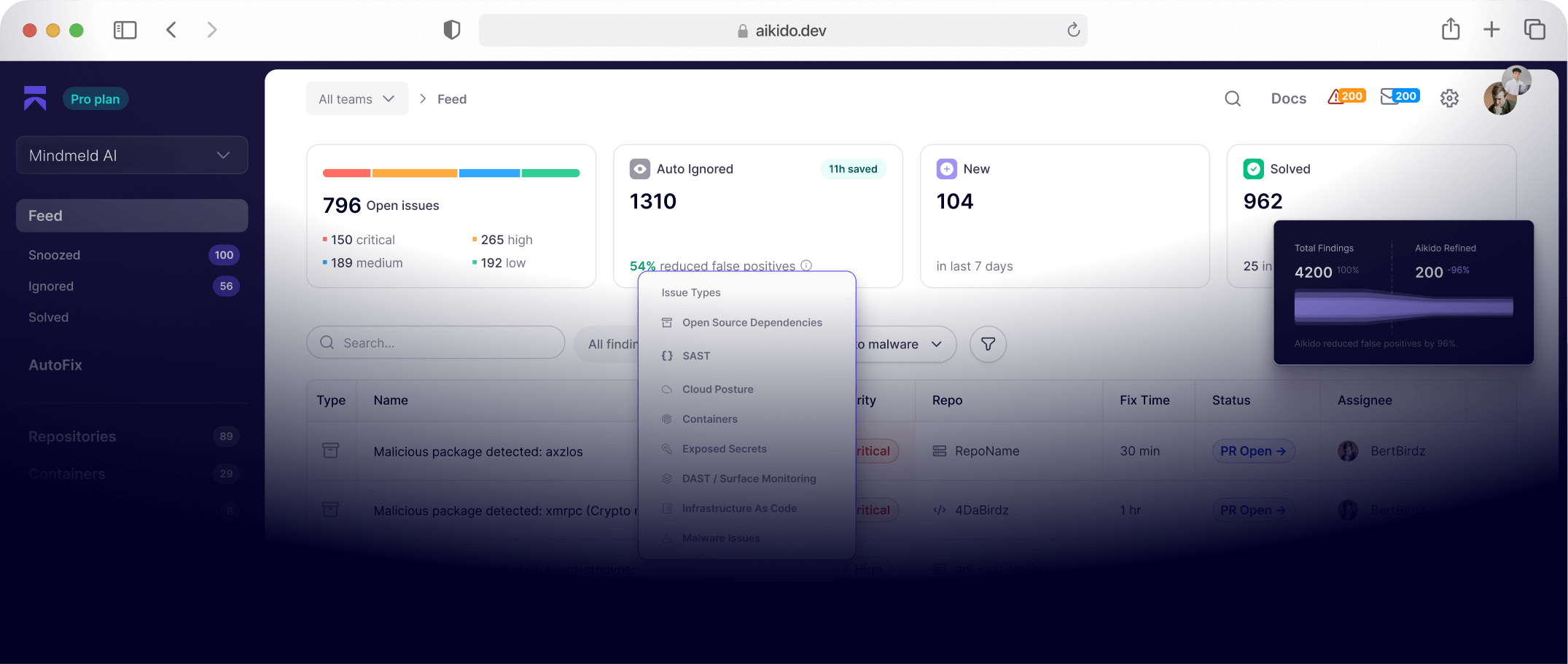
Aikido Security is a developer-first security platform that unifies security across the entire software development lifecycle. For JavaScript developers, it brings together findings from nine different security scanners—including custom code, open-source dependencies (npm), secrets, and more—into a single, intelligent platform. Aikido’s primary mission is to eliminate noise by focusing on reachable vulnerabilities and to empower developers with AI-powered fixes directly in their workflow. Learn more about their capabilities on the Aikido platform page.
Key Features & Strengths:
- Unified Security Platform: Combines SAST, SCA, secret detection, and IaC scanning into one dashboard. This provides a complete view of your JavaScript project's risk without the need to manage and triage alerts from multiple tools.
- Intelligent Triaging: Automatically identifies which vulnerabilities in your code or dependencies are actually exploitable. This allows developers to focus on fixing the 10% of issues that matter and ignore the 90% that are just noise.
- AI-Powered Autofixes: Delivers automated code suggestions to resolve vulnerabilities directly within pull requests. For JavaScript, this can include updating npm packages or patching vulnerable code, dramatically speeding up remediation.
- Transparent Pricing: Aikido is built for organizations of all sizes, with predictably simple and scalable pricing options to keep your security efforts sustainable.
- Seamless Developer Integration: Natively integrates with GitHub, GitLab, and other CI/CD tools in minutes. Security feedback is delivered as comments in pull requests, making it a frictionless part of the development process.
- Enterprise-Ready with Simple Pricing: Built to handle the demands of large organizations, Aikido offers robust performance with a straightforward, flat-rate pricing model that simplifies budgeting.
Ideal Use Cases / Target Users:
Aikido is the best overall solution for any organization, from startups to enterprises, that wants to make security an intrinsic part of its JavaScript development process. It is perfect for development teams taking ownership of security and for security leaders who need a scalable, efficient platform.
Pros and Cons:
- Pros: Exceptionally easy to set up, consolidates the functionality of multiple tools, drastically reduces false positive alerts, and offers a generous free-forever tier.
- Cons: As a comprehensive platform, it replaces many point solutions, which might be a change for teams accustomed to a multi-vendor security stack.
Pricing / Licensing:
Aikido offers a free-forever tier with unlimited users and repositories. Paid plans unlock advanced capabilities with simple, flat-rate pricing.
Recommendation Summary:
Aikido Security is the top choice for organizations seeking to integrate comprehensive and efficient security into their JavaScript development. Its developer-centric design and intelligent automation make it the premier solution for shipping secure applications at speed and scale.
2. TruffleHog
TruffleHog is a highly effective open-source tool dedicated to one critical task: finding leaked secrets in your code repositories. It scans your entire Git history, branches, and pull requests for high-entropy strings and patterns that match credentials, private keys, and other sensitive data. For JavaScript projects, this is crucial for preventing accidental exposure of API keys for services like AWS, Stripe, or Google Cloud.
If you want to understand how secret leaks and supply chain issues can impact JavaScript projects, check out Aikido’s analysis of npm package compromises and the GitHub Actions Shai Hulud incident.
Key Features & Strengths:
- Deep Git History Scanning: Goes beyond the current state of the code to find secrets that may have been committed and then removed in a later commit.
- High-Signal Detections: Uses a combination of regex and entropy detection to accurately identify secrets while minimizing false positives.
- Broad System Support: Can scan a wide variety of sources, including GitHub, GitLab, filesystems, and even S3 buckets.
- CI/CD Integration: Designed to be easily integrated into CI/CD workflows to act as a security gate, failing builds when secrets are detected.
Ideal Use Cases / Target Users:
TruffleHog is an essential tool for any JavaScript development team. It is particularly valuable for preventing accidental secret exposure—one of the most common and damaging security mistakes.
Pros and Cons:
- Pros: Highly effective at finding secrets, fast, easy to integrate into CI/CD, and has a strong open-source community.
- Cons: It is a highly specialized tool focused exclusively on secret detection. Teams will need other tools for vulnerability scanning in code and dependencies.
Pricing / Licensing:
TruffleHog is free and open-source. The creators also offer a commercial product, Truffle Security, with enterprise features like centralized management.
Recommendation Summary:
TruffleHog is the go-to tool for automated secret detection in your JavaScript projects. Its focused mission and effectiveness make it a critical layer in any DevSecOps strategy. For a deeper dive into real-world incidents involving secrets and supply chain attacks, explore Aikido’s security blog.
3. JSHint
JSHint is a community-driven tool for detecting errors and potential problems in JavaScript code. While its primary purpose is to enforce coding standards and help developers avoid common mistakes, it also plays a role in security by identifying insecure coding patterns.
Key Features & Strengths:
- Static Code Analysis: A linter that statically analyzes your JavaScript code as you write it or in your CI pipeline.
- Highly Configurable: Allows you to configure a wide range of rules to match your team's coding style and best practices.
- Focus on Code Quality: Helps catch issues like undeclared variables, syntax errors, and style violations that can sometimes lead to bugs or security flaws.
- IDE Integration: Integrates with virtually every popular code editor and IDE, providing real-time feedback to developers.
Ideal Use Cases / Target Users:
JSHint is a foundational tool for any JavaScript developer. It's best used as a first line of defense to maintain code quality and catch basic errors before they become bigger problems.
Pros and Cons:
- Pros: Free and open-source, very fast, highly configurable, and widely supported in the developer community.
- Cons: It is a linter, not a dedicated security tool. It will not find complex vulnerabilities like XSS or insecure dependencies. Its functionality is largely superseded by more modern tools like ESLint.
Pricing / Licensing:
JSHint is free and open-source.
Recommendation Summary:
JSHint is a useful, classic tool for enforcing JavaScript code quality. While it’s not a substitute for a true security scanner, it helps build a foundation of clean, predictable code.
4. NodeJS Security Checks (nsp)
NodeJS Security Checks (nsp) was a command-line tool for finding vulnerabilities in Node.js dependencies. It was a pioneering tool in the Node.js ecosystem for Software Composition Analysis (SCA). Note: nsp was acquired by npm and its functionality has been integrated into the npm audit command.
Key Features & Strengths (of npm audit):
- Native Integration:
npm auditis built directly into the npm command-line interface, making it available to every Node.js developer by default. - Dependency Scanning: Scans your project's
package-lock.jsonfile to identify dependencies with known vulnerabilities from the GitHub Advisory Database. - Automated Fixes: The
npm audit fixcommand can automatically update vulnerable dependencies to a secure version where possible, saving developer time. - CI/CD Usage: Can be run in CI/CD pipelines to fail builds if vulnerabilities are found.
Ideal Use Cases / Target Users:
npm audit is an essential, baseline tool for every Node.js developer. It's the first and easiest step to securing your project's open-source dependencies.
Pros and Cons:
- Pros: Free, built directly into npm, and provides automated fixes.
- Cons: Only covers Node.js dependencies (SCA). It does not scan custom code, and its vulnerability database may not be as comprehensive or timely as some commercial offerings.
Pricing / Licensing:
npm audit is free and included with npm.
Recommendation Summary:
The successor to nsp, npm audit, is a non-negotiable starting point for Node.js security. It’s a simple and effective way to manage supply chain risk.
5. Semgrep
Semgrep is a fast, open-source static analysis tool that is gaining popularity for its flexibility and developer-friendly approach. It uses a simple, intuitive rule syntax that makes it easy for developers and security engineers to write custom checks for their JavaScript codebase. For a deeper comparison of Semgrep with other security tools, check out our analysis on SonarQube vs Semgrep.
Key Features & Strengths:
- Lightweight and Fast: Semgrep is designed to run quickly in CI/CD pipelines, providing near-instant feedback on every commit.
- Customizable Rules: It’s easy to write custom rules tailored to your organization’s specific coding patterns, frameworks (like React or Express), and security requirements.
- Community and Registry: Benefits from a large community that contributes rules to a public registry, covering thousands of checks for security, correctness, and performance in JavaScript and other languages.
- Strong JavaScript Support: Has excellent support for JavaScript, TypeScript, and popular frameworks like React. If you're interested in exploring other open-source scanners, see our roundup of the top open-source dependency scanners.
Ideal Use Cases / Target Users:
Semgrep is great for teams that want a fast, customizable static analysis tool for their JavaScript projects. It’s loved by security engineers who want to write their own checks and developers who appreciate its speed and precision.
Pros and Cons:
- Pros: Extremely fast, highly customizable, free and open-source core, and a strong community.
- Cons: While powerful for custom checks, it may not have the same depth of analysis for complex bugs as some enterprise tools. It also needs to be combined with an SCA tool for dependency scanning.
Pricing / Licensing:
Semgrep is open-source and free. Semgrep, Inc. offers a paid commercial platform with features like a centralized dashboard and enterprise support.
Recommendation Summary:
Semgrep is a fantastic choice for teams that value speed and customizability in their static analysis. Its developer-friendly nature makes it a powerful addition to any modern JavaScript security toolchain. To learn more about code security analysis and current industry trends, read our post on the best code analysis tools.
6. Snyk
Snyk is a popular developer-focused security platform that helps teams find and fix vulnerabilities in their code, open-source dependencies, and container images. It is particularly strong in the JavaScript ecosystem.
Key Features & Strengths:
- Developer-First Approach: Integrates seamlessly into IDEs, command lines, and CI/CD tools, providing fast feedback where developers work.
- Strong SCA for JavaScript: Snyk's open-source scanning is highly regarded for its accuracy and comprehensive vulnerability database for npm packages.
- Actionable Remediation Advice: Provides clear explanations and one-click fixes for many types of vulnerabilities, such as automatically creating pull requests to upgrade dependencies.
- Snyk Code (SAST): Offers static analysis to find vulnerabilities in your custom JavaScript and TypeScript code.
Ideal Use Cases / Target Users:
Snyk is ideal for development teams who want to take an active role in security. It’s a great fit for organizations of all sizes that are looking for a user-friendly platform to embed security into their daily workflows.
Pros and Cons:
- Pros: Excellent developer experience, fast scan times, and actionable fix advice. The free tier is generous.
- Cons: Can become expensive at scale. The unification of its various products into a single platform can sometimes feel disjointed. Can still produce a significant number of alerts.
Pricing / licensing:
Snyk offers a free tier that is popular with individual developers. Paid plans are priced based on the number of developers and the features required.
Recommendation Summary:
Snyk is a very popular and effective tool for empowering developers to own security. Its ease of use and focus on fast, actionable feedback make it a strong choice for securing JavaScript projects.
7. SonarQube
SonarQube is an open-source platform for continuous inspection of code quality and security. It goes beyond just finding vulnerabilities to also detect code smells, bugs, and maintainability issues, helping teams improve the overall health of their JavaScript codebase.
Key Features & Strengths:
- Code Quality and Security: Combines SAST with code quality metrics to provide a holistic view of the codebase's health, which is critical for long-term security.
- Quality Gate: Allows you to define a "Quality Gate," a set of conditions (e.g., "no new critical vulnerabilities") that your code must meet before it can be released.
- Deep JavaScript Analysis: Provides robust static analysis for JavaScript and TypeScript, detecting common vulnerabilities like XSS, injection flaws, and insecure configurations.
- Strong Community and Ecosystem: Has a large user base and a rich ecosystem of plugins to extend its functionality.
Ideal Use Cases / Target Users:
SonarQube is ideal for development teams that want to adopt a comprehensive approach to code quality, not just security. It’s excellent for creating and enforcing consistent coding standards across a JavaScript organization.
Pros and Cons:
- Pros: Excellent for improving overall code quality, strong community support, and the open-source version is very powerful.
- Cons: The security-specific features may not be as deep as specialized SAST tools. The enterprise editions can be expensive.
Pricing / Licensing:
SonarQube Community Edition is free and open-source. Commercial editions (Developer, Enterprise) offer more advanced features and are priced per lines of code.
Recommendation Summary:
SonarQube is a leading tool for teams that believe secure code is high-quality code. It’s a great way to build a culture of code craftsmanship and security for your JavaScript projects.
Conclusion: Making the Right Choice
Securing your JavaScript applications requires a layered defense. Foundational tools like npm audit are essential. Specialized open-source scanners like TruffleHog for secrets and Semgrep for custom static analysis provide incredible value.
However, managing a collection of separate tools often leads to alert fatigue, integration headaches, and a fragmented view of risk. This is where a unified platform provides a clear advantage. Aikido Security stands out by consolidating the functionality of these point solutions into a single, cohesive platform.
By integrating security seamlessly into your CI/CD pipeline, triaging alerts to show only what's reachable, and providing AI-powered fixes, Aikido eliminates the friction that holds DevSecOps back. For any organization looking to build a fast, efficient, and secure JavaScript development process, Aikido provides the best balance of comprehensive coverage, developer experience, and enterprise-grade power.