GitHub is the heart of modern software development, a collaborative hub where code comes to life. But as your repositories grow, they can also become a minefield of security risks. A single vulnerable dependency, or an accidentally committed secret can expose your entire application to attack.
The challenge of securing your code directly within GitHub is finding tools that integrate into the fast-paced, pull-request-driven workflow of GitHub. Developers need security feedback that is accurate and actionable. This guide will help you navigate the ecosystem of GitHub security tools, offering a clear comparison of the top options for 2026. We'll break down their features, ideal use cases, and limitations to help you find the perfect fit for your team.
How We Evaluated the Tools
To create a useful comparison, we assessed each tool against criteria that matter most for securing GitHub repositories:
- Developer Experience: How easily does the tool integrate with GitHub and provide feedback within pull requests?
- Comprehensiveness: What types of security issues does the tool find (e.g., code flaws, dependencies, secrets)?
- Accuracy and Actionability: How well does it minimize false positives and offer clear guidance for fixes?
- Integration and Speed: Does it provide fast feedback without slowing down the CI/CD pipeline?
- Scalability and Pricing: Can it support a growing organization, and is the pricing model transparent?
The 9 Best GitHub Security Tools
Here is our curated list of the top tools for locking down your GitHub environment.
1. Aikido Security
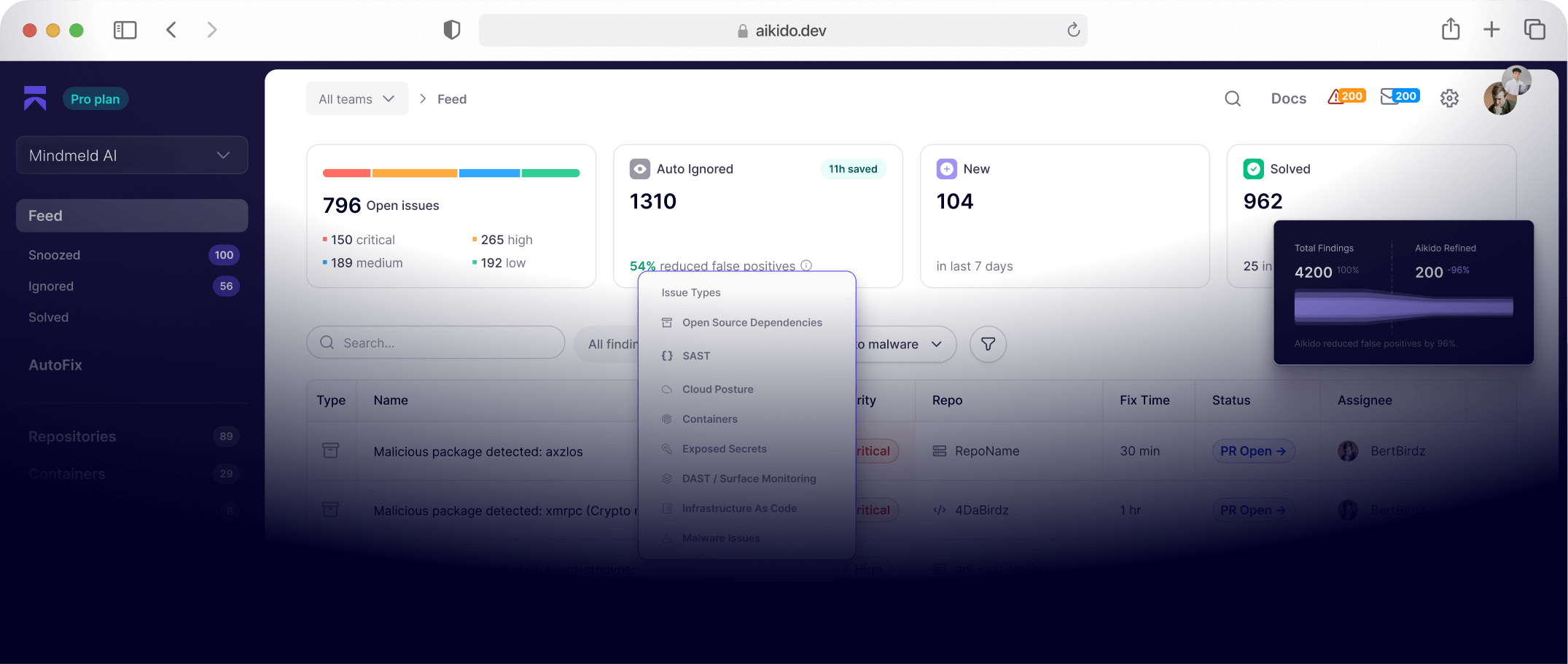
On GitHub, your biggest supply-chain exposure is your open-source dependencies. Aikido SCA scans your dependencies for CVEs, malware, license, and end-of-life issues, then prioritizes what's actually reachable. It runs reachability analysis, tracing whether your code reaches a vulnerable function, and then goes a step further: its exploitability agent reads how each package is actually used in your repository and reasons about whether a given CVE is genuinely exploitable in your context. Where reachability-based tools reduce false positives by 80 to 90 percent, Aikido's latest update removes 100%. It also flags risky licenses, spots unmaintained packages, and groups related fixes into clean tickets.
What powers all of it is Aikido Intel, a real-time feed tracking both malware and vulnerabilities across open-source ecosystems. Intel's malware pipeline monitors packages across npm, PyPI, Maven, and 15+ other ecosystems, running each new release through static rules, sandbox detonation, and an AI layer, with researchers confirming the hardest cases by hand. In Q2 2026 it analyzed around 7.5 million package versions and confirmed 19,500 malicious ones, catching most within eight minutes. On the vulnerability side, it spots security fixes maintainers ship quietly and publishes an advisory with its own Aikido Vulnerability ID.
Beyond the upgrade trap: Most tools hand you a CVE and tell you to upgrade, which falls apart when the patched version has breaking changes, or no patched version exists yet. When there's a clean upgrade, AutoFix opens a merge-ready pull request with the change already made. When there isn't, Aikido Libraries provides a patched build of the exact version already in your lockfile, with no changes other than the security patches. At the container layer, Aikido Images does the same for base images, clearing high and critical CVEs to an SLA using backports and selective upgrades on the OS and distro you already run.
Stopping malware before it reaches a developer: The highest-leverage place to stop a supply-chain attack is the moment of install, before malicious code runs on a developer machine or in CI. Aikido Device Protection guards every developer endpoint across the organization, blocking malicious packages and extensions at the point they'd otherwise execute. It's the enterprise counterpart to Aikido Safe Chain, a free, open-source tool that sits beside your package manager and blocks any npm install confirmed as malware or less than 24 hours old. Both draw on the Intel feed, so what the research team confirms is what gets blocked at the endpoint.
Key Features & Strengths:
- Risk-based prioritization: Focuses on exploitable issues by reachability and data sensitivity, cutting noise from irrelevant CVEs.
- Advanced malware detection: Catches hidden scripts, exfiltration, typosquatting, and dependency confusion across npm, PyPI, Go, Rust, and more, based on what a package does rather than known signatures.
- Automated remediation: AutoFix pull requests, plus ticketing and alerts through Slack, Jira, and GitHub Actions.
- Broad coverage: One tool across IDE, Git, CI, containers, and cloud, with duplicate findings correlated.
- Fast: Scans run in under two minutes, even on large repos.
- Extensive language support: All major ecosystems, with no lockfile needed for C/C++ and .NET.
- Flexible deployment: Cloud, on-prem, or local CLI for privacy-sensitive teams.
- SBOMs: Generated and maintained automatically, with risky-license and EOL flags.
Ideal Use Cases / Target Users:
Teams that want dependency and supply-chain security handled properly inside their GitHub workflow, from a first repository through to a large multi-repo estate. It fits organizations that need reachable-and-exploitable prioritization rather than a raw CVE list, and security leaders who need governance and reporting without pulling developers out of their pull requests. Aikido also brings the governance an enterprise program runs on, with policy enforcement, RBAC, and SSO, plus portfolio-wide SBOM generation and license management that support NIS2 and CRA compliance. It's trusted for SCA at enterprise scale by companies including Visma and Revolut.
Pros and Cons:
- Pros: Eliminates false positives through reachability plus exploitability reasoning, blocks malware at install through Intel and Device Protection, and handles the cases upgrades can't via Libraries and Images. Flexible deployment and predictable pricing.
- Cons: It reaches well beyond dependency scanning into malware, containers, cloud, and runtime, so teams that only want a narrow SCA point tool are buying into more platform than that.
Recommendation Summary:
For securing what your GitHub repositories depend on, Aikido goes past listing CVEs to reasoning about which ones are actually exploitable, then gives you a real path to fix each one, whether that's an AutoFix PR, a patched library, or a hardened base image. It's the strongest choice when dependency risk is where your GitHub exposure actually lives.
2. Dependabot
Dependabot is a native GitHub feature that helps you keep your dependencies up to date. It automatically scans your dependency files for known vulnerabilities (from the GitHub Advisory Database) and can be configured to automatically create pull requests to upgrade them to the next secure version.
Because it's built into GitHub, Dependabot is usually the first security feature teams turn on: it watches your dependency manifests, raises alerts from the GitHub Advisory Database when a known vulnerability appears, and opens upgrade pull requests automatically. It's worth being clear about the boundary, though. Dependabot handles known-vulnerable dependency versions and nothing else, so it won't catch malware in a package, secrets in your code, or issues in your own code or IaC. Treat it as the baseline layer, not the whole picture.
Key Features & Strengths:
- Native GitHub Integration: As a built-in GitHub feature, it is incredibly easy to enable and use across all your repositories.
- Automated Pull Requests: Saves developers time by automatically generating pull requests to upgrade vulnerable dependencies, complete with release notes and compatibility scores.
- Vulnerability Alerts: Provides security alerts directly in your repository when new vulnerabilities are discovered in your project's dependencies.
- Broad Language Support: Supports a wide range of languages and package managers, including npm, Maven, Pip, RubyGems, and more.
Ideal Use Cases / Target Users:
Dependabot is an essential, foundational tool for any team developing on GitHub. It's the first line of defense against open-source vulnerabilities and requires almost no effort to set up.
Pros and Cons:
- Pros: Free, seamlessly integrated into GitHub, and highly effective at automating dependency updates.
- Cons: It only covers open-source dependencies (SCA). It does not scan for vulnerabilities in your custom code, secrets, or IaC files.
Recommendation Summary:
Dependabot is a non-negotiable tool for basic dependency security on GitHub. It’s a simple, powerful, and free way to manage open-source risk.
3. Opengrep
Opengrep is an open-source static analysis engine, forked from Semgrep in early 2025 by a group of security companies (Aikido among them) after Semgrep moved parts of its open-source engine behind a commercial license. If you want SAST you can run and customize yourself on GitHub, without a vendor account, Opengrep is the option to know.
Key Features & Strengths:
- Open-source SAST engine: Write and run your own rules across many languages, with an engine that stays fully open.
- CI-friendly: Runs in GitHub Actions and other pipelines as a build-time gate, so findings surface on the pull request.
- Rule compatibility: Keeps backward compatibility with existing rule formats and standard JSON/SARIF output, so it drops into existing workflows.
Ideal Use Cases / Target Users:
Teams that want customizable, self-hosted static analysis on GitHub without committing to a commercial SAST product, and open-source-minded engineers who want to write rules that read like code.
Pros and Cons:
- Pros: Free and open source, customizable, integrates cleanly into GitHub Actions.
- Cons: It's a static-analysis engine, not a full platform. You'll pair it with separate tooling for dependencies, secrets, and cloud, and there's no managed dashboard out of the box.
Recommendation Summary:
Opengrep is an open-source SAST engine to run on GitHub if you want control over your own rules and no vendor lock-in. Expect to combine it with other tools for coverage beyond code.
4. GitGuardian
GitGuardian is a security platform laser-focused on detecting and remediating secrets that have been accidentally committed to your code. It integrates directly with GitHub to provide real-time alerts the moment a secret is pushed, helping you prevent costly leaks.
Key Features & Strengths:
- Real-Time Secret Detection: Scans every commit in real-time and immediately alerts developers and security teams if a secret is found, often before a pull request is even merged.
- High-Fidelity Scanning: Uses a sophisticated library of over 350 specific detectors, plus pattern matching, to accurately identify a wide variety of secrets with very few false positives.
- Historical Scanning: Can perform a full scan of an organization's entire GitHub history to uncover secrets that have been leaked in the past.
- Automated Remediation Workflows: Provides playbooks and tools to help teams quickly remediate exposed secrets, a crucial step after detection.
Ideal Use Cases / Target Users:
GitGuardian is an essential tool for any organization on GitHub. It’s invaluable for security teams needing a centralized platform for secret management and for development teams who need immediate feedback to prevent leaks.
Pros and Cons:
- Pros: Best-in-class real-time secret detection, highly accurate, and offers great tools for collaboration between security and development.
- Cons: It is a specialized tool focused exclusively on secrets. Teams will need other tools for SAST and SCA.
Recommendation Summary:
GitGuardian is a must-have for preventing and remediating secret leaks in GitHub. Its real-time, developer-friendly approach makes it a critical part of any secure coding strategy.
5. GitHub Advanced Security
GitHub Advanced Security (GHAS) is GitHub's own set of security features, built directly into the platform. As of April 2025 it's no longer sold as a single bundle: GitHub split it into two standalone products, GitHub Secret Protection and GitHub Code Security, and made both available to GitHub Team customers, not just Enterprise. That matters if you've read older comparisons that treated GHAS as an Enterprise-only add-on; you can now buy either product on its own.
Between them, the two products cover the core of what you'd want natively in GitHub: secret scanning and push protection on the Secret Protection side, and CodeQL code scanning, Copilot Autofix, and dependency review on the Code Security side.
Key Features & Strengths:
- Code scanning with CodeQL: A semantic analysis engine that traces data flow through your code to find complex vulnerabilities, not just pattern matches. It's one of the stronger SAST engines available, and it's part of GitHub Code Security.
- Secret scanning and push protection: GitHub Secret Protection scans for known secret formats and can block a commit that contains one before it ever lands, with AI detection to catch less obvious credentials.
- Copilot Autofix: Suggests fixes for code-scanning findings directly in the pull request, which shortens the path from alert to remediation.
- Native to the platform: Everything surfaces in the GitHub UI, pull requests, and Actions, so there's no separate tool to wire up if you're already on GitHub.
Ideal Use Cases / Target Users:
Teams that run their development on GitHub and want security that lives in the same interface. Since the unbundling, this now includes GitHub Team customers, not only Enterprise, so smaller organizations can adopt Secret Protection or Code Security without an Enterprise contract. It's a strong fit if you want GitHub-native tooling and are comfortable running your code and security in one vendor.
Pros and Cons:
- Pros: Deep, native integration with GitHub. CodeQL is a powerful and accurate SAST engine. The split into standalone products makes it easier to buy only what you need, and Team-plan availability widens who can use it.
- Cons: Coverage stops at GitHub's boundary and at code and secrets; it won't give you cloud posture, container, IaC, DAST, or runtime coverage. It can still generate a high volume of alerts to triage, and it lacks the cross-scanner triaging and reachability filtering that unified platforms use to cut noise. Priced per active committer, costs add up as your contributor count grows.
Recommendation Summary:
For teams building on GitHub, GHAS is a convenient, deeply integrated way to cover code and secrets without leaving the platform, and the move to standalone products has made it more accessible than it used to be. Just plan to pair it with other tooling if you need coverage beyond code and secrets, since it doesn't reach cloud, containers, or runtime.
6. Gitleaks
Gitleaks is a popular open-source static analysis tool for detecting and preventing secrets in Git repositories. It is designed to be fast and flexible, making it easy to integrate into your CI/CD pipeline to catch secrets before they are merged.
Key Features & Strengths:
- Fast and Efficient: Written in Go, it is designed for performance and can scan large repositories quickly.
- Customizable Rules: Allows you to define your own rules using regular expressions and other criteria to find secrets specific to your organization.
- CI/CD Integration: Easily integrates into GitHub Actions and other CI systems to act as a security gate, failing builds when secrets are detected.
- Historical Scanning: Can be used to audit your entire Git history for any secrets that may have been committed in the past.
Ideal Use Cases / Target Users:
Gitleaks is perfect for developers and DevOps engineers who want a free, fast, and highly customizable tool for secret detection in their CI pipelines. It’s a great open-source alternative to commercial secret scanning tools.
Pros and Cons:
- Pros: Free and open-source, very fast, highly customizable, and easy to integrate into CI/CD.
- Cons: It is a command-line tool and lacks a central management UI. It is focused solely on secret detection.
Recommendation Summary:
Gitleaks is a fantastic open-source tool for automated secret detection. Its speed and customizability make it a valuable addition to any GitHub security workflow.
7. GuardRails
GuardRails is an application security platform that integrates into your GitHub workflow to find, fix, and prevent vulnerabilities. It supports a wide range of languages and security testing types, providing feedback directly in pull requests.
Key Features & Strengths:
- Multi-Scanner Approach: Orchestrates a curated set of open-source and commercial security scanners to provide broad vulnerability coverage.
- Pull Request Integration: Delivers security findings as comments within pull requests, allowing developers to see and fix issues in context.
- Actionable Remediation: Provides clear instructions on how to fix identified vulnerabilities.
- Security Dashboard: Offers a centralized dashboard to track the security posture of all your repositories.
Ideal Use Cases / Target Users:
GuardRails is a good fit for development teams who want a simple way to add a layer of security scanning to their GitHub workflow without the complexity of managing multiple tools themselves.
Pros and Cons:
- Pros: Easy to set up and use. The pull request integration provides a good developer experience.
- Cons: It acts primarily as an orchestrator for other scanning tools, so the quality of results can vary. It may not have the same depth as specialized enterprise tools.
Recommendation Summary:
GuardRails is a user-friendly platform that makes it easy to add automated security scanning to your GitHub pull requests, making it a solid choice for teams just starting with DevSecOps.
8. SonarCloud
SonarCloud is the cloud-based version of SonarQube, a platform for continuous inspection of code quality and security. It integrates with GitHub to analyze your code on every push, helping you maintain a high standard of code health.
Key Features & Strengths:
- Code Quality and Security: Combines SAST with code quality metrics (bugs, code smells) to provide a holistic view of your codebase's health.
- Pull Request Decoration: Provides detailed analysis directly within GitHub pull requests, showing new issues and whether the code meets the defined "Quality Gate."
- Quality Gate: Allows you to enforce a set of conditions that your code must meet before it can be merged, such as "no new critical vulnerabilities."
- Fast Analysis: Designed for speed, providing feedback quickly within the CI/CD pipeline.
Ideal Use Cases / Target Users:
SonarCloud is ideal for development teams that want to adopt a comprehensive approach to code quality, not just security. It’s excellent for creating and enforcing consistent coding standards across an organization.
Pros and Cons:
- Pros: Excellent for improving overall code quality. The Quality Gate feature is powerful for enforcing standards. Strong integration with GitHub.
- Cons: The security-specific features may not be as deep as specialized SAST tools. It can produce a lot of non-security-related "noise" for teams focused purely on vulnerabilities.
Recommendation Summary:
SonarCloud is a leading tool for teams that believe secure code is high-quality code. It’s a great way to build a culture of code craftsmanship and security within GitHub.
9. Snyk
Snyk is a popular developer-security platform that helps teams find and fix vulnerabilities in their code, open-source dependencies, and container images. It is known for its strong developer experience and deep integration with GitHub.
Key Features & Strengths:
- Developer-First Experience: Integrates seamlessly into GitHub, providing automated pull requests to fix vulnerable dependencies and clear feedback on code issues.
- Comprehensive Scanning: Offers a suite of products including Snyk Code (SAST) and Snyk Open Source (SCA).
- Actionable Fix Advice: Provides clear explanations and often one-click fix pull requests for vulnerabilities, empowering developers to remediate issues quickly.
- Strong Vulnerability Database: Maintains its own high-quality vulnerability database, which often provides earlier and more detailed information than public databases.
Ideal Use Cases / Target Users:
Snyk is ideal for development teams of all sizes that want to take an active role in security. Its user-friendly platform and strong GitHub integration make it easy to embed security into daily development workflows.
Pros and Cons:
- Pros: Excellent developer experience and GitHub integration. Fast scan times and actionable fix advice.
- Cons: Can become expensive at scale. The unification of its various products can sometimes feel disjointed, and it can still produce a significant number of alerts to manage.
Recommendation Summary:
Snyk is a highly effective platform for empowering developers to own security. Its ease of use and strong GitHub integration make it a powerful choice for code security.
Making the Right Choice
Securing your GitHub repositories requires a layered approach. Essential free tools like Dependabot and Gitleaks provide a strong foundation. For enterprises already on GitHub's top tier, GitHub Advanced Security is a convenient, native option.
However, juggling multiple tools creates its own problems: alert fatigue, integration overhead, and a fragmented view of risk. A unified platform that solves these challenges provides a clear advantage. Aikido Security stands out by consolidating the strengths of multiple scanning types into a single, intelligent platform built for GitHub. By filtering out the noise to show only what's truly reachable and providing AI-powered fixes directly in pull requests, Aikido removes the friction that slows down development.
For any organization looking to build a fast, efficient, and secure workflow on GitHub, Aikido provides the best balance of comprehensive coverage, developer experience, and enterprise-grade power.
FAQ
Is Dependabot enough to secure a GitHub repo?
Dependabot is a strong baseline for one job: flagging and updating dependencies with known vulnerabilities, using the GitHub Advisory Database. It doesn't scan your own code, detect secrets, catch malicious packages, or check IaC, so most teams pair it with tools that cover those gaps.
How do I stop secrets from being committed to GitHub?
Secret detection tools catch credentials before or shortly after they're pushed. GitHub Secret Protection and GitGuardian scan commits in real time and can block a push that contains a secret, while Gitleaks is a free, open-source option you can run as a GitHub Actions gate. The most effective setups block the secret at push time rather than alerting after it's already in history.
Can GitHub security tools catch malware in open-source packages?
A known-vulnerability check (like Dependabot) won't, because malware often isn't a listed CVE. Catching it takes a tool that analyzes what a package actually does, or that draws on a live malware feed for open-source ecosystems like npm and PyPI. If supply-chain malware is a concern, look for that capability specifically rather than assuming CVE scanning covers it.
How do I check open-source license compliance on GitHub?
License risk is handled by software composition analysis (SCA) tools that inventory your dependencies and flag licenses that conflict with your policy, often alongside an SBOM. Dependabot and GitHub's dependency graph show what you depend on, but flagging risky licenses against a policy generally needs a dedicated SCA tool.