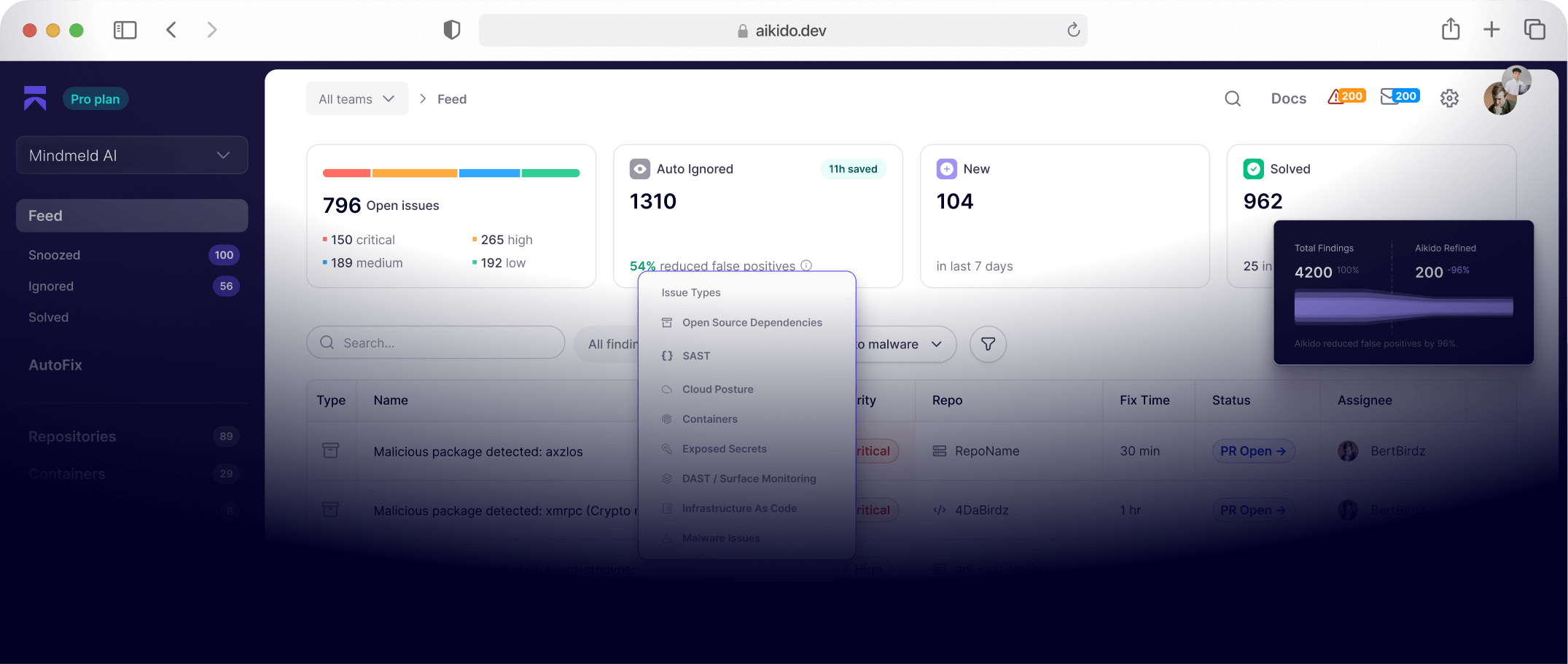
Chainguard built its product around stripping a container image down to only what your application actually needs and rebuilding it from a minimal base. The idea is that fewer packages means fewer vulnerabilities. To scale this, it maintains its own Linux distribution, Wolfi, which is where the model starts to show its constraints.
To use Chainguard, you have to move onto its images and commit to its distribution. If your application depends on something Chainguard has stripped out, it breaks. Chainguard also only covers the container layer in any meaningful way. It has extended into application libraries, but coverage is narrow, and the same proprietary-distribution commitment applies.
For teams running software they've been shipping for a while, switching base images is a migration project. It can be costly, and breaking away from a proprietary distribution is harder than it looks. That's probably why you're on this page looking for alternatives.
This post walks through what to look for in a Chainguard alternative and the vendors worth evaluating.
TL;DR
Aikido Security is the strongest Chainguard alternative for teams that want CVEs fixed in the base image version they already run, without migrating to a proprietary distribution. Aikido patches open source vulnerabilities in place for both application dependencies and container base images, keeping your existing distribution rather than replacing it. It also blocks malicious packages at install time before they reach a developer's laptop, and clears the CVEs that can be upgraded cleanly through automated pull requests. The result is a continuous protection loop that finds vulnerabilities, fixes them where they are, and blocks new threats before they enter the pipeline. No other platform closes it end-to-end this way.
If you specifically want hardened images and nothing else, Docker Hardened Images, Minimus, RapidFort, and Echo are the direct alternatives.
What Chainguard does well
The images themselves are strong. Chainguard ships them with SBOMs and Sigstore signatures generated at build time, rebuilds from upstream sources nightly so patches land in base images within a day, and publishes a CVE remediation SLA of 7 days for critical and 14 days for everything else.
The other area where Chainguard is strong is federal compliance. They maintain over 700 FIPS-validated image variants with NIST-validated cryptographic modules, a kernel-independent design that removes the traditional need for a FIPS-mode host, and DISA STIG hardening applied by default. For teams targeting FedRAMP, DoD Impact Levels, or similar regulated environments, the Chainguard image catalog is a short path to compliance-ready containers.
Why teams look for Chainguard alternatives
Requires full migration to Chainguard catalog and distro
To get Chainguard's CVE remediation SLA, you commit to their curated catalog, their Wolfi-based distribution, and their package versions. Custom Assembly lets you add packages, but anything pulled from the general Wolfi OSS repository falls outside the SLA, and the FIPS commitment doesn't extend to custom builds. If you're running something that doesn't have a Chainguard equivalent, or you're maintaining custom internal packages, the migration cost climbs and the security guarantees fragment.
Chainguard's upgrade treadmill never stops
Chainguard's approach to keeping CVE counts low is to rebuild images from upstream every night and ship new digests. When a fix lands, you roll forward. That trades one operational burden (patching CVEs manually) for another (constant change management on your base images). Every new digest is a different image that needs re-testing, and if your compliance posture requires change control, you're approving updates daily. Chainguard even recommends pinning to a digest for reproducibility, but pinning stops the patches from reaching you, which is the reason you were on Chainguard in the first place.
They tell you to scan with someone else's tools
Chainguard builds hardened, CVE-less images, but it doesn't tell you what's actually in them at the CVE level, or what's changed between digests. Their own documentation walks users through scanning Chainguard images with Trivy, Grype, Snyk, or Docker Scout, because that's where the vulnerability findings come from.
Piecemeal, not a platform
Chainguard only covers a narrow slice of the security stack. You get hardened base images, FIPS variants, an SLA on the packages they curate, and SBOMs for what they ship. Chainguard recently extended coverage into application dependencies for Python, Java, and JavaScript, though it's still three ecosystems (no Go, .NET, PHP, Ruby, or Rust), and it carries the same proprietary distribution commitment as the images. Everything else, from SAST and DAST to secrets detection, IaC scanning, container runtime monitoring, and cloud posture management, is still your problem to solve elsewhere.
What to look for in a Chainguard alternative
Backports for pinned versions
Every CVE fix from Chainguard requires you to move to a new image. That means new testing, new compliance approval, and a new deployment for each patch. The right alternative should let you apply security fixes into the version you already run, so a security fix doesn't require a full release cycle. This is the pattern that escapes the upgrade trap. You keep the version pinned, backport the security fix into it, and end up with no known CVE, no forced upgrade, and none of the "latest release" malware risk that comes with pulling the newest available package.
A path that works with your existing images
Adopting Chainguard means moving onto Chainguard's catalog and Wolfi distribution. The right alternative should work with the base images you already use, like Docker Hub’s official ones, vendor images like Elastic's or Bitnami's, and your own internal builds. Aikido scans all of these and applies VEX attestations from sources like Docker Hardened Images automatically, so adoption doesn't require rebuilding your image strategy.
Coverage past the base image
Hardened base images reduce the CVE count in the layer underneath your application. Everything else attackers reach for sits above it, starting with the open source packages your code depends on directly. Chainguard has extended into libraries, but only for Python, Java, and JavaScript, and only from their own rebuilt catalog. Aikido patches vulnerabilities in place across six ecosystems (npm, PyPI, Maven, Go, NuGet, and PHP), on the exact package versions your application already runs, with no proprietary distribution to migrate onto. The rest of the software development lifecycle sits above that: SAST, IaC, secrets detection, and runtime signals. Aikido covers those on the same platform, so a finding in a dependency is enriched by the IaC and runtime context around it.
Top Chainguard alternatives
Aikido Security
Aikido goes beyond Chainguard on container security, pairing 2,000+ secure base images with container image scanning, VEX-aware triage, and reachability analysis that traces a CVE from an exposed entry point to the exact code path it affects.
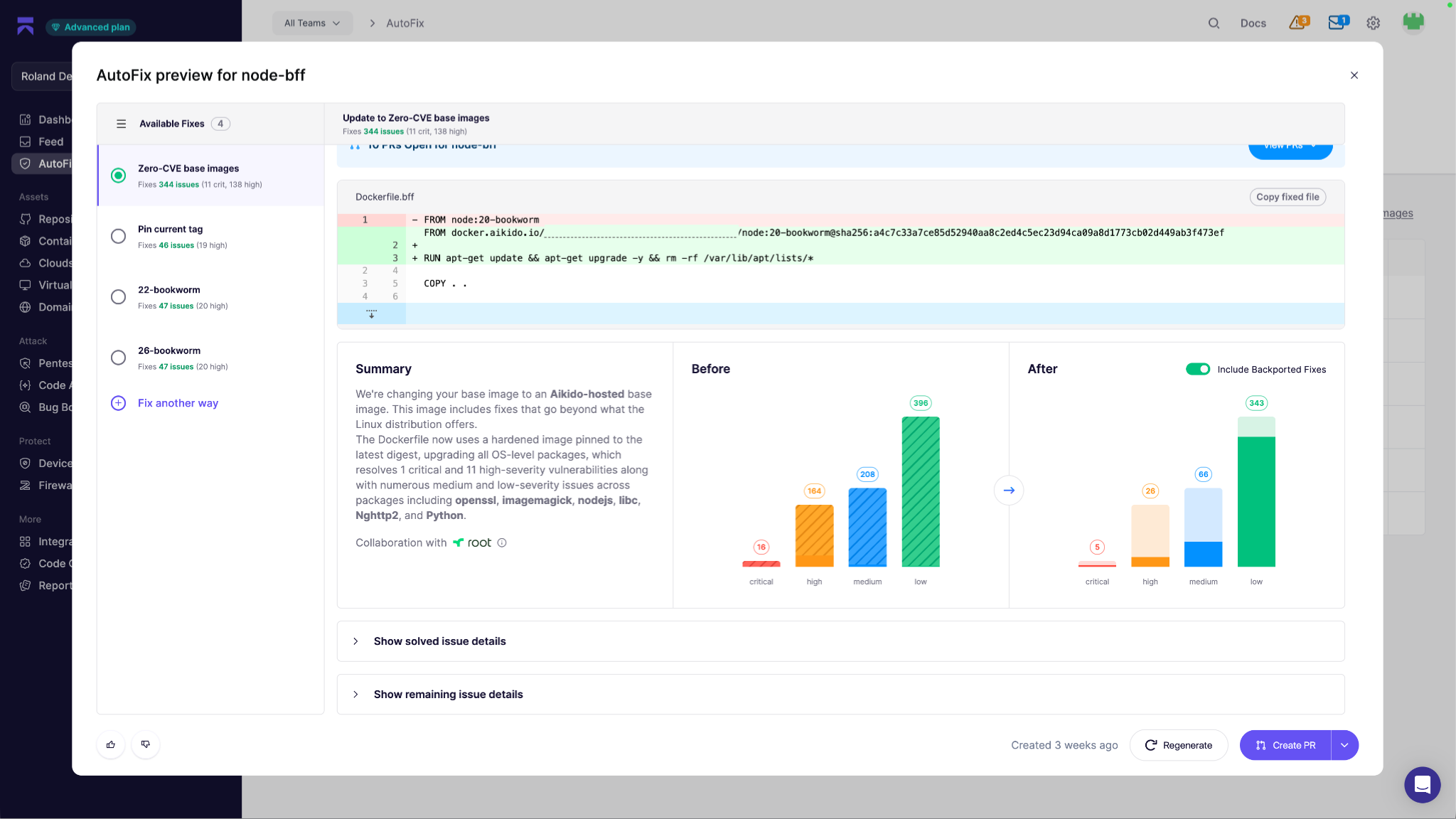
Aikido Images provides secure, drop-in container base images that stay on the same distribution and major version as your existing base, with patches already backported. AutoFix opens a pull request that updates the FROM line, so the fix lands in code review rather than as a forced digest swap. Aikido delivers CVE fixes to a defined SLA using backports and selective upgrades, so patches land on the version you're running rather than pushing you to a new major version. You keep the version pinned, apply the security fix to it, and end up with no known CVE and no forced migration.
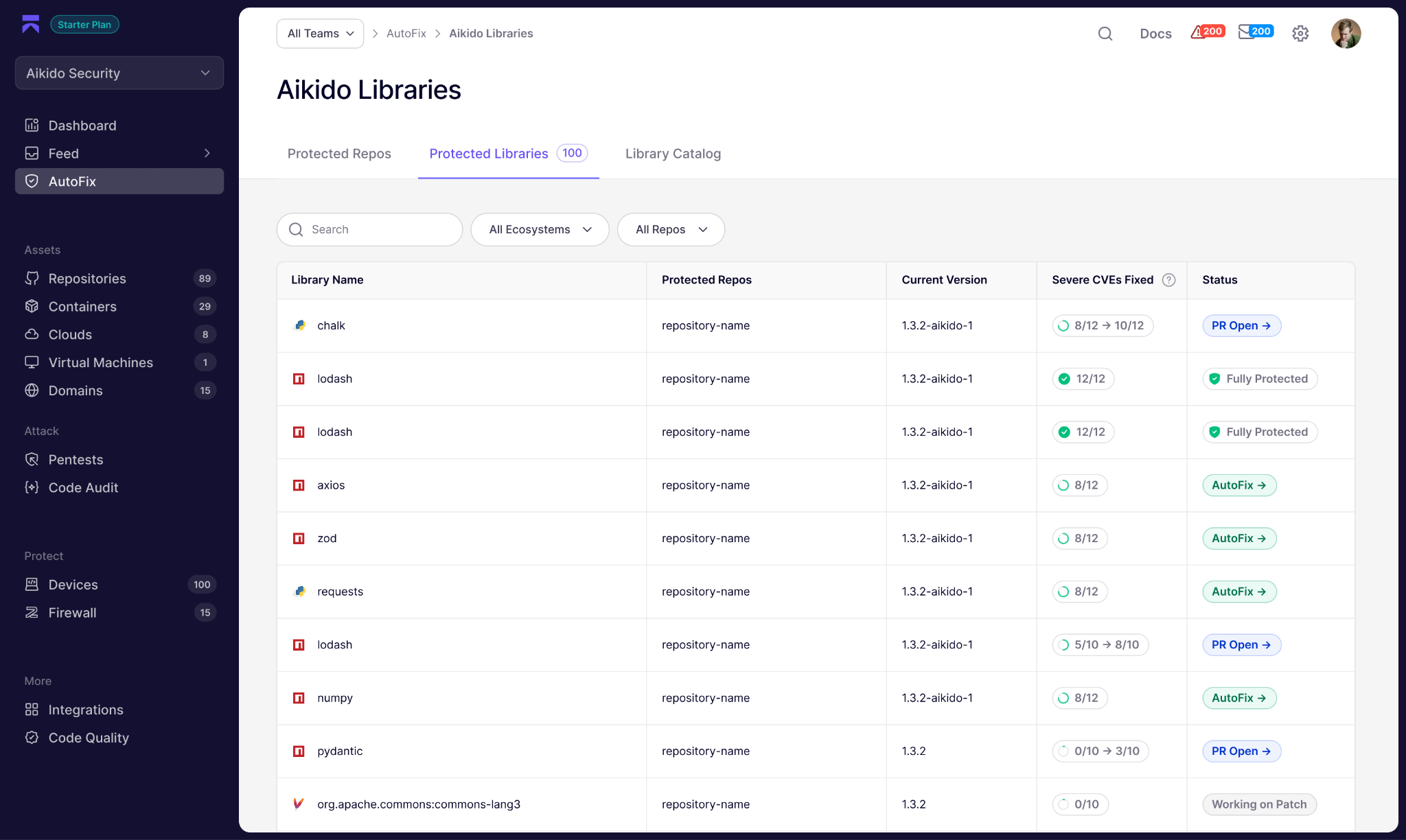
Aikido Libraries does the same for application dependencies across six ecosystems (npm, PyPI, Maven, Go, NuGet, and PHP). When a CVE hits a package version you've pinned, Aikido backports the fix into that version and delivers it as a pull request, so you get the patch without the breaking changes of a major upgrade.
For images and dependencies you'd rather harden than replace, Aikido works with whatever you already use, including Docker Hub officials, vendor images like Elastic's or Bitnami's, Docker Hardened Images, and internal builds. All of them go through the same container image scanning workflow with no migration onto an Aikido-specific catalog. When an image ships VEX attestations, Aikido reads them and removes cleared CVEs from the active queue automatically. For images that haven't been secured yet, Aikido pairs CVE detection with reachability analysis, tracing the network route from an exposed entry point to the running container and confirming whether the vulnerable code path actually executes.
Aikido Intel detects malicious packages and undisclosed vulnerabilities before they reach public databases. Safe Chain uses that feed to block malicious packages at install time, before they ever land on a developer's laptop. And AutoFix clears the CVEs that can be upgraded cleanly, opening pull requests with the fix already drafted. Together with Images and Libraries, that's the full supply chain loop closed from developer laptop to registry to running container.
And Aikido is a complete software security platform covering the entire SDLC, so the same platform that patches your base images also runs SAST on your application code, SCA on your dependencies, IaC checks, secrets detection, cloud posture management, and runtime protection. Findings across those domains share context, so a vulnerability in a container dependency is a different priority if the IaC around it exposes the container to the internet or runtime telemetry shows the affected code path actually executes.
For a closer look at how Aikido stacks up, take a look at our head-to-head Chainguard comparison.
Best for: engineering teams that want CVEs fixed in the base image and dependencies they already run, without migrating to a proprietary distribution.
{{cta}}
Rapidfort
RapidFort offers curated near-zero CVE container images backed by FIPS validation and STIG and CIS hardening. Their approach is to strip out packages and components an application doesn't actually use at runtime, informed by observed production behavior. The pitch that distinguishes it is that RapidFort's images are built on standard LTS distributions like Alpine, Debian, Ubuntu, and Red Hat rather than a proprietary container distro. So teams who would rather not commit to Wolfi specifically don’t have to. The catalog runs to over 25,000 images and is heavily oriented toward federal and defense workloads, including FedRAMP, FISMA, and CMMC.
What RapidFort adds on top of the images themselves is runtime profiling. Its Profiler component observes which packages and binaries actually execute in production, generates a Runtime Bill of Materials (RBOM), and uses that data to strip out unused components from the image.
The limitation is that RapidFort, like Chainguard, is a container-focused product. There's no SAST for application code, no source code dependency scanning before images are built, no IaC scanning, no secrets detection, and no cloud posture management. You're still buying separate tooling for the rest of the software development lifecycle. The runtime profiling is also a heavier integration than image-only approaches, since you need to run workloads under the Profiler to generate the runtime data the hardening depends on.
Best for: federal contractors, defense vendors, and regulated teams already committed to FIPS and STIG compliance who want a Chainguard-style outcome without adopting a proprietary distribution.
Echo
Echo is a newer entrant, whose pitch is an AI-driven image factory that compiles container images from source code, including only the components an application actually needs. Its agents watch vulnerability feeds and regenerate images as new CVEs land upstream. The resulting images aim for zero CVEs and ship as drop-in replacements for standard Docker base images.
The images are FIPS-validated and STIG-aligned for teams that need that, and Echo positions itself as a direct alternative to Chainguard and Docker Hardened Images in the rebuilt-base-image space. Where Echo is least proven is the operational track record of the AI-driven rebuild and patching pipeline under regulated, production-scale workloads.
Best for: teams that want a rebuilt base image strategy and are comfortable evaluating a Series A vendor with a smaller catalog and a shorter operational history.
Minimus
Minimus was founded in October 2022 by co-founders who previously built Twistlock (acquired by Palo Alto Networks in 2019). The product itself launched publicly at RSAC in April 2025, so its track record is still quite new. Minimus images are built from upstream source with only the minimal software needed to run an application. Their pipeline continuously monitors open source projects, rebuilds packages when maintainers publish new releases, and pushes fresh images daily after automated testing and signing. Their published catalog runs to over 1,200 hardened images, and they support FIPS, CIS, NIST, and STIG compliance baselines.
The notable positioning move is that in June 2026, Minimus opened its entire catalog free with no registration required. The company framed it as a response to AI-driven CVE discovery outpacing remediation. The friction reduction is real for buyers, and evaluation costs nothing. Like Chainguard and the others in this category, Minimus is a base image product and doesn't cover the rest of the security stack. Drop-in replacements through single-line Dockerfile changes are the migration path, which is roughly comparable to what Chainguard offers.
Best for: teams that want a free, source-built minimal image catalog and are comfortable with a vendor whose production track record is still measured in months.
Docker Hardened Images
Docker's own hardened image catalog launched in May 2025 and became free and open source under Apache 2.0 in December 2025. DHI is the most natural-fit Chainguard alternative for teams already using Docker Hub. It provides near-zero CVE base images built on standard Alpine and Debian foundations, ships with signed SBOMs, SLSA Build Level 3 provenance, and VEX attestations, and is available in a free community tier covering the full catalog. DHI Select adds a 7-day SLA for critical CVEs and FIPS and STIG variants. DHI Enterprise adds unlimited customization on top of that, with Extended Lifecycle Support available as a paid add-on for up to five years past upstream end-of-life.
The case for DHI over Chainguard is friction. The catalog runs to over 1,000 images, the foundations Alpine and Debian, and the workflow lives where most teams already are. VEX attestations are designed to work with the scanners you already run, with documented integrations across major container scanners including Aikido. The case against is that Chainguard's catalog is more mature, since it’s been around since 2021, and Chainguard's Custom Assembly gives finer-grained package-level control than DHI's customization model. DHI is also more recent, so the track record under heavily regulated workloads is shorter.
Best for: teams who would rather adopt hardened images inside their existing Docker workflow than migrate onto a new image catalog and a new distribution.
Other tools worth knowing about
A few adjacent options don't fit the hardened images framing but might be on your radar. Seal Security patches vulnerabilities in place across application dependencies, OS packages, and container base images, with a focus on teams that can't afford forced upgrades. They are primarily known for patching application dependencies and OS packages, and their base image catalog is newer and narrower than Chainguard's. Wiz is a cloud-native application protection platform that recently added WizOS, its own hardened image offering, though the value of buying Wiz is really the broader cloud security graph rather than the images themselves. HeroDevs sells Never-Ending Support for end-of-life open source software, filling the gap when a framework you depend on has gone dark and no hardened image will fix the underlying dependency. Depthfirst is an AI-native security platform focused on triage rather than hardened images, using AI agents to reason about which findings are actually exploitable in your codebase.
<script type="application/ld+json">
{
"@context": "https://schema.org",
"@graph": [
{
"@type": "TechArticle",
"@id": "https://www.aikido.dev/blog/top-chainguard-alternatives-2026#article",
"isPartOf": {
"@id": "https://www.aikido.dev/blog/top-chainguard-alternatives-2026#webpage"
},
"mainEntityOfPage": {
"@id": "https://www.aikido.dev/blog/top-chainguard-alternatives-2026#webpage"
},
"headline": "Top Chainguard alternatives in 2026",
"description": "A comparison of the strongest Chainguard alternatives in 2026, from complete security platforms like Aikido Security to direct hardened-image competitors including RapidFort, Echo, Minimus, and Docker Hardened Images.",
"url": "https://www.aikido.dev/blog/top-chainguard-alternatives-2026",
"datePublished": "2026-07-07T00:00:00Z",
"dateModified": "2026-07-07T00:00:00Z",
"inLanguage": "en-US",
"wordCount": 2600,
"timeRequired": "PT13M",
"author": {
"@id": "https://www.aikido.dev/authors/nicholas-thomson#person"
},
"publisher": {
"@id": "https://www.aikido.dev/#organization"
},
"image": {
"@type": "ImageObject",
"url": "https://www.aikido.dev/images/blog/top-chainguard-alternatives-2026.png",
"width": 1200,
"height": 630
},
"keywords": [
"Chainguard alternatives",
"hardened container images",
"container security",
"CVE remediation",
"base image security",
"supply chain security",
"Wolfi",
"distroless containers",
"FIPS validated images",
"CVE backporting"
],
"about": [
{"@type": "Thing", "name": "Container Security"},
{"@type": "Thing", "name": "Hardened Container Images"},
{"@type": "Thing", "name": "Software Supply Chain Security"},
{"@type": "Thing", "name": "CVE Remediation"}
],
"mentions": [
{"@type": "SoftwareApplication", "name": "Aikido Security", "url": "https://www.aikido.dev", "applicationCategory": "SecurityApplication"},
{"@type": "SoftwareApplication", "name": "Chainguard", "url": "https://www.chainguard.dev", "applicationCategory": "SecurityApplication"},
{"@type": "SoftwareApplication", "name": "RapidFort", "url": "https://www.rapidfort.com", "applicationCategory": "SecurityApplication"},
{"@type": "SoftwareApplication", "name": "Echo", "url": "https://www.echo.ai", "applicationCategory": "SecurityApplication"},
{"@type": "SoftwareApplication", "name": "Minimus", "url": "https://www.minimus.io", "applicationCategory": "SecurityApplication"},
{"@type": "SoftwareApplication", "name": "Docker Hardened Images", "url": "https://www.docker.com", "applicationCategory": "SecurityApplication"},
{"@type": "SoftwareApplication", "name": "Aikido Images", "url": "https://www.aikido.dev/cloud/hardened-images"},
{"@type": "SoftwareApplication", "name": "Aikido Libraries", "url": "https://help.aikido.dev/autofix-and-remediation/aikido-libraries-overview"},
{"@type": "Thing", "name": "Wolfi Linux Distribution"},
{"@type": "Thing", "name": "FIPS 140-3"},
{"@type": "Thing", "name": "DISA STIG"},
{"@type": "Thing", "name": "FedRAMP"},
{"@type": "Thing", "name": "SBOM"},
{"@type": "Thing", "name": "SLSA Build Level 3"},
{"@type": "Thing", "name": "VEX Attestations"},
{"@type": "Thing", "name": "Sigstore"}
],
"speakable": {
"@type": "SpeakableSpecification",
"cssSelector": ["h1", "h2", ".tldr"]
}
},
{
"@type": "WebPage",
"@id": "https://www.aikido.dev/blog/top-chainguard-alternatives-2026#webpage",
"url": "https://www.aikido.dev/blog/top-chainguard-alternatives-2026",
"name": "Top Chainguard alternatives in 2026",
"isPartOf": {
"@id": "https://www.aikido.dev/#website"
},
"primaryImageOfPage": {
"@type": "ImageObject",
"url": "https://www.aikido.dev/images/blog/top-chainguard-alternatives-2026.png"
},
"datePublished": "2026-07-07T00:00:00Z",
"dateModified": "2026-07-07T00:00:00Z",
"breadcrumb": {
"@id": "https://www.aikido.dev/blog/top-chainguard-alternatives-2026#breadcrumb"
},
"inLanguage": "en-US"
},
{
"@type": "BreadcrumbList",
"@id": "https://www.aikido.dev/blog/top-chainguard-alternatives-2026#breadcrumb",
"itemListElement": [
{
"@type": "ListItem",
"position": 1,
"name": "Home",
"item": "https://www.aikido.dev"
},
{
"@type": "ListItem",
"position": 2,
"name": "Blog",
"item": "https://www.aikido.dev/blog"
},
{
"@type": "ListItem",
"position": 3,
"name": "Top Chainguard alternatives in 2026",
"item": "https://www.aikido.dev/blog/top-chainguard-alternatives-2026"
}
]
},
{
"@type": "ItemList",
"@id": "https://www.aikido.dev/blog/top-chainguard-alternatives-2026#itemlist",
"name": "Top Chainguard Alternatives in 2026",
"description": "Ranked list of Chainguard alternatives for hardened container images and container security.",
"numberOfItems": 5,
"itemListOrder": "https://schema.org/ItemListOrderAscending",
"itemListElement": [
{
"@type": "ListItem",
"position": 1,
"item": {
"@type": "SoftwareApplication",
"name": "Aikido Security",
"url": "https://www.aikido.dev",
"applicationCategory": "SecurityApplication",
"description": "Complete software security platform covering hardened images, dependency patching, SAST, SCA, IaC, secrets, CSPM, and runtime protection. Fixes CVEs in the base image version you already run without migrating to a proprietary distribution."
}
},
{
"@type": "ListItem",
"position": 2,
"item": {
"@type": "SoftwareApplication",
"name": "RapidFort",
"url": "https://www.rapidfort.com",
"applicationCategory": "SecurityApplication",
"description": "Curated near-zero CVE container images backed by FIPS validation and STIG and CIS hardening, built on standard LTS distributions with runtime profiling."
}
},
{
"@type": "ListItem",
"position": 3,
"item": {
"@type": "SoftwareApplication",
"name": "Echo",
"url": "https://www.echo.ai",
"applicationCategory": "SecurityApplication",
"description": "AI-driven image factory that compiles container images from source code, delivering FIPS-validated and STIG-aligned drop-in replacements for standard Docker base images."
}
},
{
"@type": "ListItem",
"position": 4,
"item": {
"@type": "SoftwareApplication",
"name": "Minimus",
"url": "https://www.minimus.io",
"applicationCategory": "SecurityApplication",
"description": "Source-built minimal images supporting FIPS, CIS, NIST, and STIG compliance baselines, with a free catalog of over 1,200 hardened images."
}
},
{
"@type": "ListItem",
"position": 5,
"item": {
"@type": "SoftwareApplication",
"name": "Docker Hardened Images",
"url": "https://www.docker.com",
"applicationCategory": "SecurityApplication",
"description": "Near-zero CVE base images built on Alpine and Debian foundations, available under Apache 2.0 in a free community tier with paid Select and Enterprise tiers."
}
}
]
},
{
"@type": "FAQPage",
"@id": "https://www.aikido.dev/blog/top-chainguard-alternatives-2026#faq",
"mainEntity": [
{
"@type": "Question",
"name": "What is Chainguard?",
"acceptedAnswer": {
"@type": "Answer",
"text": "Chainguard is a security company best known for its catalog of hardened, near-zero CVE container images. The images are built on Wolfi, a Linux distribution Chainguard maintains specifically for containers, and ship with signed SBOMs, SLSA Build Level 3 provenance, and a published CVE remediation SLA. By stripping the base image down to just what an application actually needs, the vulnerability surface shrinks dramatically before any scanning even happens."
}
},
{
"@type": "Question",
"name": "What are hardened container images?",
"acceptedAnswer": {
"@type": "Answer",
"text": "Hardened container images are base images that have been stripped of unnecessary components such as shells, package managers, build tools, and utilities the application never calls. They are configured with secure defaults and continuously patched against known CVEs. The goal is to reduce both the attack surface and the volume of vulnerabilities a scanner will flag."
}
},
{
"@type": "Question",
"name": "What are CVE-less images and how are they made?",
"acceptedAnswer": {
"@type": "Answer",
"text": "CVE-less or near-zero CVE images are container images that, at the time of build, contain no known vulnerabilities in their packaged components. Most vendors achieve this two ways. First, by including only the packages an application actually needs at runtime, which removes whole categories of CVEs by default. Second, by continuously rebuilding the image from upstream sources or backporting patches so that newly disclosed CVEs are fixed quickly. The zero claim is always relative to a point in time. New vulnerabilities are disclosed daily, and how fast the vendor patches them matters more than the count on launch day."
}
},
{
"@type": "Question",
"name": "Why are standard container base images so vulnerable?",
"acceptedAnswer": {
"@type": "Answer",
"text": "A standard base image like Ubuntu or Debian ships with a full Linux operating system, including package managers, shells, build tools, certificate stores, locale data, and a few hundred transitive dependencies that exist to support the broadest possible audience. Most of those packages are not used by any given application at runtime, but every one of them is still scanned and flagged for CVEs. The result is hundreds of findings before a single line of application code has been written."
}
},
{
"@type": "Question",
"name": "Is Chainguard worth it?",
"acceptedAnswer": {
"@type": "Answer",
"text": "For teams targeting federal compliance including FedRAMP, DoD Impact Levels, and FIPS, Chainguard's catalog of 700+ FIPS-validated image variants and built-in STIG hardening can save months of CMVP submission work. For teams whose biggest problem is container CVE noise, the images deliver. The questions to ask before committing are whether your stack maps cleanly onto Chainguard's curated catalog, whether your deployment pipeline can absorb a new digest daily, and whether you are prepared to keep buying separate tools for everything outside the base image."
}
},
{
"@type": "Question",
"name": "Do I still need a vulnerability scanner if I use hardened images?",
"acceptedAnswer": {
"@type": "Answer",
"text": "Yes. Hardened images reduce CVEs in the base layer, but they do not analyze your application code, your direct dependencies, your IaC, or your runtime behavior. Chainguard's own documentation points users to third-party tools like Trivy, Grype, Snyk, and Docker Scout to verify the images themselves. A complete security program still needs SAST, SCA, container scanning, IaC checks, secrets detection, and runtime monitoring on top of whatever base image strategy you adopt."
}
}
]
},
{
"@type": "Person",
"@id": "https://www.aikido.dev/authors/nicholas-thomson#person",
"name": "Nicholas Thomson",
"url": "https://www.aikido.dev/authors/nicholas-thomson",
"jobTitle": "Senior SEO & Growth Lead",
"worksFor": {
"@id": "https://www.aikido.dev/#organization"
},
"sameAs": [
"https://www.linkedin.com/",
"https://x.com/"
]
},
{
"@type": "Organization",
"@id": "https://www.aikido.dev/#organization",
"name": "Aikido Security",
"url": "https://www.aikido.dev",
"logo": {
"@type": "ImageObject",
"url": "https://www.aikido.dev/logo.png",
"width": 512,
"height": 512
},
"sameAs": [
"https://www.linkedin.com/company/aikido-security",
"https://x.com/AikidoSecurity"
]
},
{
"@type": "WebSite",
"@id": "https://www.aikido.dev/#website",
"url": "https://www.aikido.dev",
"name": "Aikido Security",
"publisher": {
"@id": "https://www.aikido.dev/#organization"
},
"inLanguage": "en-US"
}
]
}
</script>