

If you’ve spent time building or maintaining software, you’ve probably heard of Snyk and SonarQube. Both tools are widely used across DevOps and AppSec teams, and while both aim to help developers ship better and more secure software, they each focus on different aspects.
Because of this, choosing between them isn’t always straightforward. They appear similar from the outside, but their approaches and capabilities differ especially when implementing them into development workflows.
Snyk and SonarQube solve different halves of the same problem. Snyk is an AI-native application security platform, strongest on open-source, container, and IaC risk, while SonarQube is a code quality and security platform, strongest on first-party code analysis and, with SonarQube Advanced Security, now adding dependency scanning too. Many teams run both, or replace them with one platform like Aikido that covers code quality and full-stack security together.
TL;DR
Aikido Security brings together the strengths of both Snyk and SonarQube by offering a platform with native code-quality analysis and full-stack security. It combines Snyk’s coverage of dependency, container, and open-source risk with SonarQube’s static code analysis and code-quality insights, while solving the pain points they leave behind such as false positives, tool sprawl and complex setup.
The result? end-to-end application security, robust code quality insights, fewer false positives and faster triages.
For both startups and enterprises, Aikido Security consistently stands out thanks to its fast onboarding, AI-powered prioritization and autofix, and its ability to replace multiple tools with one streamlined, developer-friendly workflow.
Quick Feature Comparison of Snyk vs SonarQube vs Aikido Security
What is Snyk?
Snyk is an AI-native application security platform. It began with open-source dependency scanning (SCA) and grew into SAST through Snyk Code, powered by its DeepCode AI engine, plus container and IaC security, with Snyk AppRisk for application security posture management. Over the past year Snyk has repositioned around AI, launching its AI Security Platform and, in 2026, Agent Security for governing AI agents (MCP scanning, runtime guardrails, and agent red-teaming) alongside general availability of Evo AI-SPM. It is known for easy workflow integration, and also for noisy results that need triage.
What is SonarQube?
SonarQube, from Sonar, is a code quality and security platform. Developers use it to flag code smells, enforce quality gates, and catch vulnerabilities in their own code. Since 2024, Sonar has pushed hard into security and AI. SonarQube Advanced Security, built on its Tidelift acquisition, adds software composition analysis (SCA), advanced SAST, SBOM generation, and malicious-package detection, while AI Code Assurance and AI CodeFix help verify and fix AI-generated code. It still centers on the code layer, with no container scanning, DAST, cloud posture management, or runtime protection.
Feature-by-Feature Comparison
Security Capabilities
- Snyk: Offers broad application security coverage. It includes SAST for code, software composition analysis (SCA), container image scanning, and Infrastructure as Code (IaC) security. Snyk focuses on identifying known vulnerabilities and quick remediation.
- SonarQube: Historically focused on static code analysis and code quality, it now covers more of the security surface. Alongside SAST and taint analysis, SonarQube Advanced Security adds SCA for third-party dependencies, SBOM generation, malicious-package detection, secrets detection, and IaC scanning. It still does not cover containers, DAST, cloud posture, or runtime.
Integration
- Snyk: Snyk is designed to integrate seamlessly into modern development workflows. Its cloud-based architecture allows it to connect to CI/CD pipelines, repositories, and IDEs with minimal configuration. Developers can view security issues directly in pull requests or right inside their editor.
- SonarQube: SonarQube also integrates with CI/CD and developer tools, but with more overhead. Teams must host a dedicated server ( and connect it to their build process. Its initial setup and maintenance can be challenging for new development teams.
Accuracy
- Snyk: When it comes to scans, Snyk offers a robust vulnerability database, but is also known to produce noise. Users have reported “excessive false positives” from Snyk scans which require additional effort during triaging to filter out. Here's what some of its users have to say about its accuracy:..
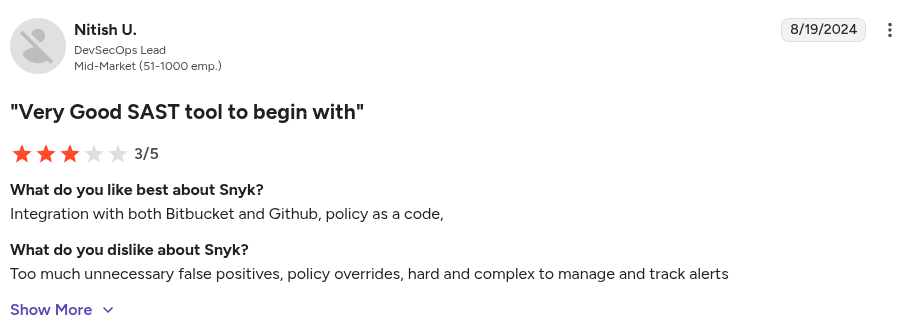
- SonarQube: SonarQube is known to flag issues that aren’t actual problems often requiring teams to adjust rules to filter noise. That aside, its findings are generally high-quality. Here's what some of its users have to say about it:

Coverage
- Snyk: Snyk covers several security areas. It scans open-source dependencies across popular ecosystems, container images and IaC configurations. For static code analysis (SAST), Snyk supports major modern programming languages such as Java, JavaScript/TypeScript and Python. However, it has limited support for legacy languages.
- SonarQube: Offers static analysis across more than 30 languages, including legacy stacks, and with Advanced Security it now also scans third-party dependencies (SCA) and IaC. It still does not scan container images, run DAST, or manage cloud posture, so teams needing those either pair it with other tools or move to a broader platform.
Developer Experience
- Snyk: Snyk integrates into existing development workflows, surfacing issues directly in pull requests(PRs) and IDEs. Its interface is straightforward, and it also suggests fixes (like recommended dependency upgrades). However, it’s also known to cause alert fatigue.
- SonarQube: SonarQube is often seen as a helpful quality gatekeeper that nudges developers toward better code. It catches bugs and code smells, providing detailed examples that help developers learn. On the other hand, if you don’t tune SonarQube’s rules, it may overwhelm you with minor issue alerts.
Pricing
- Snyk: Many teams consider Snyk as expensive as its costs add up quickly when scaling. Snyk standard plan charges $25 per month/contributing developer with a minimum of 5 developers. It also offers a free tier for small projects, but costs climb steeply for larger teams requiring its full feature set.
- SonarQube: SonarQube’s Community Edition is free for basic code scanning. The paid editions unlock advanced security rules and more language support, and they charge by the number of lines of code (LOC) analyzed. Its pricing model can get expensive for very large codebases.
Aikido Security offers a simpler, more transparent pricing model and is significantly more affordable at scale than either Snyk or SonarQube.
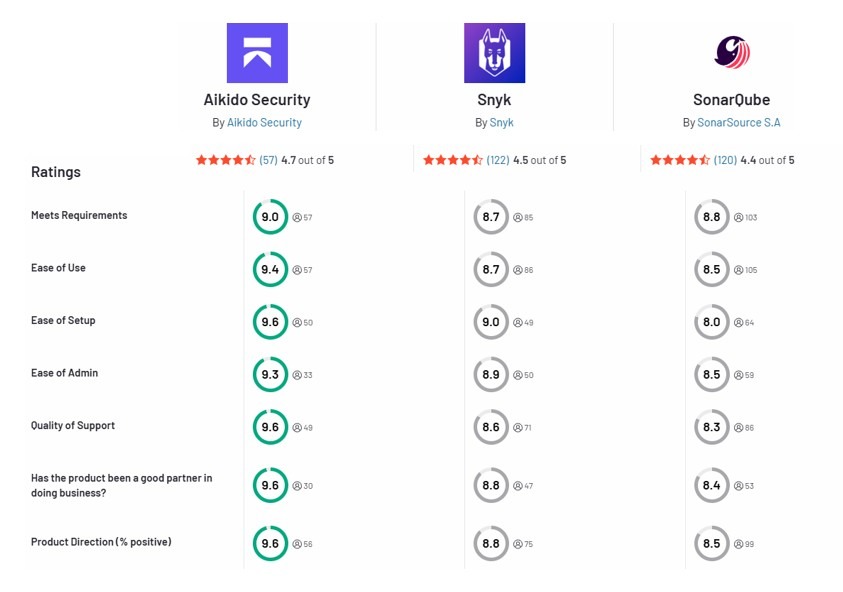
To help you compare the features of both tools, the table below summarizes it for you.
Pros and Cons of Each Tool
Snyk
Pros:
- Comprehensive security coverage (code, open source, containers, IaC)..
- Integrates into developer workflows (CLI, Git repositories, CI pipelines, IDE plugins).
- AI-driven remediation and automated fixes.
- Free tier available for trial and small-scale use .
Cons:
- Can overwhelm teams with false positives or low-priority alerts..
- High pricing for full-featured use in larger teams; many feel the cost ramps up faster than expected.
- Some users report the support experience as slow or unhelpful if you run into problems.
- Primarily a cloud-based service, which may not suit organizations with strict data policies.
- The platform has a steep learning curve, especially for teams new to its ecosystem.
- It has a 1 MB file-size limit for static analysis, which can restrict scanning for certain codebases.
- Scan times can be slow on large repositories
- Some remediation recommendations can feel generic or not tailored to the specific issue.
- It may struggle with proprietary or highly specialized codebases, occasionally missing relevant issues.
SonarQube
Pros:
- Customizable rule-sets and quality gates
- Supports a wide range of languages and tech stacks.
- Offers support for common CI/CD platforms
- Free version, so teams can start using it at no cost.
Cons:
- It is more of a code quality tool, than a security tool
- It doesn’t scan open source dependencies for known vulnerabilities.
- Its security rule depth varies by language
- It doesn’t provide runtime or environment security.
- Requires infrastructure and maintenance effort (hosting the server, managing database and upgrades).
- Tends to flag minor issues leading to “alert fatigue”.
- Requires third party tools for full Application Security coverage
- Advanced security rules and features are only available in paid editions.
Aikido Security: The Better Alternative
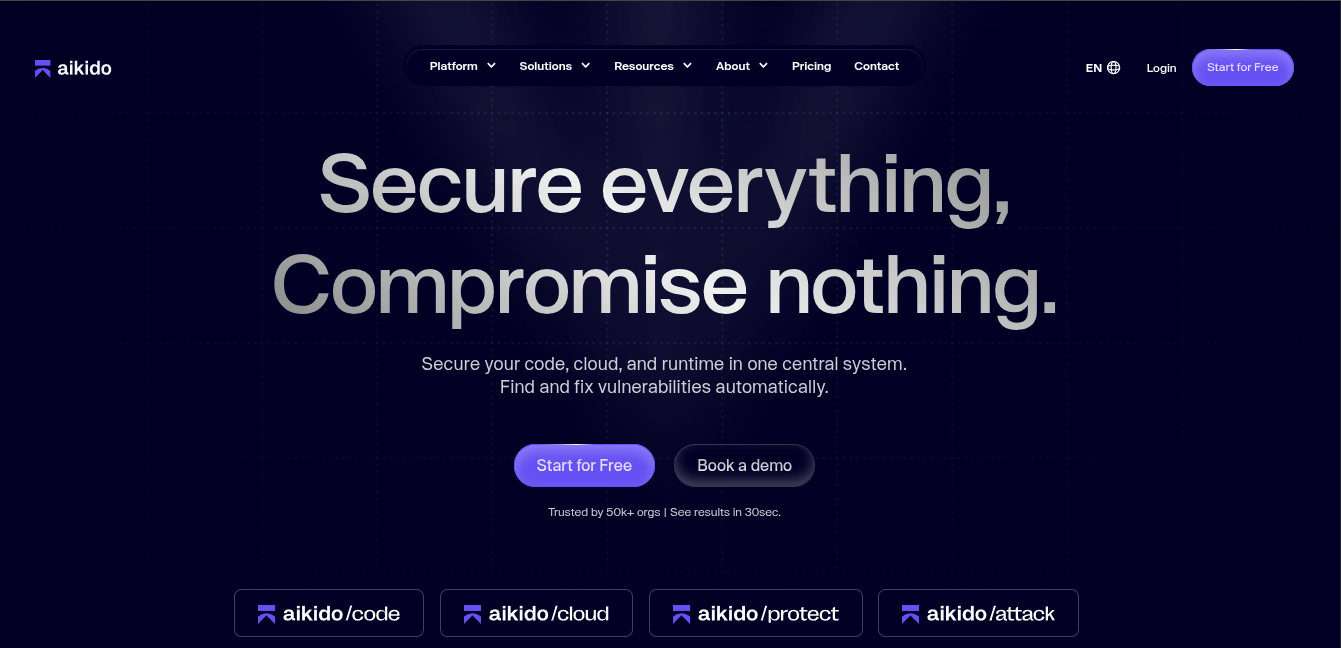
Aikido Security is an AI‑driven application security platform that covers everything from source code and open‑source dependencies to cloud infrastructure, containers, code quality, runtime, and APIs, all within a developer-friendly workflow.
What sets Aikido Security apart is its focus on accuracy and actionable insights. It uses its artificial intelligence engine to correlate issues across your codebase, dependencies, cloud configurations, and runtime paths. And performs reachability analysis to surface real, exploitable vulnerabilities. Once issues are identified, It offers automated remediation through pull requests, inline suggestions, and AI-powered one-click fixes.
Its code quality engine also highlights bugs, code smells, and maintainability issues, helping teams write cleaner, safer, and more maintainable code.
Teams can start with any module, SAST, SCA, IaC scanning, DAST, container scanning, secrets detection, or code quality, and enable additional modules as they grow.
With its transparent, flat-rate pricing (no per-seat or LOC-based fees) and a free forever tier, Aikido Security is a compelling alternative for teams seeking a comprehensive, scalable security and code quality solution without the noise, complexity, or cost of tools like Snyk and SonarQube.
Want to improve your application’s security and code quality?
Start your free trial or book a demo with Aikido Security today.
FAQ
What are the main differences between Snyk and SonarQube?
Snyk and SonarQube serve complementary but distinct purposes. Snyk focuses primarily on security for both your own code and third-party dependencies, covering open-source libraries, container images, and infrastructure as code. SonarQube, on the other hand, is centered on static code analysis and code quality. It is centered on code quality and static code analysis, and with Advanced Security now also scans third-party dependencies (SCA)
Can Snyk and SonarQube be used together effectively, and if so, how?
Yes, they can be used together to provide a more comprehensive view of your application. SonarQube can ensure your code follows quality standards and is free from common coding issues, while Snyk simultaneously scans your dependencies, containers, and IaC for vulnerabilities. However, managing multiple tools may increase complexity. Platforms like Aikido Security offer a unified alternative, combining both security and code quality insights.
How do Snyk and SonarQube compare in terms of scanning capabilities?
Snyk covers a broad spectrum of security areas, including SAST, SCA for, container image scanning, and IaC security. With SonarQube Advanced Security, it now adds dependency scanning (SCA), though it still does not cover container scanning, DAST, or cloud posture. Platforms like Aikido Security provide both security and code quality scanning in a single platform.
How do static application security testing (SAST) and software composition analysis (SCA) differ?
SAST analyzes your own source code to detect vulnerabilities, coding errors, or insecure patterns within the code you write. It’s focused on the internal logic and structure of your application. SCA, on the other hand, scans the third-party libraries and dependencies your application uses, checking them against known vulnerability databases. Aikido Security combines both approaches, providing unified visibility over code-level issues and dependency vulnerabilities in a single platform.
You Might Also Like:


