Wiz built its reputation on cloud security, and that's still where it's strongest, finding and ranking cloud risks without installing agents. Code security came later. Wiz Code launched in 2024 to cover the parts of code that touch infrastructure, like IaC templates, secrets, and containers, and Wiz SAST reached general availability for Wiz Code customers in late 2025. Dynamic testing is newer still. Wiz added native DAST in 2026 through its AI-powered Red Agent and Wiz ASM, though that lives in the broader Wiz platform rather than the Wiz Code product, and it sits alongside the third-party DAST results Wiz has long ingested.
That leaves a specific question for teams evaluating it in 2026. Does bolting code and application security onto a cloud platform give developers the workflow they actually need, or is it cloud-first tooling with the rest added on top? In practice, Wiz Code is a convenient add-on if you already live in Wiz, and a partial one if code security is your main problem.
If you're looking for alternatives with deeper code analysis, DAST that runs in the developer workflow, or tooling built around how developers actually work, several are worth a look. The six compared here on coverage, developer experience, AI-powered triage, and cost:
- Aikido Security
- Snyk
- Checkmarx
- GitHub Advanced Security
- Mend
- Veracode
What problems does Wiz Code solve?
Wiz Code is the application-security layer of the Wiz CNAPP platform, adding code scanning on top of Wiz's cloud monitoring. It covers SAST (generally available to Wiz Code customers since late 2025), SCA, secrets detection, IaC scanning, container security, and malware detection.
The value proposition is the security graph, which connects code findings to your live cloud resources. If you have a SQL injection vulnerability, Wiz Code can show whether that code is deployed, which database it reaches, and whether that database is exposed to the internet. In 2026 Wiz has leaned further into this, correlating SAST, SCA, secrets, IaC, and ingested DAST findings into a single attack path from source to runtime.
If you already run Wiz for cloud security, Wiz Code lets you add code, SCA, and IaC coverage without onboarding another vendor. It flags vulnerabilities in AI-generated code, ties IaC misconfigurations to deployed resources, and gives security teams one view of code risk alongside cloud, container, Kubernetes, and VM risk. For a team already standardized on Wiz, that consolidation is the draw.
What are the Challenges with Wiz Code?
Wiz Code is still cloud-first at heart. Code scanning is the newer, lighter side of the platform, and it shows. As of 2026 the SAST and SCA capabilities are functional but secondary to the infrastructure focus, leaning on the Security Graph for context rather than on a developer workflow of their own. Findings often arrive as a raw list, leaving teams to work out which alerts are real.
Remediation is where the gap is widest. Wiz SAST added AI-assisted remediation with its 2025 launch, but independent comparisons through 2026 still report Wiz AutoFix as constrained to the main branch in many setups, which makes it awkward for pull-request workflows, and strongest on dependency upgrades rather than fixes spanning SAST, IaC, and containers. When findings pile up and the tool doesn't help close them, teams route around it. Two-thirds of teams bypass security, dismiss findings, or delay fixes, which is why developer trust matters when you choose a code security tool.
Secrets scanning is a good example of the lightweight approach. Wiz Code detects hardcoded secrets in code, IaC, and container images, but it doesn't tell you whether a secret is still active, map the permissions it grants, or auto-downgrade it. It also can't block secrets before they reach the default branch (PR gating) or the commit history (pre-commit hooks).
The bigger structural point is where the code and application security sit. Wiz added native dynamic testing in 2026 with the Red Agent, an AI attacker that reached general availability mid-year and probes web applications and APIs for logic flaws and authorization bypasses, and it still ingests third-party DAST results too. But that dynamic testing belongs to the wider Wiz platform and its attack-surface tooling rather than to Wiz Code, and it is newer than the DAST built into platforms that have run it in CI for years. Because the Security Graph correlation only works inside the broader Wiz platform, Wiz Code still isn't something you buy or run on its own. Pricing is tied to cloud infrastructure and runs well past $100k a year for mid-sized deployments, and the day-to-day experience is aimed at security teams and CISOs more than developers, with lighter IDE integration and slower feedback loops.
Wiz Code makes sense if you're already deep in Wiz Cloud and want a convenient add-on for IaC, secrets, and now code coverage. But if code security is the main event, and you want it embedded across the SDLC where developers work, you'll be weighing alternatives.
What are the top Wiz Code alternatives?
We evaluated alternatives based on coverage (SAST, SCA, DAST, IaC, containers, cloud security), developer experience (IDE integration, CI/CD, PR feedback), AI-powered triage and remediation, pricing transparency, and deployment speed.
Aikido Security
Enterprise-grade software security platform with AI-powered triage and automated fixes
Aikido secures the code, cloud, and runtime in one platform, with the governance enterprise security teams need and a workflow developers will actually use. It runs everywhere code moves, from the IDE and pre-commit hooks through CI/CD, pull-request review, and periodic repo analysis, and it scales from a startup's first repository to an enterprise running thousands. Where Wiz Code surfaces hundreds of raw findings and leaves developers to sort them, Aikido is built to hand back a short list of what actually matters.
Aikido's SAST engine uses production-grade cross-file taint tracking that follows data flow across your whole codebase, not just inside a single file, so it catches vulnerabilities that depend on how data moves between components. Wiz's own SAST reached general availability for Wiz Code customers only in late 2025 and doesn't match that depth or maturity yet.
Where rules-based SAST stops, Aikido's Code Security Audit keeps going. Launched in 2026, it uses pentest-grade reasoning agents that read your source directly and follow logic across files, services, and repositories to surface the flaws patterns can't describe, things like broken access control, IDORs, privilege escalation, and multi-step business-logic bypasses. It needs no staging environment or live target, so it runs on codebases that are hard to exercise live, and Aikido positions it between SAST and a full pentest. In early testing it surfaced roughly 70 to 80% of what a full pentest engagement finds at about a tenth of the cost, with a median of around 25 issues per codebase and no audit yet coming back clean. The same reasoning engine powers Deep PR Review, which reads every pull request with full-codebase context and flags verified issues before they merge, so logic flaws get caught when they're cheapest to fix. Wiz Code's SAST is rules-based repository and PR scanning, with no equivalent reasoning layer for this class of vulnerability.
Dependencies are where most real risk hides. Aikido's SCA is built to surface only what's exploitable. Function-level reachability confirms whether a vulnerable function is actually called in your code before it raises an alert, and upgrade-impact analysis checks whether a fix will break your build before it proposes one, so the pull requests it opens are safe to merge and not just technically newer. Wiz Code depends on its runtime sensor to add reachability context, and its dependency remediation is lighter.
The other half of dependency risk is malware, not just known CVEs, and that is where Aikido Intel comes in. Intel is Aikido's real-time, open-source threat feed. It watches more than 4 million open-source packages across npm, PyPI, Packagist, and other registries, and combines static analysis, sandboxing, AI reasoning, and human review to flag most malicious packages within eight minutes of release. In Q2 2026 it analyzed roughly 7.5 million package versions and confirmed 19,500 malicious ones, and it also surfaces undisclosed vulnerabilities that never get a CVE. That feed powers Aikido's SCA directly, and it is trusted enough to protect Packagist, the PHP registry, where flagged packages are blocked at install. Wiz Code scans the packages in your repositories but does not run a live feed across the registries themselves.
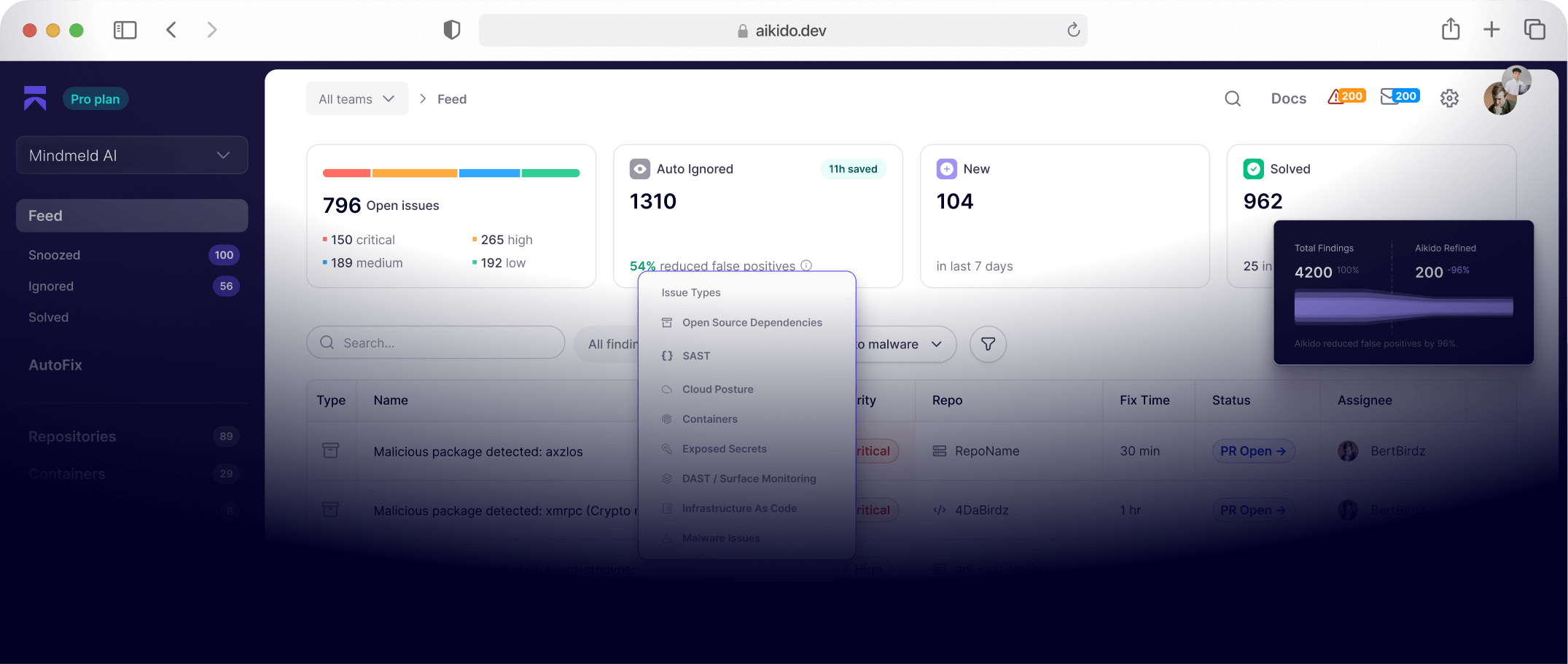
Through AI AutoTriage and reachability analysis, Aikido filters out non-exploitable CVEs and surfaces only the vulnerabilities that are actually callable in your code, cutting false positives by up to 95% so developers spend their time on real problems. It does this straight from the code with no agents to deploy for analysis, while Wiz Code leans on a separate runtime agent, the Wiz sensor, for the context behind its more basic analysis.
When something needs fixing, Aikido's AI AutoFix opens pull requests with the change already written. For SAST findings, IaC misconfigurations, and container vulnerabilities, it analyzes breaking changes first, then proposes PRs that are ready to merge with safe upgrades built in. Wiz added AI-assisted remediation to its SAST in 2025, but independent comparisons through 2026 still report its AutoFix constrained to the main branch in many setups, which makes it awkward for pull-request workflows and strongest on dependency upgrades rather than fixes that span SAST, IaC, and containers.
Aikido's secrets detection goes past detection. It checks whether a leaked secret is still active, maps the permissions it grants, supports auto-downgrades, and blocks secrets before they reach the commit history with pre-commit protection. Wiz Code finds hardcoded secrets but stops there.
For enterprise buyers, the governance holds up under review. Aikido offers SAML SSO with Okta, Microsoft Entra ID, Google Workspace, and JumpCloud, role-based access with SAML access profiles, policy enforcement in CI/CD that can block pull requests on severity rules, and an activity log API you can feed into your SIEM. It carries SOC 2 Type II, ISO 27001:2022, and ISO 42001 attestations, manages security centrally across multiple Git organizations and cloud accounts, and offers a local scanner for teams whose source code cannot leave their network. Wiz Code's correlation only works inside the broader Wiz platform, and it points compliance work at a separate GRC tool.
That enterprise footing doesn't come with an enterprise onboarding slog. You can be running Aikido in about 10 minutes through a GitHub App or CLI, and Aikido Pro is priced transparently at roughly $15k a year for 20 users, a number you can see without a sales call. Wiz Code requires the broader Wiz platform and an enterprise sales cycle, and typically runs past $100k a year on infrastructure-based pricing that moves with your cloud footprint.
Top Features
- Native DAST and API security in the developer workflow. REST and GraphQL testing, authenticated DAST, and runtime firewall protection catch what static analysis misses, and they run in CI and pull requests rather than as a separate offensive exercise. Wiz added native dynamic testing in 2026 through its Red Agent attacker and Wiz ASM, but that sits in the broader Wiz platform and is newer than an in-workflow DAST.
- Compliance automation built in. Pre-configured checks for ISO 27001, SOC 2, NIST, PCI, HIPAA, DORA, and NIS2, with direct integration to Vanta, Drata, and Secureframe. Wiz Code points you at a separate GRC platform.
- Faster analysis. In customer-run benchmarks across three large open-source repos, Aikido's combined SAST and SCA runs beat Wiz Code's SAST-only runs, scanning Jellyfish in 12 seconds against 36, and Grafana in 61 seconds against 115.
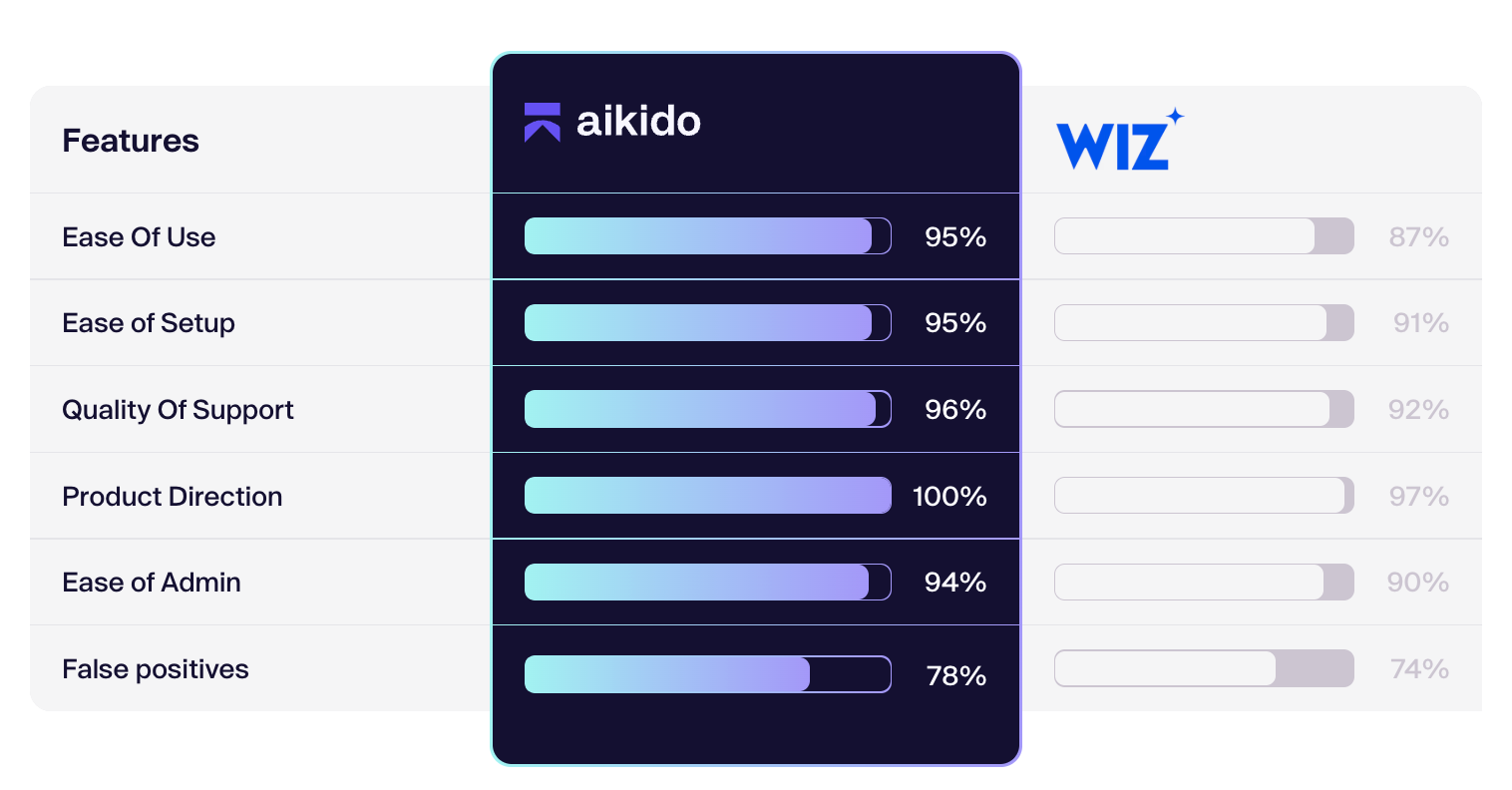
One company that tried both tools said, "We trialled Wiz Code at the same time as Aikido. It was harder to set up than Aikido.” Aikido stood out for being an all-around strong option, and it didn’t break the bank.
Unlike other code security alternatives, Aikido also offers AI pentesting, delivering the depth of manual penetration testing without the weeks-long turnaround and cost overhead.
Aikido Security vs. Wiz Code: Feature Comparison
Top Features
- AI AutoTriage and reachability analysis reduce false positives
- AI AutoFix generates PRs for SAST, IaC, and container vulnerabilities with minimal safe upgrades
- SAST, SCA, DAST, secrets, IaC, container, CSPM, all in a single platform
- Runtime protection through an in-app firewall for live threat blocking
- Malware detection for uploaded files and dependencies
- Compliance mapping to 10+ frameworks with GRC tool integration
- Agentic AI Pentesting to find complex vulnerabilities
Snyk
SCA-focused platform with established container security capabilities
Snyk started as a developer-first alternative to security-team platforms like Checkmarx and Veracode, and that early focus drove its popularity. It maintains a database covering open source vulnerabilities. Container and Kubernetes security scanning is available, along with IaC analysis for Terraform, CloudFormation, and Kubernetes manifests.
To support developers, Snyk’s DeepCode AI generates fix suggestions for some code vulnerabilities. It also has IDE integrations for VS Code, IntelliJ, Eclipse, and Visual Studio, and scans directly in developer environments instead of requiring centralized infrastructure like Wiz Code.
Unfortunately, after its initial success, Snyk pivoted to chase some deals and grew through acquisitions, and… it shows. The IDE plugin is heavy and slows down dev environments. The platform feels like a bundle of separate tools with clunky integrations (especially Jira, which doesn't sync properly) and multiple UIs to learn. Instead of letting developers fix issues inline, Snyk makes you create a Jira ticket for everything. The product floods developers with false positives because it doesn’t have intelligent filtering, and reachability analysis is only available in higher-tier plans.
Snyk doesn’t have cloud security, and, like Wiz Code, Snyk doesn't include DAST, so you’ll have to buy a few different tools to get broad security coverage. Pricing gets expensive fast through feature-based tiers and add-ons for CI/CD, API access, and reporting. Full enterprise coverage can exceed $50k annually, and you need to spend at least $20k to get human support. Things to keep in mind if you’re considering Snyk.
Features:
- SCA with vulnerability database covering 1M+ open source packages
- DeepCode AI for automated fix suggestions
- Container and Kubernetes security scanning
- IaC security for Terraform, CloudFormation, Kubernetes manifests
- IDE integrations (VS Code, IntelliJ, Eclipse, Visual Studio)
- License compliance and policy management
Checkmarx
Application security platform with legacy on-premises roots
Checkmarx has been in the SAST business since 2006, and built its name on deep code inspection for regulated industries like finance, healthcare, and government, where detailed audit trails mattered more than scan speed. It covers a wide range of languages, including Java, C#, JavaScript, TypeScript, Python, C/C++, PHP, Ruby, Go, and COBOL, and its exploitable-path analysis traces how an attacker could reach a vulnerable function from user input. For teams whose primary requirement is depth and compliance evidence, that heritage is still a real strength.
The product has also moved on from the tool the older writeups describe. Checkmarx One now brings SAST, SCA, IaC, API, DAST, and container security under one ASPM layer that correlates and deduplicates findings across scan types. DAST is part of that platform now rather than a wholly separate product, and the Checkmarx One Assist family of AI agents adds triage that uses reachability and exploitability to cut noise, plus remediation that can open review-ready fix pull requests for certain vulnerability types. IDE plugins for VS Code, IntelliJ, Cursor, and others surface findings before code is committed. If your last look at Checkmarx was the on-prem engine, most of those gaps have since been closed.
What hasn't changed is the shape of the buying decision. Checkmarx is moving customers off its on-prem engine toward Checkmarx One, so on-prem users have a migration to plan, or a moment to weigh alternatives. Pricing is quoted per contributing developer with extra charges for advanced modules, so the "single platform" still arrives as a stack of separately licensed capabilities, and seeing the full number takes a sales conversation rather than a public page. The AI remediation is genuinely new and governed by design: helpful, but scoped to eligible findings rather than everything it flags.
Against Wiz Code specifically, the contrast runs the opposite way from most of this list. Checkmarx is far deeper on application security than Wiz Code's recently added, lightweight code scanning. What it doesn't do is cloud security posture: there's no equivalent to Wiz's Security Graph tying findings back to live cloud infrastructure. Choosing between the two usually comes down to whether your real problem is application depth or cloud context.
Top Features
- SAST with broad language support (25+ languages) and exploitable-path analysis
- SCA for dependency vulnerabilities and license compliance
- DAST, API, IaC, and container security unified in Checkmarx One (modules licensed separately)
- Checkmarx One Assist: AI triage using reachability and exploitability, with remediation PRs for eligible findings
- ASPM correlation and deduplication across scan types
- Codebashing developer training and IDE plugins (VS Code, IntelliJ, Cursor, and more)
GitHub Advanced Security (GHAS)
Native security scanning for GitHub-centric development teams
If your team lives in GitHub, GHAS carries the advantage that you never have to leave that environment, but it is a lightweight alternative to other code security platforms. For some organizations, GHAS comes bundled with their GitHub Enterprise agreement, which makes it free for them. In that case, GHAS is a good option for teams just getting started with security, because there's no onboarding process or separate login to get started. As far as capabilities, it covers SAST and SCA specifically, scanning both first-party and third-party code.
GitHub Advanced Security provides a good baseline of real-time feedback during development, code scanning, secrets scanning and dependency reviews. It uses Dependabot for dependency management– it’s an open-source tool that natively integrates with GitHub repositories, automates pull requests and patches with minimal configuration. In general, GHAS is easier for developers to adopt than alternatives.
But of course, GHAS only works if you're on GitHub, so if you use GitLab, Bitbucket, or Azure DevOps (which Wiz Code and Aikido Security both support), you're out of luck. There's no DAST capability, no cloud security posture management, and no infrastructure scanning (you’ll need someone else to check your Terraform or CloudFormation templates for misconfigurations). Wiz gives you cloud and infra scanning in its CNAPP product.
While Dependabot handles dependency updates, it's pretty basic compared to dedicated SCA tools. CodeQL, GitHub's semantic analysis engine, lets you write custom security queries in its query language. However, it can time out on large repositories after an hour or two, which becomes a problem for enterprises with big codebases.
And like Wiz Code, GHAS doesn't offer AI triage or reachability analysis, so you're manually reviewing every alert to figure out what actually matters.
Top Features
- CodeQL for semantic SAST analysis with custom queries
- Dependabot for automated dependency updates
- Secret scanning with push protection
- Native PR integration shows findings inline with code changes
- Custom auto-triage rules for Dependabot alerts
- Security dashboard within GitHub
Further Reading:
GitHub Advanced Security Alternatives
Mend.io
Enterprise-grade SCA and license compliance management
Mend, formerly WhiteSource, focuses exclusively on open source dependencies with deeper analysis than Wiz Code's SCA. Mend provides advanced dependency graph analysis and transitive vulnerability tracking, and offers license risk management and policy enforcement.
Mend’s reachability analysis identifies which vulnerable dependencies are actually called in your code, filtering out theoretical risks that never execute in practice. It also has a remediation engine that calculates minimal safe upgrades to avoid breaking changes, using a 'Least Vulnerable Package' strategy that evaluates the entire dependency tree rather than blindly upgrading to the latest version.
Mend is a focused, single-purpose tool that only scans dependencies, not proprietary code, so you have to look at multiple, separate tools for SAST to get your basics covered. With its narrow focus, Mend doesn't offer cloud security or infrastructure correlation like Wiz Code's Security Graph. And like Wiz, there's no DAST capability. Container scanning is limited to dependency analysis rather than full image security.
Organizations still need some other tools for code scanning, DAST, and cloud security, making Mend a point solution instead of being able to solve many of your security needs. And the usage-based pricing model can get expensive, especially considering it’s only covering a narrow slice of your security. Some teams look for Mend alternatives if they need more than SCA.
Top Features
- SCA with database of over 200M open source components
- License compliance and policy enforcement
- Reachability analysis to filter unexploitable vulnerabilities
- Supply chain security and dependency graph mapping
- Automated pull requests for dependency updates
- Integration with legal and compliance workflows
Veracode
Binary analysis and compliance reporting for regulated industries
Veracode is a long-time player in security scanning, having launched in the waterfall era days in 2006, like Checkmarx. Their technical bet was binary scanning, analyzing compiled applications instead of source code. At the time, this solved a real problem because scanning C and C++ applications involved inspecting both source and compiled binaries to do reliable taint analysis. Veracode was revolutionary for its time by launching a cloud-hosted product, meaning customers could upload builds for analysis without installing more on-site infrastructure (For reference, AWS launched in the same year, and cloud computing wasn’t part of the common vernacular).
Veracode, because of its focus on binaries, can analyze compiled applications without source code access (Wiz Code requires source). It’s also built for creating audit-friendly documentation in regulated industries, like finance, healthcare, and government. Veracode includes dynamic testing and offers manual security expert analysis beyond its automated scanning (which Wiz Code does not).
Unfortunately, what was groundbreaking in 2006 is not really appropriate for CI/CD workflows (or other modern software practices). Veracode's upload-and-wait model takes hours to days for results. Veracode scans applications in isolation without any cloud security context or infrastructure correlation, and the interface is geared toward security analysts with minimal IDE integration.
Veracode also gatekeeps the product, with months of setup before you can even find the first vulnerability with it (the company bizarrely requires a compatibility questionnaire before they’ll let you try it out). And unlike some other Wiz alternatives on the list, Veracode doesn't offer AI AutoTriage or reachability analysis, and AI AutoFix is only available for a few languages. And like Wiz, pricing is hidden and expensive.
Top Features
- Binary and bytecode SAST analysis without source code
- DAST for dynamic application testing
- SCA for dependency vulnerability scanning
- Compliance reporting for SOC 2, PCI DSS, HIPAA
- Sandbox environment for safe code analysis
- Human-assisted penetration testing options
- Policy enforcement and workflow automation
Further Reading: Veracode Alternatives
Which Wiz Code alternative is right for you?
Aikido Security delivers the strongest alternative to Wiz Code by combining coverage, cost efficiency, and developer experience. Aikido provides SAST, SCA, DAST, IaC, containers, CSPM, secrets, malware, and API testing in one platform, with AI AutoTriage and reachability analysis to reduce false positives and AI AutoFix that opens ready-to-merge PRs for SAST, IaC, and container issues. Another option worth a mention is GitHub Advanced Security, a solid choice for GitHub-centric teams that want code security without leaving their existing workflow, though it only covers GitHub repositories.
Organizations that run Wiz for cloud security might keep Wiz for CSPM while replacing Wiz Code with Aikido to get deeper code security and DAST that runs in the developer workflow, at transparent seat-based pricing rather than infrastructure-based cost. Wiz has since added its own native dynamic testing through the Red Agent, but it is a newer, platform-level capability, so the Aikido case rests on coverage in one developer-native platform, workflow fit, and price rather than on Wiz lacking DAST. If your organization isn't in the Wiz ecosystem, Aikido saves you from buying the broader platform at all.
Frequently Asked Questions (FAQ)
1. Is Wiz Code a standalone code security tool?
No. Wiz Code is an extension of the Wiz cloud security (CNAPP) platform. It can’t be purchased or used independently from Wiz Cloud. Its Security Graph and correlation features only work within the broader Wiz ecosystem, which is typically priced based on cloud infrastructure usage rather than developer seats. If you're looking for a standalone AppSec platform focused purely on developer workflows, tools like Aikido Security, Snyk, or GitHub Advanced Security may be better suited.
2. Does Wiz Code include DAST or API security testing?
No. Wiz Code does not offer native DAST (Dynamic Application Security Testing) or API fuzzing. Organizations that need runtime vulnerability detection, authenticated scanning, or API security testing must integrate third-party tools. Alternatives like Aikido Security, Checkmarx (add-on), and Veracode provide DAST capabilities, while most other Wiz Code competitors focus only on static analysis (SAST/SCA).
3. How does Wiz Code compare to Aikido Security?
Wiz Code is cloud-first and adds lightweight SAST, SCA, secrets, and IaC scanning to its CNAPP platform. However, it lacks DAST, reachability analysis, PR-native AutoFix, and developer-first integrations like pre-commit protection. Aikido Security provides broader coverage in a single platform, including SAST, SCA, DAST, API security, IaC, containers, CSPM, secrets with liveness checks, and AI-powered triage and AutoFix, while integrating directly into IDEs, PR workflows, and CI/CD pipelines. For teams prioritizing developer experience and shift-left security, Aikido is typically the stronger option.
4. Why do teams look for Wiz Code alternatives?
Teams often look for alternatives to Wiz Code because:
- Wiz Code lacks native DAST and API security testing
- False positives require manual triage
- AutoFix is limited and not PR-native in many setups
- Secrets scanning only detects leaks without validating liveness
- Pricing depends on cloud infrastructure size, often exceeding $100k annually
Organizations that want developer-first workflows, AI-powered prioritization, transparent pricing, and full SDLC coverage often evaluate alternatives like Aikido Security, Snyk, or GitHub Advanced Security.