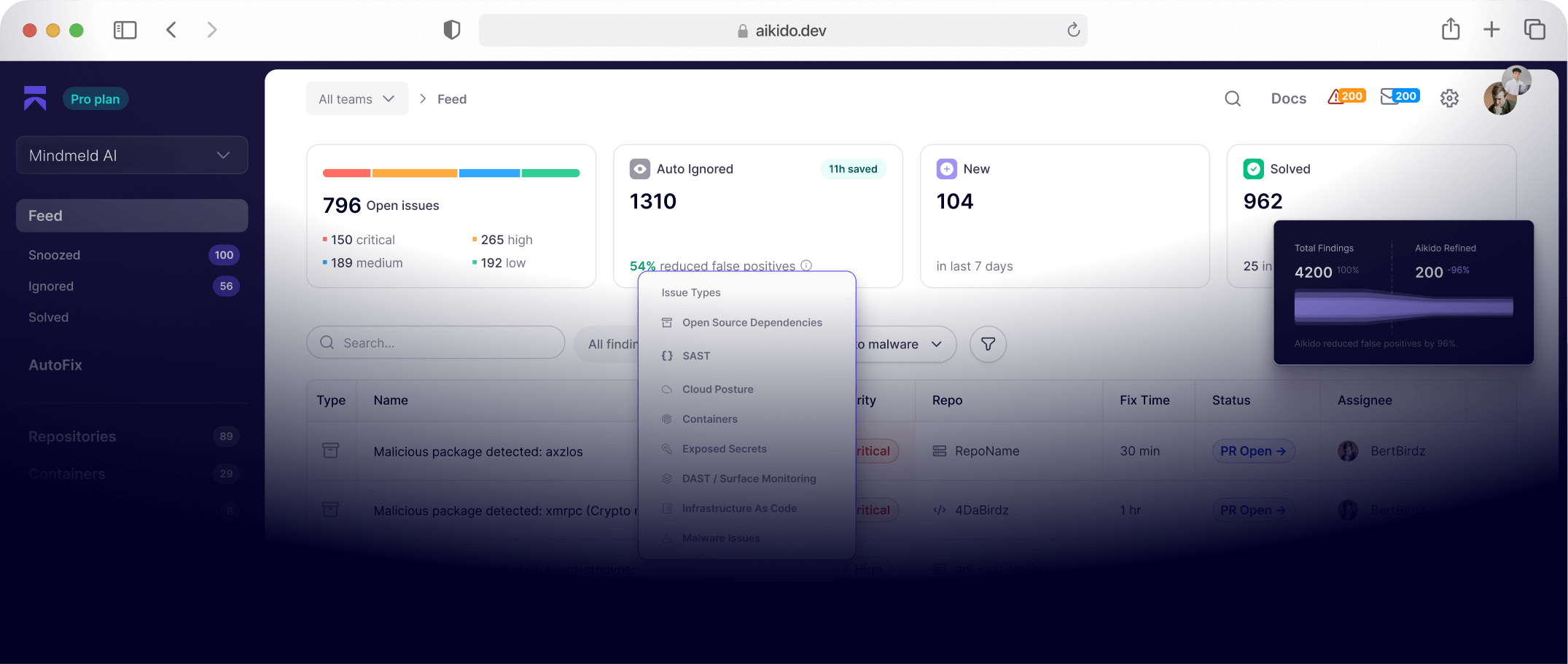
A UK public sector cyber function replaced fragmented security tooling with a single platform and reduced supply-chain incident response from days to minutes.
At a glance
- Unified SAST, SCA, secret scanning, DAST, and CI/CD security in one platform
- Reduced supply-chain incident triage from days to minutes
- Built measurable visibility across the software delivery lifecycle
- Embedded developer education directly into security findings
- Established compliance evidence across ISO 27001, SOC 2, NIST, and CIS
- Extended coverage with Aikido Device Protection to secure developer environments
Challenge
Walid Mahmoud is a Senior DevSecOps Engineer inside a UK public sector cyber function responsible for embedding security controls across the entire software delivery lifecycle. In practice, that meant securing everything from early planning stages through CI/CD pipelines and production services. Over time, the organisation’s security tooling had grown organically.
Different vendors handled SAST, SCA, secret detection, dynamic testing, and CI/CD security. Each tool solved a real problem individually, but together they created fragmentation across workflows, findings, and ownership.
“We had a set of criteria. Secret scanning, dependency scanning, SAST, DAST, all the things that make a DevSecOps methodology a thing. We looked at who could give us the most under one platform to minimise tool sprawl.”
The biggest challenge was not simply alert fatigue. It was visibility.
When a supply-chain incident occurred, the team had no fast or reliable way to answer the most important operational question: Are we affected?
Cross-referencing inventories, checking repositories manually, and coordinating with engineering teams could take days. At the same time, developer adoption was non-negotiable. Public sector engineering teams move carefully, and Walid knew any new platform would fail if it disrupted existing delivery workflows.
“Most importantly, we wanted a platform that doesn’t make our developers’ lives harder. Something that just works within their way of delivering software.”
The team also approached vendor evaluation cautiously. As a public sector organisation operating in a risk-averse environment, trust had to be earned through proof rather than positioning.
Solution
Walid’s team discovered Aikido through market research and decided to run a proof of concept against the existing security stack. For Walid, the evaluation came down to one principle: Let the product speak for itself.
“The challenge for the UK public sector was that Aikido was up-and-coming and relatively new. The best way, and probably the only way, is to let the tool do the talking. So we spun up a proof of concept.”
The proof of concept quickly demonstrated something the team had not previously achieved:
A single platform covering SAST, SCA, secret scanning, DAST, and CI/CD security without introducing new workflow friction for developers. Just as importantly, the cyber function gained a unified view across every workspace and production service. That visibility fundamentally changed how the team responded to supply-chain incidents.
When the next major ecosystem compromise emerged, the team was able to determine exposure almost immediately instead of spending days coordinating investigations manually.
“With supply-chain attacks, very quickly being able to ascertain whether we’re affected or not is hugely advantageous. The worst answer we want to give is ‘we don’t know.’”
For Walid, one of the most valuable aspects of the platform was the educational layer attached to each finding.
Instead of surfacing raw alerts alone, Aikido explains why vulnerabilities matter, how they can be exploited, and how developers should approach remediation.
“Aikido includes an educational piece. ‘This line of code is susceptible to SQL injection’, three or four minutes explaining what the vulnerability is and how it could be a catastrophe. That makes devs more conscious.”
This helped the cyber function improve developer awareness without introducing separate training overhead or additional process friction.
Several factors ultimately drove the decision:
- Unified SAST, SCA, secret scanning, DAST, and CI/CD security
- Developer-first workflows that fit existing delivery practices
- Contextual education embedded directly into findings
- Fast vendor responsiveness and feature delivery
- A roadmap aligned with AI pentesting and endpoint security
Results
For the first time, the cyber function could measure and track its security posture across the full software lifecycle. Instead of operating reactively, the team could now attach measurable metrics and roadmaps to governance initiatives and demonstrate progress against ISO 27001, SOC 2, NIST, and CIS controls.
“Our team now has observability. We can put a number on our current security posture, high, medium, low, and that gives us a defined roadmap to where we go next.”
Aikido now sits across every stage of the delivery lifecycle, creating multiple layers of validation before software reaches production. Walid describes the approach as full-circle coverage.
“At every stage, even if a step gets skipped, there’s always another layer scrutinising it again. Unless you somehow crack six stages, we have more confidence our publicly-facing services are secure.”
As supply-chain attacks continue evolving, the team is also expanding coverage into developer devices themselves through Aikido Device Protection. This gives the organisation visibility into installation activity and developer-level exposure before malicious packages ever reach CI/CD pipelines.
For the team, the result is more than tool consolidation. It is the ability to move from fragmented security operations toward measurable, observable DevSecOps governance across the entire delivery lifecycle.
How the UK public sector team uses Aikido today
Already using
- SAST and SCA scanning
- Secret detection
- DAST
- CI/CD pipeline security
- Container image scanning
- Compliance module (ISO 27001, SOC 2, NIST, CIS)
- Aikido Safe Chain
Planning to adopt
- Aikido Device Protection
- Expanded GRC engineering workflows
Evaluating next
- AI pentesting
- Aikido Zen Firewall
Final verdict
“Aikido helps us move from reactive defence to measurable DevSecOps governance.”