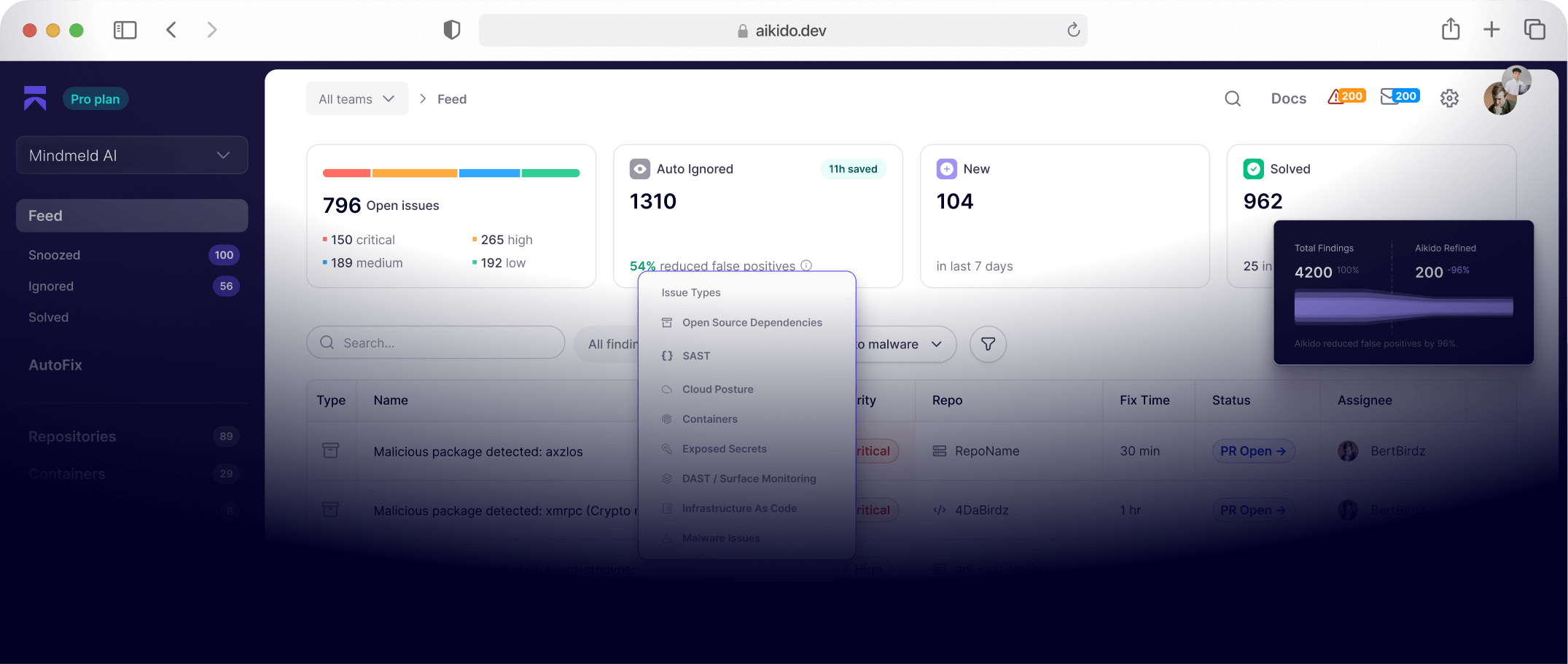
Self-securing software is a security engineering model where software systems continuously discover, validate, and remediate exploitable risk as they change, without relying on periodic, human-driven security processes.
It treats security as a built-in system capability rather than a series of reviews, scans, or audits. As code is written, deployed, and run, the software actively works to keep itself secure. This model applies across modern software environments, including application code, cloud infrastructure, software supply chains, and runtime systems, wherever change introduces risk.
This is not a future concept. Early forms of self-securing behavior already exist today in systems that can automatically validate vulnerabilities, triage real risk, and apply fixes as part of normal development workflows, and the research shows this is what organizations want. Aikido's 2026 State of AI in Security & Development report found that 79% of CISOs, AppSec engineers and developers use AI to fix security vulnerabilities, while 56% rely on automated gates to block risky AI-generated code before merging it.
Why This Concept Exists At All
Self-securing software is a response to how software is actually built now, not an abstract vision.
Development cycles have collapsed from months to minutes. Infrastructure is ephemeral. AI-generated code and autonomous agents introduce changes faster than traditional security workflows can reasonably keep up.
In this environment, security models designed around static reviews and periodic testing break down. Risk is introduced continuously, but validated intermittently. That window is where attackers operate.
Self-securing software exists to close that gap.
What Self-securing Software Changes
Traditional security treats software as something that is secured from the outside.
Self-securing software treats security as an internal feedback system.
When a change is introduced:
- The system validates whether that change creates a real attack path
- Risk is triaged based on exploitability, not severity labels
- Remediation is proposed or applied immediately
- Evidence is retained automatically
This turns security from a reactive process into a continuous control loop. This enables autonomous application security, self-securing cloud and runtime.
The Feedback Loop That Makes Software Self-securing
At the core of self-securing software is a closed feedback loop:
- Software changes
- Real attack paths are tested
- Exploitable risk is confirmed or dismissed
- Fixes are generated, applied, or proposed
- The system learns from the outcome
This loop runs continuously and safely, without waiting for human scheduling or intervention.
This is a systems problem, not a tooling problem. The important point is not the components themselves, but the fact that detection, validation, and remediation are no longer separate phases.
Autonomy requires enforceable guardrails.
Unguarded automation is unsafe in security contexts. For self-securing systems to operate responsibly, autonomous testing and remediation must be constrained by enforceable technical safeguards. This includes strict scoping, isolation between reasoning and execution, full observability, and the ability to immediately halt execution when behavior falls outside defined bounds.
These guardrails cannot rely on instructions or intent alone. They must be enforced technically, independent of agent behavior. This is why Aikido has defined minimum safety requirements for autonomous security testing, establishing a baseline for how AI-driven offensive systems can operate safely at scale.
This is Already Happening, Just Not Everywhere
Self-securing software and self-securing applications are often described as possible in five or ten years. That framing is misleading.
Many teams already rely on systems that automatically:
- Detect vulnerabilities in running applications
- Triage findings to remove noise
- Generate or apply fixes inside existing workflows
- Retest changes immediately
What is changing now is scope and autonomy. These capabilities are moving from isolated features to system-level behavior.
Most organizations will encounter self-securing behaviors incrementally, as isolated capabilities today and system-level autonomy over time.
One of the clearest early examples of this model is continuous pentesting. It is one of the first areas where detection, validation, and remediation can be fully automated in a closed loop, because exploitability can be confirmed in real systems. As platforms mature, the same pattern extends beyond testing into cloud, supply chain, and runtime security.
What Self-securing Software is Not
Clarity matters as the term gains attention.
Self-securing software is not:
- A single tool or feature
- A claim that humans are removed from security
- A promise that vulnerabilities never exist
It is a model for continuously reducing exploitable risk by embedding validation and remediation directly into how software is built, deployed, and run.
Humans remain responsible for oversight, policy, and judgment. The system handles the constant work.
Who This Model is For
Self-securing software matters most where the pace of change itself creates risk.
That includes organizations that deploy frequently, operate complex systems, or manage large and dynamic attack surfaces.
For slower-moving environments, traditional controls may be sufficient. For modern software organizations, they are not.
Final Thoughts
Self-securing software is not a marketing term and not a distant vision. It is the logical response to software systems that change continuously.
Security that depends on periodic human intervention cannot keep up. Security that operates as a feedback system can.
At Aikido, this model shapes how we build security systems today, focusing on closing feedback loops and reducing exploitable risk as software changes.
This is the direction software security is moving, whether teams label it this way or not.