Frost & Sullivan has recognized Aikido Security with the 2026 Global Customer Value Leadership Recognition in Application Security Posture Management (ASPM).
We’re honored, but the award matters less than the why.
Most application security tools still optimize for finding more issues. More scans, more alerts, more dashboards. In practice, that creates noise, not better security.
Frost & Sullivan’s analysis focuses on something different: results. The recognition criteria (innovation, strategic execution, and measurable outcomes) evaluate vendors on outcomes rather than feature checklists. Developer adoption, backlog reduction, and confirmed remediation are the outcomes we optimize for, not finding counts. According to Frost & Sullivan’s analysis, Aikido stands out for its developer-first approach to application security, combining extensive platform coverage, rapid deployment, and AI-driven automation to help teams secure software without slowing development.
.jpg)
Frost & Sullivan’s analysis highlights a reorientation toward platforms that reduce operational complexity, prioritize real risk, and integrate directly into developer workflows.
That’s the problem Aikido was built to solve.
Consolidation leads to better security
For years, the dominant response to application security complexity was procurement. Teams acquired scanners, added dashboards, subscribed to threat feeds, and assembled collections of point solutions that each work in their own siloes. Instead of better security, what we got was lots of fragmentation. More visibility in theory, but less clarity in practice.
Frost & Sullivan's analysis identifies Aikido's unified platform as a central differentiator. Consolidating code security, cloud security, runtime protection, and compliance into a single system fixes the context continuity issues that you get with fragmented tooling. When findings from different surfaces share the same data model, prioritization becomes possible in a way it simply isn't when you're reconciling outputs from five separate tools.
This follows strong customer feedback on Gartner Peer Insights, where Aikido is consistently rated highly by engineering and security teams.
With security alerts, less is more
One of the more persistent dysfunctions in application security is equating the volume of findings with security value. More findings, the thinking goes, means more coverage. In practice, this translates into significantly less noise and faster remediation, with teams focusing only on vulnerabilities that are actually exploitable. More findings don’t mean more security. It usually means less action.
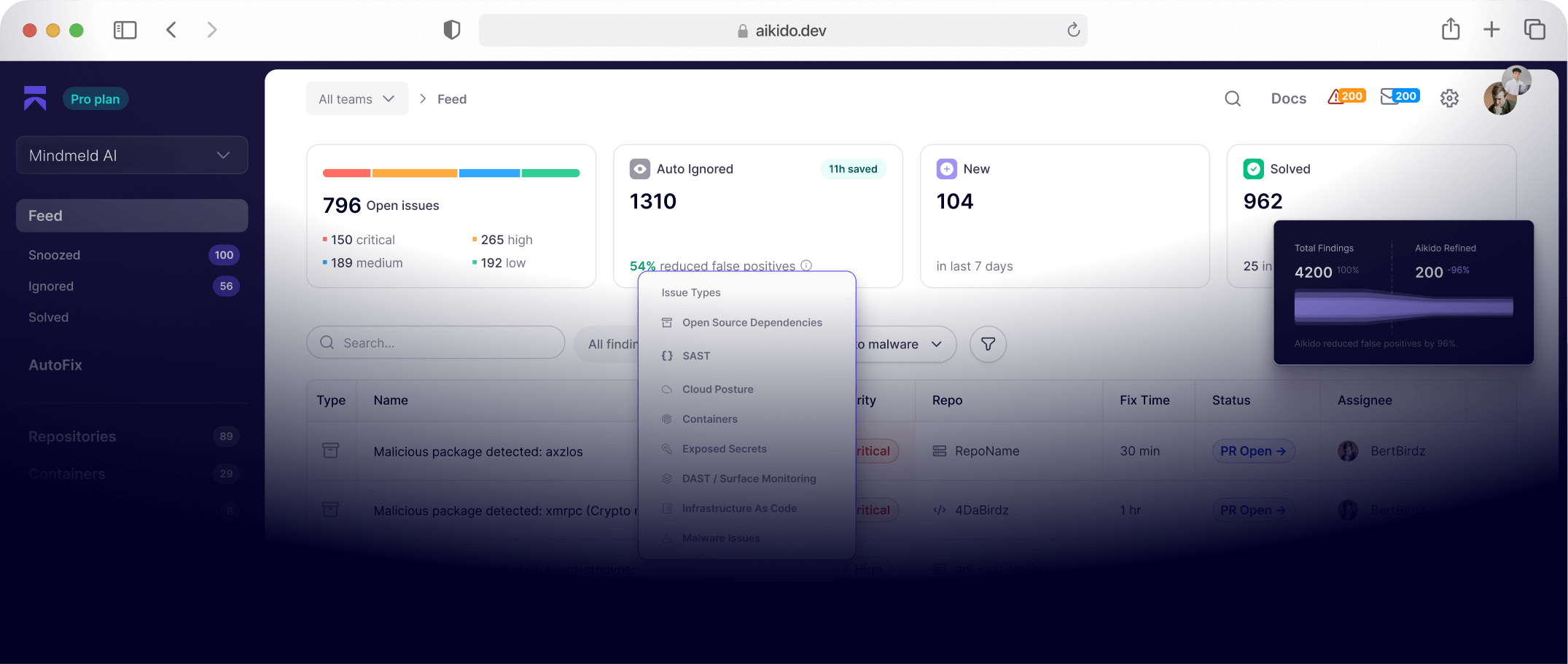
Frost & Sullivan cites Aikido's AI AutoTriage and AutoFix capabilities as standout differentiators because of this often overlooked problem with security solutions. AutoTriage analyzes real exploitability, so it reduces false positives before they start taking up engineering attention. AutoFix delivers remediation directly into pull requests, inside the development environment rather than adjacent to it.
“The 92% noise reduction is a game changer. It allows us to focus on the 8% that actually matter. That alone is gold… It’s a massive productivity and sanity boost,” said Cornelius, VP of Engineering at n8n.
AI AutoTriage and AutoFix address the real-life limitation of engineering capacity. Security findings aren’t as useful if engineering doesn’t have time to fix them.
Other security tools create work for teams by dumping findings on them with no context. Aikido works as a productive part of your organization. “We actually think of Aikido as a third team in our DevOps structure. Developers focus on building, operations handle infrastructure, and Aikido takes care of security in the background,” said Salvatore Cuccurullo, Senior DevOps Manager at GEA Digital.
Adoption leads to action
A lot of AppSec is technically correct and operationally useless. It happens when tools produce accurate findings that nobody acts on because they see too much friction compared to what they see as the urgency. It's unfortunately the default when security tooling is designed for security teams and deployed to engineering organizations.
Frost & Sullivan's analysis positions Aikido's developer-first approach as central to its customer value. Security that integrates into IDEs, CI/CD pipelines, and cloud environments gets used. Security that requires engineers to context-switch into a separate system, reconcile unfamiliar output formats, and manually initiate remediation processes does not, or gets used inconsistently enough that the coverage guarantees dissolve. Aikido was built with developers at the heart, so that security becomes part of the development process rather than an interruption to it.
Aikido's 2026 State of AI and Security report, derived from research with 450 CISOs and engineers, found that platforms created for both security and developer audiences produced fewer security incidents. Adoption, it turns out, is the variable that determines outcomes more than coverage ever could. That's the design principle behind Aikido's IDE integrations, pull request automation, and AutoFix.
Next up? Self-securing software
All of this points toward something larger than platform consolidation or noise reduction. AI-generated code is accelerating software production at a rate that our old security processes weren’t designed to handle. Periodic scans, manual review cycles, and quarterly penetration tests were calibrated for a development workflow that no longer exists in organizations moving fast with AI-powered workflows.
The industry is moving toward continuous, automated security that works at the pace of development. The volume and velocity of code production have surpassed what human-reviewed security cycles can cover. Almost half of companies say that they're pentest reports are often or always out of date by the time they receive them. Instead of accepting worse security outcomes, the industry needs to innovate and reinvent.
Aikido Infinite is the concrete expression of that direction. Rather than running periodic tests against a static target, Infinite deploys autonomous agents that pentest every release, validate what's actually exploitable through direct exploitation, generate fixes, and retest automatically. The testing loop closes in hours rather than weeks. Security no longer operates on a separate calendar from development. It runs on the same one.
That's where Aikido is building. Frost & Sullivan's recognition is a useful marker of how far the industry has already traveled in that direction. And we’re excited for what’s next.
Download Frost & Sullivan's full analysis to learn more.