Key takeaways
- The npm account of the lead axios maintainer was hijacked. Two malicious versions were published:
axios@1.14.1andaxios@0.30.4. npm has since removed both. - Anyone who installed either version before the takedown should assume their system is compromised. The malicious versions inject a dependency (
plain-crypto-js) that deploys a cross-platform remote access trojan targeting macOS, Windows, and Linux. - axios has ~100 million weekly downloads. This is one of the most impactful npm supply chain attacks on record.
- The malware self-destructs after execution, so post-infection inspection of
node_moduleswill not reveal it. You need to check your logfiles.
Credit to the great coverage of this incident by:
- StepSecurity (https://www.stepsecurity.io/blog/axios-compromised-on-npm-malicious-versions-drop-remote-access-trojan)
- Socket (https://socket.dev/blog/axios-npm-package-compromised)
How to check if you are affected by the axios attack
Option 1) Check manually
1. Check for malicious axios versions
Scans your installed packages and lock file for 1.14.1 or 0.30.4.
npm list axios 2>/dev/null | grep -E "1\.14\.1|0\.30\.4"
grep -A1 '"axios"' package-lock.json | grep -E "1\.14\.1|0\.30\.4"
2. Check for the hidden dropper package
Even if setup.js self-deleted, the directory still exists. Its presence alone confirms the dropper ran.
ls node_modules/plain-crypto-js 2>/dev/null && echo "POTENTIALLY AFFECTED"3. Check for RAT artifacts on disk
macOS
ls -la /Library/Caches/com.apple.act.mond 2>/dev/null && echo "COMPROMISED"Windows
dir "%PROGRAMDATA%\wt.exe" 2>nul && echo COMPROMISEDLinux
ls -la /tmp/ld.py 2>/dev/null && echo "COMPROMISED"Option 2) Use Aikido (free)
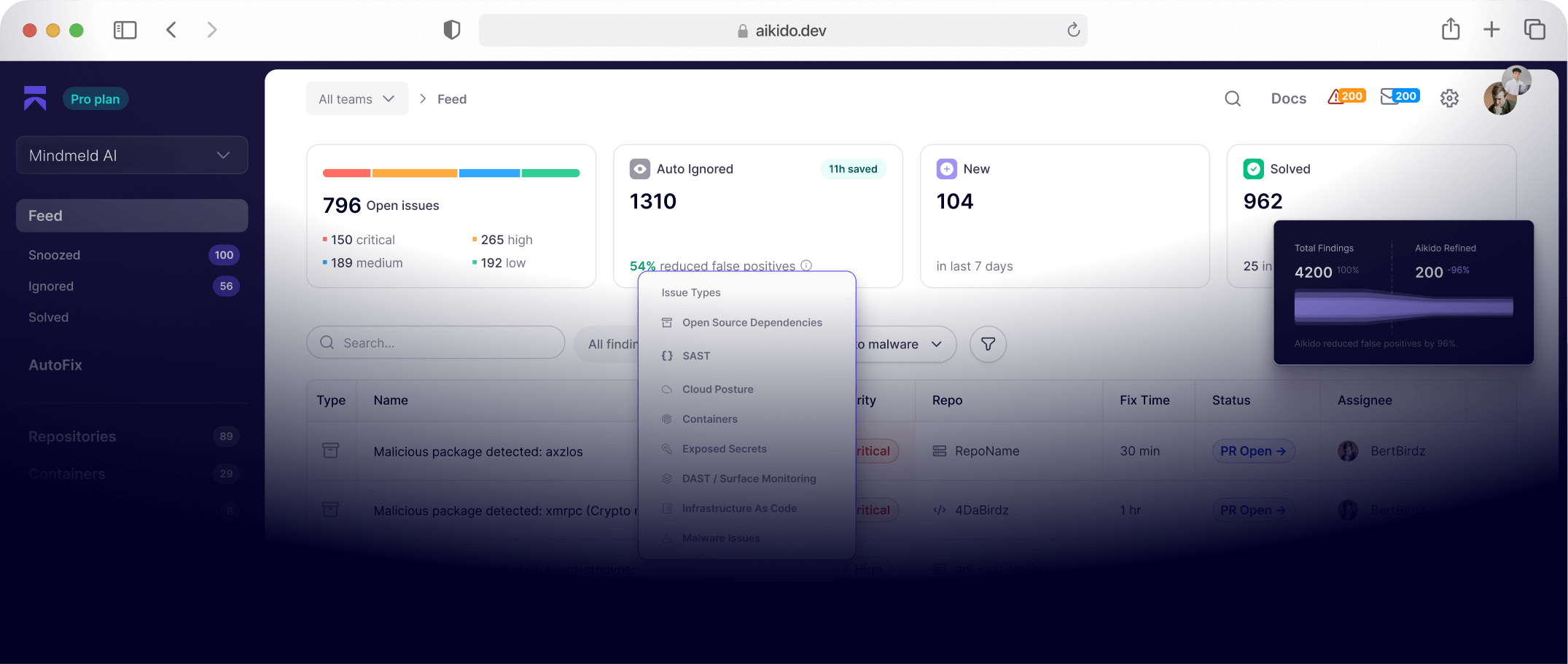
Connect your repositories to Aikido (https://app.aikido.dev). Aikido's Malware Monitor compares your dependencies against Aikido Intel's live malware feed. If axios@1.14.1, axios@0.30.4, or plain-crypto-js@4.2.1 is present in any of your projects, Aikido flags it immediately. This works on the free tier.
Check if your code is affected by the Axios supply chain attack - scan it free with Aikido
Remediation steps
- Pin to safe versions:
npm install axios@1.14.0   # 1.x users
npm install axios@0.30.3 # 0.x users- Add overrides to prevent transitive resolution:
{
  "dependencies": { "axios": "1.14.0" },
  "overrides":    { "axios": "1.14.0" },
  "resolutions":  { "axios": "1.14.0" }
}- Remove
plain-crypto-jsfrom node_modules:
rm -rf node_modules/plain-crypto-js
npm install --ignore-scripts- If any RAT artifact is found (
com.apple.act.mond,wt.exe,ld.py), do not attempt to clean in place. Rebuild from a known-good state. - Rotate all credentials accessible on the affected system: npm tokens, AWS access keys, SSH private keys, CI/CD secrets,
.envvalues. - Audit CI/CD pipeline logs for any runs that installed the affected versions. Rotate all injected secrets.
- Run
npm ci --ignore-scriptsas a standing policy in CI/CD.
What happened in the axios supply chain attack
The attacker compromised the jasonsaayman npm account, the primary maintainer of axios. The account email was changed to ifstap@proton.me. The attacker then published axios@1.14.1 at 00:21 UTC on March 31 and axios@0.30.4 at 01:00 UTC. Both the 1.x and legacy 0.x branches were hit within 39 minutes.
Neither version had a corresponding commit, tag, or release in the axios GitHub repository. Legitimate axios releases are published via GitHub Actions with OIDC Trusted Publisher binding. These were published manually with a stolen npm access token.
The only change in both versions was the addition of plain-crypto-js@^4.2.1 as a dependency. This package is never imported anywhere in the axios source. It exists solely to run a postinstall hook that deploys a RAT.
The dependency was pre-staged ~18 hours earlier by a separate attacker account (nrwise, nrwise@proton.me). A clean decoy version (4.2.0) was published first to build registry history, followed by the malicious 4.2.1 at 23:59 UTC on March 30.
The RAT dropper (setup.js) contacts sfrclak[.]com:8000 and delivers platform-specific payloads: a macOS binary disguised as an Apple cache daemon at /Library/Caches/com.apple.act.mond, a PowerShell script on Windows run via hidden VBScript with the interpreter copied to %PROGRAMDATA%\wt.exe, and a Python script on Linux at /tmp/ld.py. After execution, the dropper deletes itself and replaces its own package.json with a clean stub to hide evidence.
{{cta}}
Indicators of compromise (IOCs)
Malicious axios versions and dependencies:
axios@1.14.1(shasum:2553649f2322049666871cea80a5d0d6adc700ca)axios@0.30.4(shasum:d6f3f62fd3b9f5432f5782b62d8cfd5247d5ee71)plain-crypto-js@4.2.1(shasum:07d889e2dadce6f3910dcbc253317d28ca61c766)
Network:
- C2:
sfrclak[.]com/142.11.206[.]73/http://sfrclak[.]com:8000/6202033
File system:
- macOS:
/Library/Caches/com.apple.act.mond- sha256:
92ff08773995ebc8d55ec4b8e1a225d0d1e51efa4ef88b8849d0071230c9645a
- sha256:
- Windows:
%PROGRAMDATA%\wt.exe, %TEMP%\6202033.vbs, %TEMP%\6202033.ps1- sha256:
617b67a8e1210e4fc87c92d1d1da45a2f311c08d26e89b12307cf583c900d101(powershell)
- sha256:
- Linux:
/tmp/ld.py- sha256:
fcb81618bb15edfdedfb638b4c08a2af9cac9ecfa551af135a8402bf980375cf
- sha256:
Attacker accounts:
- jasonsaayman: compromised axios maintainer, email changed to ifstap@proton.me
- nrwise: attacker-created, nrwise@proton.me
How to protect against installing malware
Aikido Safe Chain (https://github.com/AikidoSec/safe-chain) is an open-source tool that wraps around npm, yarn, and pnpm. It checks every package against Aikido Intel's malware feed before it reaches your machine and enforces a configurable minimum package age (48 hours by default), suppressing newly published versions until they have been validated. In this axios attack, plain-crypto-js@4.2.1 existed for less than 24 hours before the compromised axios versions pulled it in. Safe Chain's age check alone would have blocked it.
Free, no tokens required:
curl -fsSL https://github.com/AikidoSec/safe-chain/releases/latest/download/install-safe-chain.sh | shDeveloping story... Stay tuned for updates.
{{cta}}